Dept. of Corrections will continue policy allowing for punishment regardless of guilt
Sep 28, 2026 | 4:45 am ET
Description
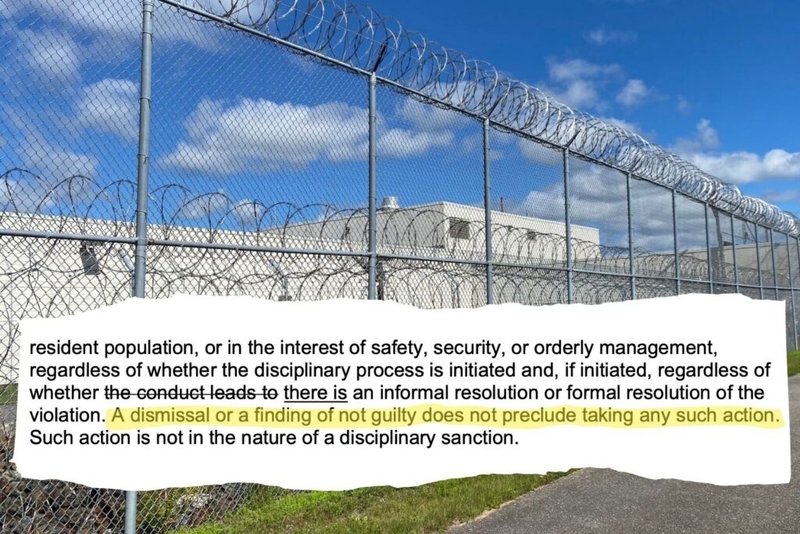
A provision in the proposed Maine Department of Corrections disciplinary policy overlaid on a photo taken outside Maine State Prison. (Photo by Evan Popp/ Maine Morning Star)
The Maine Department of Corrections has opted to continue its policy that allows staff to punish incarcerated people before and regardless of a finding of guilt, underscoring the discretion that props up the prison system.
Incarcerated Mainers raised concern about this section of the department’s disciplinary policy that permits prison staff to issue sanctions regardless of whether the formal disciplinary process has been initiated or if someone has been found not guilty.
It’s been a part of the department’s rules for decades, but proposed disciplinary policy changes recently offered an avenue to sound alarm. The department announced it would not alter the section of concern last week.
Defending its decision, the department argued in written responses to critical testimony that it would be unreasonable to wait for the formal process, which can take weeks to complete, and not take certain actions, such as changing one’s housing status, particularly when safety is at risk.
“Yes, in the most good faith, literal interpretation of the [policy] as it’s written, surely I could see somebody making that coherent argument,” said Brian Nam-Sonenstein, senior editor and researcher at the think tank Prison Policy Initiative. “But so much comes down to discretion.”
A longstanding loophole in prison disciplinary policy allows for punishment regardless of guilt
Discretion in prison discipline is a common feature across the country. The loophole at issue in Maine has been part of the department’s policy for decades.
“Not every response to conduct is a punitive one implicating due process protections,” the department wrote in one of its responses. For example, if an incarcerated person participating in a dog training program was found to be mistreating a dog in its care, the department said it would be necessary to act outside the formal process to quickly remove them from the program.
Because the policy is defendable in a specific scenario does not mean it holds up across the board, Nam-Sonenstein cautioned. In practice, the lines are often much blurrier.
For example, someone can be put in segregated housing if deemed dangerous, disruptive or at risk in the general population. But other times, a change in housing is used as punishment.
“The distinctions matter. I’m not saying that they have no value at all,” he said, “but I’m saying that because the distinctions matter, it’s easy to hide behind the differences and use them for whatever purpose.”
That is complicated by the fact that Maine’s prisons, as is the case for many across the country, have little independent oversight.
Then, there is the matter of recourse.
Maine’s department said incarcerated people have the opportunity to file grievances and appeal decisions that are made. “Even if due process were implicated by an action taken outside of the disciplinary process, these safeguards are more than sufficient,” the department wrote.
But as incarcerated Mainers have previously told Maine Morning Star, they face barriers, such as cost and a lack of knowledge of how to navigate the system, that hinder their ability to challenge sanctions.
“It’s what’s on paper versus what are the facts on the ground,” as Nam-Sonenstein put it.
Because incarceration is a response to a wide range of behavior, fundamentally it is going to rely on the discretion of officers, he said.
“At a certain point you’re like, ‘Well, how does the prison function if it can’t do these things?’” said Nam-Sonenstein. “But for me, it’s like, that is kind of the question: what do we have to sacrifice in order for this institution to work the way that it’s designed?”

Augusta, ME