Dems: WV ‘going backwards’ as House passes bill to shield political donors’ employer info
Feb 20, 2026 | 3:52 pm ET
Description
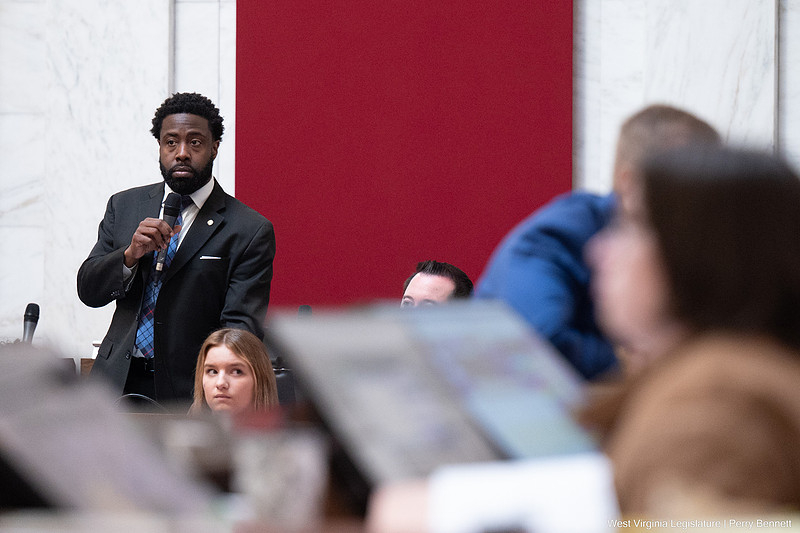
House Minority Sean Hornbuckle, D-Cabell, speaks during the West Virginia House Of Delegates’ floor session on Tuesday, Feb. 17. On Friday, Hornbuckle said Senate Bill 640 “flies in the face of transparency.” (Photo by Perry Bennett/West Virginia Legislative Photography)
A bill to keep the public from accessing certain information about political donors could soon become law after the West Virginia House of Delegates passed it on Friday.
Senate Bill 640 would stop the West Virginia Secretary of State’s Office or any other government agency from publicly posting information that some lawmakers say could be used by advocates to target political donors.
Lawmakers in the House approved the amended legislation 78-17, with five members absent and not voting. The bill was passed by the state Senate last week.
Eight members of the Republican supermajority joined the House’s nine Democrats in voting against the bill on Friday.
Under the proposed bill, a campaign treasurer’s and political donors’ house numbers and street names will be publicly redacted.
Information about a donor’s employer or “major business affiliation” would also be withheld from public campaign finance reports. Major business affiliation is defined in the proposed code to be the “entity” from which someone “derives the majority” of their income.
Current law requires that all of this information is filed and made public on campaign contribution forms when a donor gives more than $250 during a single election cycle.
City and county information for donors as well as their general professions — i.e. consultant, doctor, lawyer, teacher, etc. — would still be listed under the proposed code.
Per the proposed bill, any government agency that publishes the identifying information must remove it within 10 business days of being notified by the individual. If the information is not redacted publicly within that timeframe, the individual is eligible to recover $1,000 in civil penalties from the agency responsible for posting it.
Any state or local officer or employee who “knowingly and willfully” posts the identifiable information publicly through a government agency could also face misdemeanor charges. Per the code, they could face up to a $1,000 fine and/or be sentenced to up to a year in jail.
The House approved an amendment to the bill on Thursday to include that addresses for treasurers on campaign finance reports would also be redacted. That language was previously amended into the House’s version of the same bill, House Bill 5066.
The body also voted down an amendment from Del. Kayla Young, D-Kanawha, on Thursday that would have removed provisions requiring that a donor’s “major business affiliation” be redacted.
Proponents for the bill — including its sponsor, Sen. Mike Azinger, R-Wood — have said that it is intended to keep political donors from being “doxxed” by members of the public who may not agree with a politician’s viewpoints.

During discussion on the House floor on Friday, Del. J.B. Akers, R-Kanawha, said that the bill is meant to offer a “little bit of extra protection” to people who donate to political campaigns. He said that people who donate to campaigns should not have to fear their employers being “harassed” due to their personal beliefs or who they support politically.
“We’re just going to provide a little bit of protection for the donor in terms of where they work, so that their employer won’t be harassed, so that their employment won’t potentially be jeopardized, so they can donate and exercise their First Amendment rights,” Akers said. “It’s easy enough to find folks, but this just provides a little bit of extra protection so that the people who aren’t running for office, the people who aren’t in this building, the people who just want to participate get a little bit extra protection. That’s it.”
While they generally agreed that keeping home addresses private was understandable, Democrats in the House voiced concerns that keeping information about a donor’s employer from the public will have negative consequences.
“To just totally wipe out any employment information (for donors) — I think it’s bad on its face and I think it flies in the face of transparency,” said House Minority Leader Sean Hornbuckle, D-Cabell. “We’re going backwards. (This is) going to allow more money to be put into politics and make it harder for it to be traced and not available to the public. I feel that this is very bad for the people of West Virginia.”

Del. Mike Pushkin, D-Kanawha, said knowing a donor’s employer is useful to ensure that campaign finance laws are being followed.
Under the proposed law, the Secretary of State’s office will still receive the information on campaign finance reports, but they will be redacted before being posted publicly. Oftentimes, Pushkin said, members of the public are the ones who catch when something needs to be investigated or isn’t happening legally.
If this bill becomes law, he continued, that safeguard will be lost.
“I’d like for the public to see (an employer’s information). I’d like for the press to be able to see it, because that’s often how things get uncovered,” Pushkin said. “We cannot always rely on government to police itself, and that’s why we’ve had these laws in place for so long. It’s worked for years. I don’t know why we’re changing it now.”
The amended version of SB 640 will now be sent back to the Senate, where lawmakers there will vote on the changes made to it in the House. If the Senate approves the bill without further amendments, it will be sent to Gov. Patrick Morrisey’s desk for signature.
Charleston, WV