Demographic cliff poses concern for neighbor-state enrollment, Iowa Board of Regents reports
Nov 16, 2026 | 5:54 pm ET
Description
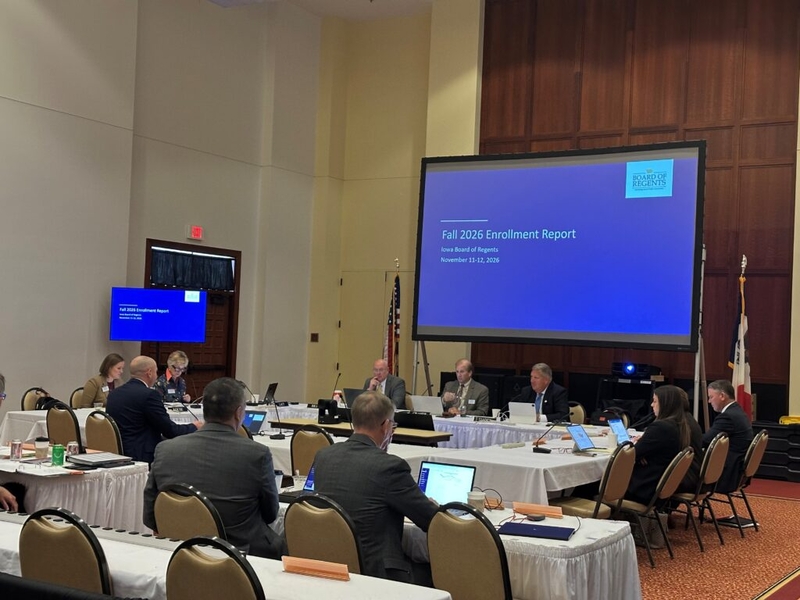
The Iowa Board of Regents met on Nov. 12, 2026. States bordering Iowa are set to see worse declines in high school graduates than Iowa itself, potentially harming university enrollment. (Photo by Brooklyn Draisey/Iowa Capital Dispatch)
Jason Pontius’s first comment to the Iowa Board of Regents about enrollment trends was his prediction for headlines — enrollment at Iowa’s three public universities remained more-or-less flat from last year to this year.
However, the underlying story stretches into the future of high school graduates, both their number and who decides to pursue higher education.
Colleges and universities across the U.S. have been preparing for the demographic cliff of fewer students graduating high school for years, including those in Iowa despite the state projecting to see less of a dip than other states.
Pontius, associate chief academic officer for the board of regents, said in past meetings he hesitated to call the decline a “cliff,” but told board members at its November meeting that the number of Iowa high school graduates right now is likely the highest the state will see for the next 20 years. States surrounding Iowa will also see their graduating classes sink, impacting out-of-state student enrollment.
“These are the traditional students we’re talking about,” Pontias said. “That pool has gotten smaller, and so it provides additional challenges for us going forward. Our undergraduate population is about 95% traditional students right now.”
Total student enrollment at the University of Iowa, Iowa State University and University of Northern Iowa decreased by one half of a percentage point — 352 students — between fall 2025 and fall 2026, according to the enrollment report discussed by the board at its November meeting last week. Undergraduate student enrollment across the universities grew by .2%, or by 98 students.
Overall, total student enrollment at the three universities in fall 2026 was 71,520, the highest seen since 2022 but nearly 10,000 students below the higher education system’s peak in 2016.
While Iowa lags one year behind the rest of the U.S. in the enrollment cliff, Pontius said new data projects further declines in high school graduates from 2036-2041, which will represent itself in Iowa as a second decline after a brief level period.
“This is the highest number of high school graduates in the state of Iowa we are likely to have in the next two decades,” Pontius said.
Declines in high school graduates are expected across the U.S., Pontius said, varied between states but averaging out to a 12% drop over the next 15 years.
From 2026 to 2041, Pontius said Iowa is expecting a 9% decline in high school graduates. In the top five states Iowa universities bring students from, Nebraska will also drop by 9%, followed by Minnesota with 13%, Missouri at 14%, Wisconsin at 16% and Illinois at 29%.
Despite other states already dealing with the enrollment cliff, Pontius said out-of-state enrollment increased for this year by 1.3%, to a total of 26,142 students. UNI, which offers in-state tuition to students from neighboring states, saw a 28% increase in Illinois students and a 55% jump among Minnesota students, alongside growing numbers from other states.
“We get about 11,400 students right now from the state of Illinois,” Pontius said. “So a major decline there is problematic and adds an additional challenge to our attempt to kind of maintain enrollment in our three public universities.”
Shifts in student’s choices for their education are also impacting enrollment, Pontius said, with midwestern public flagship institutions seeing growth between 2009-2024 and regional public institutions seeing declines. Many things could contribute to this trend, he said, and while the University of Northern Iowa hasn’t been entirely exempt, it has been “bucking this for the last few years.”
UNI was the only state university to see enrollment growth from fall 2025 to fall 2026, increasing by 1.8% while the UI saw a .6% decrease and ISU saw a 1.1% decrease.
Data from surveying Iowa high school students for their post-graduation plans and enrollment numbers show that for community colleges, both intent to enroll and actual enrollment have been dropping, while going straight into employment has been rising and intent and actually going to a state university has been “holding roughly flat.”
One question Pontius said he often gets when enrollment declines at Iowa public universities is whether students are leaving the state to attend college, which has not been happening. In the 15 years that metric has been tracked for, Pontius said it “has been very flat the entire time.”
“We retain a very large number of our students who go to college in the state of Iowa, and that has always been the case,” Pontius said.
Des Moines, IA