At portrait ceremony, Kay Ivey reflects on 10 years in office
Nov 16, 2026 | 5:23 pm ET
Description
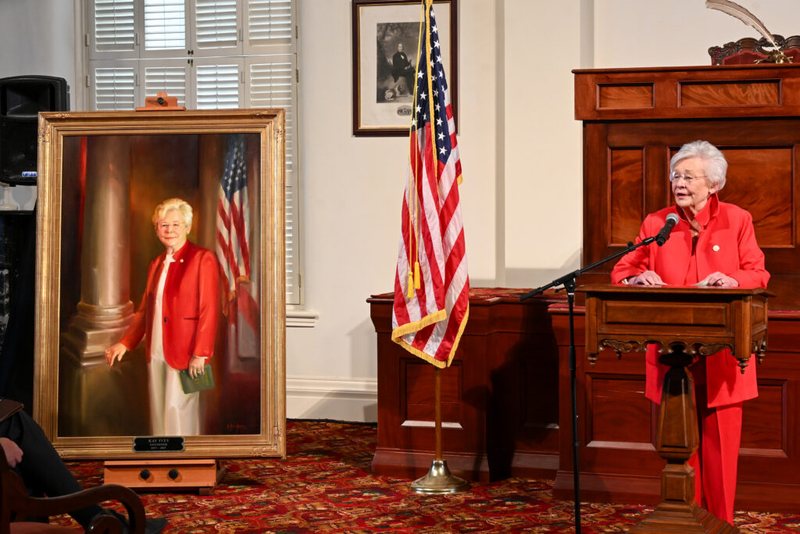
Gov. Kay Ivey speaking at the unveiling of her gubernatorial portrait in the Old Senate Chambers in the Alabama State Capitol in Montgomery, Alabama, on Nov. 16, 2026. A bust of the governor was also unveiled in front of the Gov. Kay Ivey Office Building on Washington Avenue immediately following the portrait. (Anna Barrett/Alabama Reflector)
Gov. Kay Ivey reflected on her historic tenure as a portrait and bronze bust were unveiled on the Capitol Complex Monday morning.
In the Old Senate Chambers – where Ivey took the oath of office in 2017 – the governor thanked Alabamians for trusting her during her nearly 10 years as governor, which will end in January.
“When I was sworn in as governor on April 10th, 2017, in this very room, I said to the people of Alabama that serving as your governor is no small task, but that I would do my very best. Even 10 years later, I am proud,” she said. “Alabama has made significant and truly historic gains. And y’all, that would not have been possible without all of you and many others.”
Ivey took office following former Gov. Robert Bentley’s resignation following a misdemeanor plea to campaign finance law violations and the threat of impeachment in April 2017. Ivey later won two terms in her own right, but is constitutionally barred from seeking a third consecutive term.
Ivey grew up in Camden in Wilcox County before becoming a high school teacher. She then worked as a banker before becoming the assistant director of the Alabama Development Office – now the Alabama Department of Commerce.
For 13 years, she worked at the Alabama Commission on Higher Education as the director of government affairs and communications before running for state treasurer in 2002, an office she held until 2011. In 2010, she ran for lieutenant governor, which she held until she became governor in 2017.
Ivey’s agendas have consistently revolved around education and economic development. Chief of Staff Liz Filmore said Monday morning that Ivey “hit the ground running” with policies like the Literacy and Numeracy Acts, and attracting billion-dollar companies to the state.
“Governor Ivey truly believes in our students, and that education and jobs go hand in hand,” Filmore said. “These and many other achievements were accomplished in part because Governor Ivey established and maintained an excellent rapport with the Alabama Legislature. Governor Ivey’s greatest asset is her determination to get things done, no matter what the peanut gallery has to say. And I’m here to tell you, we’ve got a lot of peanuts in Alabama.”
Jo Bonner, former chief of staff and current president of the University of South Alabama, recognized the significance of Ivey’s impact on women and girls in Alabama. When she leaves office in January, she will make history as Alabama’s longest consecutive serving governor, and the nation’s longest-serving female governor. She is also an alumna of Alabama Girls State, a leadership program that many of Ivey’s staff are also alumni of, including Filmore.
“The governor has spent a lifetime demonstrating that where you begin does not determine where you can go or how far you can go,” he said. “For those of us who are privileged to be with you today, thank you. Thank you for letting us be a small part of a story of a young girl from Camden, Alabama, who went on to become an incredible leader for our state.”
Her tenure has not always been smooth. During the COVID-19 pandemic, Ivey and Lt. Gov. Will Ainsworth sharply disagreed on how to handle the public health crisis. In October, House Speaker Nathaniel Ledbetter, R-Rainsville, a close ally of Gov.-elect Tommy Tuberville, called for a pause in Ivey’s namesake prison project in Escambia County amid rising costs of a second modern prison.
Alabama’s prisons are notoriously overcrowded and the state’s Department of Corrections is set to go to federal trial at the end of the month for reported conditions. To address overcrowding, the Legislature in 2021 approved $1.3 billion for two 4,000-bed facilities, but one prison alone has reached nearly $1.25 billion and the other has yet to break ground.
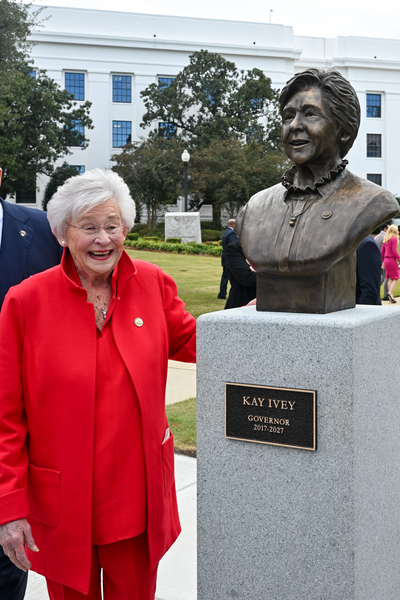
The portrait was painted by Huntington College graduate Ann Kenyon. She has also painted portraits of President Donald Trump and his family for their personal collection. The bronze bust, which is displayed in front of the Gov. Kay Ivey Office Building on Washington Avenue, was sculpted by Alabama native and Montgomery resident Claudetta Fulmer. She also sculpted the statue of Rosa Parks by the Montgomery Fountain and Revolutionary War General Richard Montgomery.
“It’s an honor to share this day with you, ladies and gentlemen, it remains the highest honor of my life to serve and be your governor,” Ivey said. “To the people of Alabama, thank you for giving me the incredible opportunity to serve you.”
Montgomery