Democrats are gunning for NH secretary of state post under new majority
Nov 10, 2026 | 2:52 pm ET

Description
Secretary of State David Scanlan (right) huddles over a stack of ballots with his No. 2, Deputy Secretary of State Brendan O’Donnell, during an official election recount on Nov. 9, 2026, at the State Archives building in Concord. There were 16 recounts called for state House races after the 2026 midterm elections earlier that month. (Photo by William Skipworth/New Hampshire Bulletin)
David Scanlan, a Republican who has served as New Hampshire’s secretary of state since 2022, will face at least three challengers — and possibly more — for his position this year.
Carleigh Beriont, a Hampton Select Board member who ran unsuccessfully for the Democratic nomination in the 1st Congressional District this year, sent an email to all 424 state House and Senate members Tuesday morning asking for their support to become New Hampshire’s next secretary of state.
James Butler, a policy adviser to former Gov. Maggie Hassan currently working for Eversource, similarly sent a letter to lawmakers last week asking for their support.
And state Rep. Patrick Long, of Manchester, has also been courting lawmakers in an effort to secure the position.
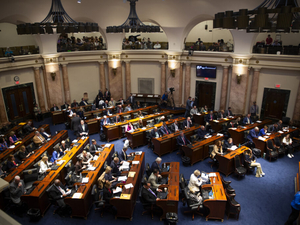
Under state law, the New Hampshire Legislature selects the secretary of state in December following each state election. That’s unlike many states, where citizens directly vote for the secretary of state. The position’s biggest duty is running elections, but it also regulates insurance risk pools, registers businesses and manages state archives. After Democrats took whopping majorities — almost 300 of the 400 House seats went to Democrats as well as 15 of 24 Senate seats — in this month’s election, some Democrats want change in the office, which has experienced an unusual amount of stability in recent history compared to the rest of state government.
A pitch for change
Beriont said her experience assisting Hampton’s election monitors (all Hampton Select Board members assist in running the town’s elections) inspired her to run, as did her campaign for Congress.
“I do think there is something really special about the day and the ritual,” she said of Election Day. “And the coming together and collectively deciding what we’re going to do, whether it’s at town meetings or in a state election or federal election. It’s definitely something that I would love to celebrate and inject some new energy into in the years ahead.”

If elected, Beriont wants to encourage more young people to register to vote as just 7% of New Hampshire’s 18-year-olds are registered, according to The Civics Center. She said she would also advocate for nonpartisan redistricting committees, though only the Legislature has that authority, and encourage the Legislature to make voting easier.
Butler said he was inspired to run after hearing from “some local elections officials who basically just want to see better collaboration, more professionalism out of the office and better preparedness.”
“I’ve been in and around elections for the better part of two decades,” Butler said, pointing to his work on campaigns and as a liaison between the governor’s office and municipalities. “It’s something that I care deeply about.”
He contended that while last week’s general election went well, Scanlan left local officials unprepared in September’s primary for a large Democratic turnout he failed to predict.
Long, on the other hand, is pointing to his experience as a poll watcher during President Barack Obama’s campaign, a fundraiser for Democratic Party voter outreach and a ballot clerk.
“In terms of elections, I’ve been involved in protecting the right to vote … for 18 years in various capacities,” he said, adding that he also has experience working in the Massachusetts State Auditor’s Office and on the House Municipal Finance Committee.
Long criticized Scanlan for his interpretation of a law banning the use of student IDs to prove identity at the polls. Long argued the law, as written, didn’t outlaw student IDs being used if the voters had no other acceptable ID, due to a so-called “safety valve” provision. However, Republicans behind the law made clear that they intended for it to do so. A federal judge blocked Scanlan’s directive on the same grounds in October, but the U.S. Supreme Court overruled after determining it was too close to an election and left Scanlan’s directive in place.
“I don’t want to attribute that to malice,” he said. “It could just be that he doesn’t understand the law, but people’s voting rights are affected by that.”
Long said he would rescind that interpretation on day one.
Long also argued that Scanlan is pushing municipalities and school districts to keep funding levels in their insurance risk pool reserves too low. He called it “not fiscally responsible” and “not actuarially sound.”
Others are also considering a run.
Sarah Chadzynski, who was one of Beriont’s opponents in the 1st Congressional District earlier this year, told the Bulletin: “I am seriously considering it, but I have not yet made a decision because I think it is a position that deserves a lot of thought and consideration.”
NHPR reported last week that former Senate President Donna Soucy is also considering a run. Soucy, who served in the state Senate from 2018 to 2024, did not respond to the Bulletin’s phone calls or text messages. State Rep. James Newsom, who represents Contoocook and serves on the House Election Law Committee, was also talked about for the role, but he told the Bulletin Tuesday he decided against running.

A pitch for experience
For his part, Scanlan offered a straightforward pitch for reelection: “There is no candidate that has anywhere near the experience that I have in this job.”
He called Beriont’s experience helping run one town’s local elections “not even close” to the challenge of running the entire state’s elections.
Before becoming secretary of state, Scanlan served as deputy to his predecessor, Bill Gardner, for 20 years. Gardner, a Democrat, served as secretary of state for 46 years. Between the two, the Secretary of State’s Office has been isolated from the political headwinds that have caused so many positions in this purple state to flip back and forth. Scanlan warned that if Democrats decide to boot him out of office, the position will lose that consistency and will likely turn over to a Republican in a few years.
“We will lose something very, very special in the state if that happens,” Scanlan said.
Gov. Kelly Ayotte, speaking to reporters Tuesday, echoed the concern: “I just think that it would be the wrong thing to do to politicize the Secretary of State’s Office.” Ayotte supports keeping Scanlan, particularly because she thinks it will help New Hampshire keep its first-in-the-nation primary status.
Asked if she’s concerned about the position becoming a political football, Beriont said: “What’s the appropriate amount of time for one person or one group of people to serve in this role? I think that if the people of New Hampshire have told us anything over the last week, it’s that we need a new generation of people in power.”
Butler contended that if he were elected, his tenure wouldn’t kick off the back-and-forth partisan nature of the office some fear because he’s “committed to this role for the long term” — though Scanlan says he is too — and he said he’s able to work in a bipartisan manner, pointing to the work he did in Hassan’s office while Republicans controlled the state Senate.
Scanlan said he knows he has Democrats behind him.
“I have a base of Democratic support,” he said. “No question about that. I will have bipartisan support going into this election. The question is, a lot of new Democrats in the House that don’t know me, and I have to make an impact on them if I’m going to survive the numbers that I’m facing at the moment.”
He points to this most recent election as evidence for his stewardship of the office, which had record turnout and no reported issues.
Scanlan has avoided any overt partisan actions in running the office, but he has implemented a series of Republican laws, including requiring proof of citizenship and the ban on student IDs, which Democrats have argued unfairly suppressed votes. Butler accused Scanlan of “caving to the extremists in his party.”
“I have to follow the laws,” Scanlan said. “The Republicans have been in power. They’ve created the laws. I follow them. The Democrats are going to be in power. If they pass new laws, I have to follow them.”
He also pointed to his recent stand against President Donald Trump.
In 2025, the Trump administration demanded New Hampshire and other states hand over confidential voter information. Scanlan refused, citing state law that prohibits him from releasing information such as Social Security and driver’s license numbers. The fight went to federal court, where Scanlan and election officials from other states prevailed.
“I’ve exhibited backbone,” he said.
The Legislature is set to vote on the position Dec. 2. Per state statute, the secretary of state earns between $102,599 and $143,061 annually depending on experience.
Concord, NH