Democratic U.S. Senate candidates spar over AI data centers, AIPAC funding
May 28, 2026 | 6:01 pm ET
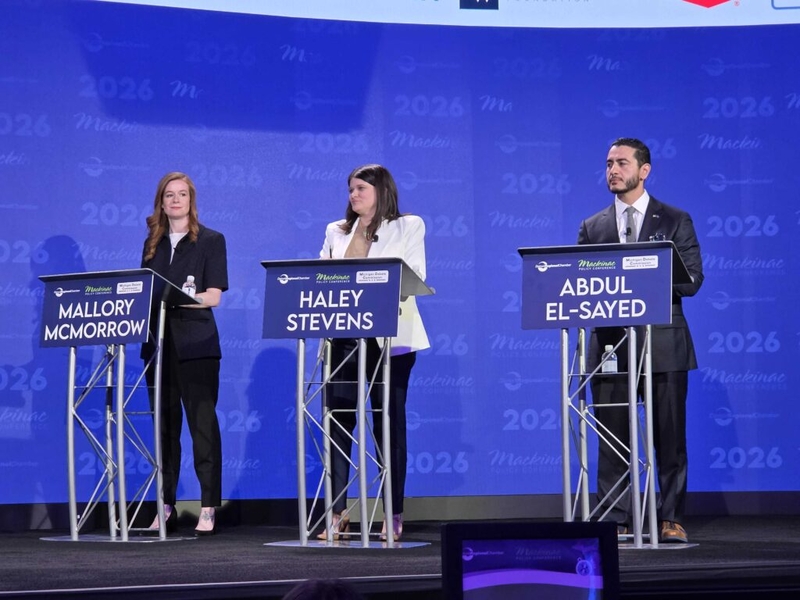
Description
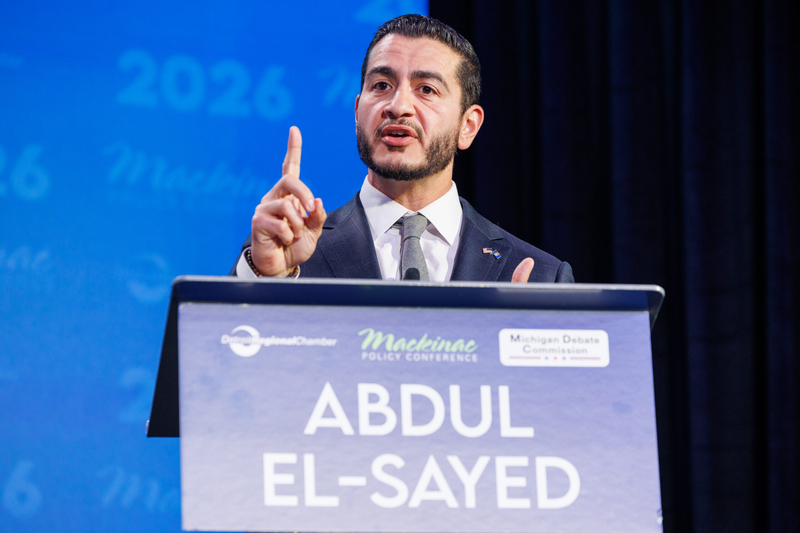
State Sen. Mallory McMorrow (D-Royal Oak), U.S Rep. Haley Stevens (D-Birmingham) and former Wayne County Health Director Abdul El-Sayed debate at the Mackinac Policy Conference. May 28, 2026 | Photo by Ben Solis/Michigan Advance
MACKINAC ISLAND – The regulation of artificial intelligence data centers and funding in the U.S. Senate race from corporate donors and the pro-Israel American lobby took center stage on Thursday as Democratic candidates Abdul El-Sayed, Mallory McMorrow and Haley Stevens squared off for one of the most policy-heavy debates or the primary campaign seasons.
The debate occurred during the final evening of the Mackinac Policy Conference, a closed door event for politicians, business leaders and members of the media, but the debate was also widely televised and streamed lived by the chamber online.
That gave voters their potential first chance to see the candidates vying for the Democratic nomination get deep into their policy bags ahead of the Aug. 5 primary.
One of the biggest issues emerging in the race surrounds the amount of corporate campaign donations and Super PAC contributions that may soon flow, if they aren’t already, to fund the candidates’ senatorial ambitions.
El-Sayed and McMorrow have both denounced corporate donations, but Stevens has not. Both Stevens and McMorrow have also been criticized for accepting donations and messaging support from groups like the American Israel Public Affairs Committee, or AIPAC, in the case of Stevens, or J-Street, a more progressive pro-Israel advocacy group, which has backed McMorrow and held events for her.
The AIPAC issue stems from divisions over the ongoing Israel-Hamas war in Gaza and the genocide that Amnesty International and a United Nations special commission have said is being perpetrated by Israel against the Palestinian people.
In a question revolving around the tension between military power and diplomacy, and how to balance those against the needs of the nation, Stevens praised her own foreign policy record in the U.S. House, and lamented that it has been “absolutely harmful and ridiculous” that the administration of President Donald Trump has “obliterated U.S. aid” to nations abroad.
“Peace always has to be the long-term goal. We need to see the United States work with our allies to achieve peace between Russia and Ukraine, between the people of Israel and Palestine, and of course between China and Taiwan,” Stevens said. “But when you remove the tools from our tool kit, you fail this country, and you fail us to allow the U.S. to work alongside our allies.”
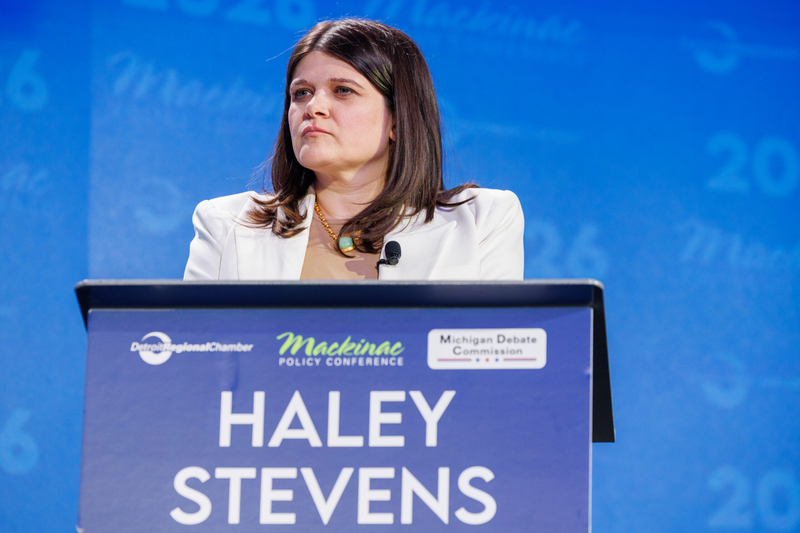
El-Sayed laid the first punch regarding AIPAC and its support for Stevens. He said that the one thing that would not advise his foreign policy aims was an organization like AIPAC, which he said has “spent already in this race to pump up one of my colleagues on this stage.”
“I’m the only candidate on this stage that didn’t ask AIPAC for their support,” El-Sayed said. “I don’t think that our taxpayer dollars, which we pay every April, ought to be going to bomb children to fund bombs and tanks for other countries when we’ve got kids who can’t afford basic things in our home.”
Shifting away from the pro-Israel discourse, McMorrow pivoted to the ongoing war in Iran. Trump had said he needed $1.5 trillion to carry out his war in Iran, while his administration has also told voters that the nation can’t afford to continue funding Medicare and Medicaid. She also turned her attention to former U.S. Rep. Mike Rogers, the sole Republican that the winner of the Democratic primary will face in November, noting that he would give Trump a blank check.
“Mike Rogers is in a tough position here, because he is facing a reality where every Republican who has stood up to Donald Trump has now been challenged, and has now lost their reelection,” McMorrow said. “He is going to have to choose: is he loyal to Michiganders or is he loyal to Donald Trump? We cannot lose sight of November here.”
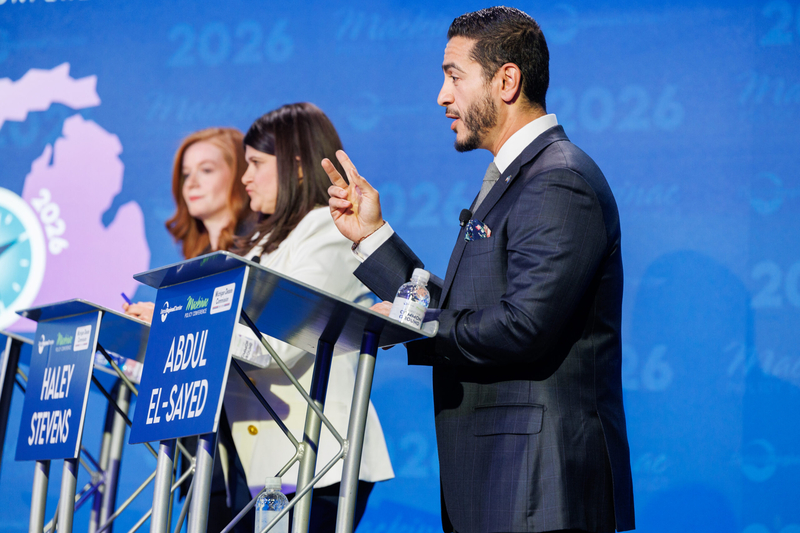
Influence of donors over the candidates
The question then turned to the influence the campaigns might feel if they do take corporate or advocacy Super PAC donations, and also toward Stevens, again on AIPAC. The congresswoman was asked to walk viewers though what that money means to her, what it buys from her and what it might do to her as a potential new U.S. senator.
Stevens did not answer the question.
Instead, she said her campaign was “a love letter to Michigan.” She spoke of her grassroots support and her many endorsements from a wide swath of former and current politicians. Stevens also said that Michiganders are frustrated because Congress has not been able to engage in comprehensive campaign finance reform, and that if Rogers was elected in November, he would not vote on the measure.
El-Sayed pounced again, pointing to the fact that Stevens punted on the AIPAC question.
Democratic U.S. Senate candidates escalate attacks as Michigan primary intensifies
“It also buys $3.5 billion sent to a foreign military that could be used to get glasses here, to provide healthcare here, to build schools here,” he said. “That’s where our money should be used. People know me. I say the same thing everywhere. I come to Mackinac and I’ll tell you, I’ll tax billionaires. I go down south to tell people to put a tax on billionaires. I say the same thing to everybody. You want to support my campaign? Fantastic. If you don’t, if it comes down to having more money from a donor or having a message, I’m going to choose a message every time.”
McMorrow said plainly that she hasn’t accepted a dime from AIPAC or corporate donations.
“This campaign is entirely funded by 120,000 individual donors, more grassroots support than my opponents combined, the most amount of money from Michigan, and we are building up a campaign that shows that we can run very differently,” McMorrow said.
The debate’s moderators tried to rein the candidates in, noting that they were talking about foreign policy and not campaign finance.
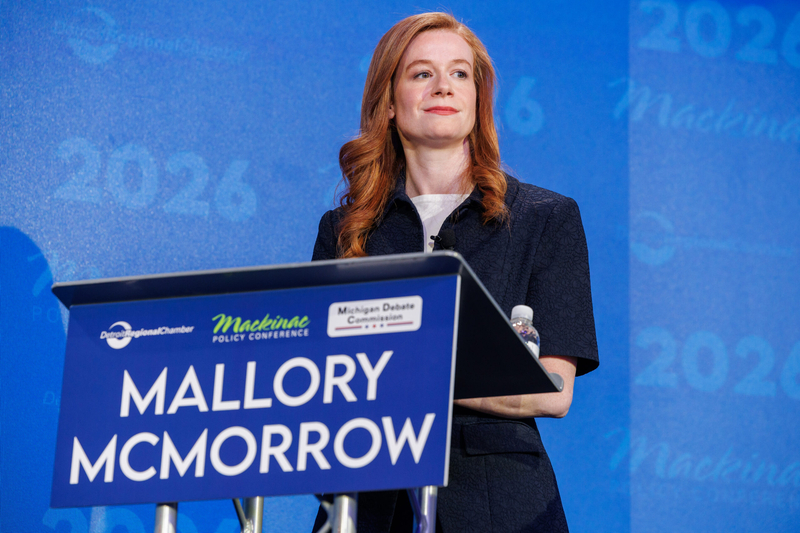
Israel-Palestine divide gets wider between the candidates
As they turned the debate back toward foreign policy, the moderators asked if the Israel-Gaza issue was exposing an antisemitism problem within the Democratic Party.
McMorrow repeated a widely spread allegation that an attendee at the Michigan Democratic Party convention in April yelled antisemitic slurs at her husband, Ray Wert, who is a Jewish. He was walking with their five-year-old daughter at the time.
“That is terrifying,” McMorrow said. “We need to be able to state very clearly that what the Netanyahu government has done violates the law, that the violence needs to stop, and that we need to bring about long-term peace and security for Palestinians and for Israelis. And that turning that into not an anti-Netanyahu, but an anti-American Jewish message is dangerous.”
Stevens said that Michiganders are scare of the rising tide of political violence and extremism.
“A temple in my congressional district was blown up by a homegrown terrorist,” Stevens added. “I served in the Congress on behalf of an incredibly diverse district, and I’m also leading on combating antisemitism in a bipartisan way that does not have to be a partisan thing. I am a proud Democrat who has been clear and consistent in a tough time about a horrible war.”
El-Sayed said he knows what it means to be discriminated against, and that antisemitism and Islamophobia go hand in hand.
“The real issue, when it comes to either of them, is the scourge of white supremacy, and I think it’s absolutely critical for us to differentiate between love, respect, and admiration for Judaism and the Jewish people, and a continued policy that has us sending our money to a foreign government,” El-Sayed said. “We can walk and chew gum at the same time.”
Data centers back in focus
When asked about how they would regulate AI data centers, El-Sayed described the issue as an impending tsunami that America was not ready for. He added that it was beyond disappointing that the federal government does “not have federal legislation that sets guideposts around the changing social contract, whether or not you can even sell your cognitive labor on a market for money, whether or not these will fall into the wrong hands, or worse, human control, or the impact on our environment in the form of data centers.”
“We need legislation now,” El-Sayed said. “We need leaders who understand the technology, are willing to stand up on it, and protect humanity from that oncoming tsunami.”
McMorrow said she’s developed comprehensive AI plans that recognize jobs were at stake if AI was not regulated and implemented the right way — and that includes both potential layoffs and possible missed jobs as the technology proliferates. She proposed that the state and the federal government impose an AI token tax on commercial uses of AI to fund apprenticeship programs for future tech leaders.
“We also need an export control to ensure we are not allowing China to succeed on AI,” McMorrow said. “We need real transparency and testing, just like very car that rolls off the assembly line can’t be sold to the public until it is tested, until it is vetted, until it is deemed safe.”
El-Sayed broke the debate’s decorum to clap back against McMorrow to say that a token tax wasn’t strong enough to protect people from the technology.
Political fault line over Israel comes into full view during Michigan Democrats’ convention
“I think we need to regulate AI and AI corporations as public utilities,” he said. “It is too dangerous to be left up to control of the government. We need to be thinking bigger about this challenge, because again, it is not just the change in technology that comes around. This is coming faster than we can even imagine, and we need to have the foresight to understand that we need new regulatory infrastructure around taking it on.”
Stevens was more optimistic on AI.
“I’m eager to see Michigan continue to lead the moonshot of the 21st Century, just like our great auto industry has been doing, just like we’re seeing defense and aerospace do, so that it employs countless people through a robust supply chain,” Stevens said. “We know that we’ve got to compete against China, and the way we are going to win the future is from a place called Michigan. I’ve got to make sure, as your senator, that the tax code and the bills and the investments that are coming down are coming properly into our communities that are saving taxpayers money and also alleviating costs.”
Lansing, MI