Death row inmate becomes 3rd in SC executed by firing squad
Nov 14, 2025 | 3:22 pm ET
Description
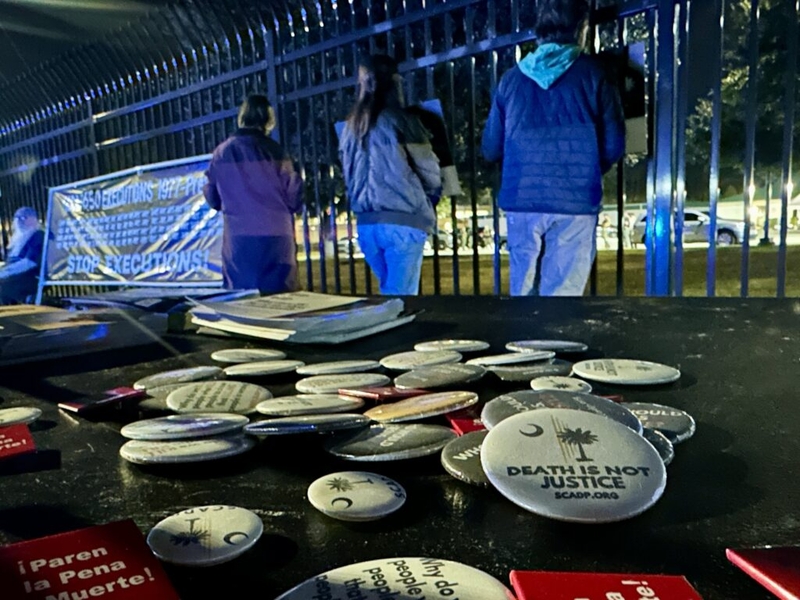
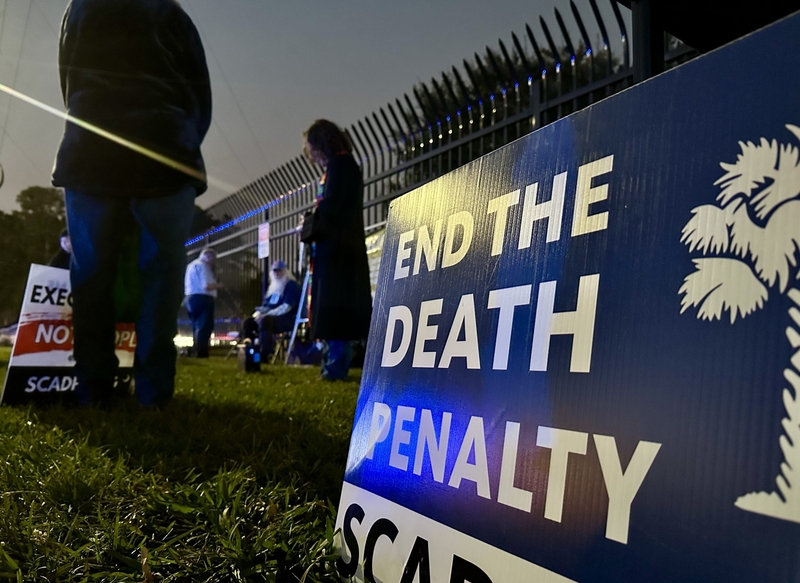
About 20 people gathered outside the gates of the prison complex in Columbia, S.C., ahead of the execution of Stephen Bryant on Friday, Nov. 14, 2025. (Photo by Jessica Holdman/SC Daily Gazette)
Editor’s note: This article has been updated with the execution.
COLUMBIA — A Sumter County man who killed three during a crime spree 21 years ago became the third person executed in South Carolina by firing squad.
Stephen Bryant was the fifth person executed in South Carolina this year and the seventh since the process resumed in September 2024. Bryant pleaded guilty in 2008 to fatally shooting three people during a string of burglaries.
The 44-year-old was declared dead at 6:05 p.m. He gave no last words.
Bryant’s execution is the 43rd nationwide this year, according to the Death Penalty Information Center.

Bryant’s attorneys made a single final appeal to attempt to halt his execution, arguing lower courts never heard evidence that he suffered from fetal alcohol spectrum disorder. The state Supreme Court rejected that argument, allowing his execution to go ahead. Unlike in other executions, Bryant’s attorneys did not appeal that decision to the U.S. Supreme Court.
As expected, Gov. Henry McMaster chose not to commute Bryant’s sentence to life in prison. No South Carolina governor has done so in at least the last half-century. This time, Bryant’s attorneys didn’t even ask, but McMaster released a denial anyway.
Bryant opted to die by firing squad instead of lethal injection or electrocution, the other two methods allowed in state law. South Carolina is now tied with Utah with the highest number of executions by firing squad. Utah is also the only other state to execute an inmate that way since the death penalty resumed nationwide in 1976.
Three members of victim Willard Tietjen’s family held hands in the front row of the witness room.
Beside them sat one of Bryant’s attorneys, representatives for the 3rd Circuit Solicitor’s Office and the Sumter County Sheriff’s Department, said prisons spokeswoman Chrysti Shain.
Like the other inmates executed by firing squad, Bryant’s legs and arms were strapped down. He wore a black jumpsuit and mittens over his hands. A sling around his chin restricted his head movement, media witnesses said.
Bryant did not seem to react to anything happening in the room. After glancing at the witnesses, Bryant kept his attention ahead of himself, his breathing normal. Guards placed a hood over Bryant’s head just after 6 p.m. About a minute later, they raised the shade that separates the room where the marksmen stand from the death chamber.
The marksmen fired at 6:02 p.m.
A small, white target with a red bullseye affixed to Bryant’s chest flew off with the impact, witnesses said. He appeared to take several more shallow breaths, then spasmed once. A doctor spent about a minute examining Bryant before declaring him dead, witnesses said.
For his last meal, Bryant requested Asian food, Shain said. He had spicy mixed seafood stir fry over rice, fried fish over rice, two egg rolls, three stuffed shrimp, duck in soy sauce, two Zero candy bars, German chocolate cake and two Pepsis. Bryant ate his last meal Wednesday evening.
Bryant’s final wish was for no one in need to face the same rejection he did when he sought help for his mental health but was denied care because he couldn’t pay for it, his attorney, Bo King, said in a statement.
“That is consistent with the man we knew, who showed grace and courage in forgiving his family and great love for those in and outside of his prison,” King said in the statement. “We will remember his unlikely friendships, his fierce protectiveness, and his love for nature, the water, and the world. We will miss him.”
The crimes
Bryant was still on probation following three years in prison for attempted burglary when his deadly crime spree started Oct. 5, 2004, with a Sumter County home robbery. His plans, however, began before that, attorneys argued during his 2008 sentencing hearing.
For several days, Bryant drove his blue-and-white pickup truck around rural Sumter County, approaching isolated homes and spinning tales to anyone who answered the door when he knocked.
On Oct. 4, Bryant came to the home of Tom Dennis, which sat on several hundred acres of property far back from the road. Bryant told Dennis his brother stole his pickup truck and he needed help getting it out of a ditch, Dennis testified in court.
Dennis helped Bryant out and thought little of the interaction. The next day, Bryant returned to rob the house after Dennis left to attend Clemson’s homecoming football game. When Dennis went out to his office in an adjoining building the next morning, he discovered someone had stolen his laptop, briefcase and bag of money.
Bryant repeated his method three days later with James Ammons, another rural homeowner. That time, Bryant took only Ammons’ .40-caliber semiautomatic rifle and the shells Ammons kept on the nightstand.
Over the following days, Bryant used that gun to shoot four people, killing three.
The first came later that same day. Bryant went out to a popular fishing spot along the Wateree River. He walked up and down the Richland County side of the river, where Clinton Brown was fishing.
After a brief conversation, Bryant walked away. A few moments later, Brown felt a shot in his back, he testified in court. When he turned around, Bryant was already gone, he said.
Brown drove himself to the hospital, where he stayed for nine days but survived the gunshot wound. Brown died in 2017, at the age of 69.
The next day, Bryant went to his friend Cliff Gainey’s house to smoke marijuana and drink some beers, Bryant said in a later statement to police. When the beers ran out, Bryant drove the two of them to a nearby convenience store, where security video showed Gainey entering the store, then returning to Bryant’s truck parked outside, according to court records.
Bryant drove around for a while, until Gainey asked him to pull over so he could “take a leak,” Bryant told police. In separate statements, Bryant told police he thought Gainey was taking a knife out of his waistband, then that he thought Gainey was making sexual advances toward him.
Regardless of what happened, Bryant shot Gainey three times, he said.
“I don’t know exactly why I shot Cliff,” Bryant later said in a statement to police. “Only thing I can (think) is his actions brought back a bad memory and I felt scared.”
Bryant remembered “sitting on my knees crying for him because he was a friend,” police testified Bryant told them. When a passerby pulled up, Bryant got back in his truck and fled, he later told police.
Bryant went back to Gainey’s house and took all the electronics from the living room, along with a fish tank from his bedroom. At some point, Bryant started a fire, in what he claimed was an accident but prosecutors said was an act of arson.
Two days later, on Oct. 11, Bryant killed 62-year-old Willard Tietjen, who friends and family called TJ.
Bryant had come to Tietjen’s house several days earlier, claiming he needed to see Tietjen’s phone book to try and track down a friend’s phone number. Tietjen helped, and Bryant left without incident, Tietjen’s wife, Millard Tietjen, testified.
When he returned, Bryant said he told Tietjen his truck had overheated. Tietjen invited him in and began to talk about religion before becoming hostile, Bryant told police. Bryant shot him nine times, an autopsy showed.
Bryant stayed in Tietjen’s house long after killing him. He smoked Tietjen’s cigarettes and used his computer. He took Tietjen’s Masonic ring off his finger and cleaned off the blood in the sink. He rearranged the furniture and lit candles over Tietjen’s body, police testified.
“He was there for hours, enjoying his work, admiring what he had done,” solicitor Kelly Jackson told the judge during his trial.
When Tietjen’s wife and daughter called to check on him, Bryant answered his cellphone, calling himself “the prowler” and telling the women he killed Tietjen, the victim’s relatives testified in court.
Bryant also burned Tietjen’s eyes with a lit cigarette, set his goatee on fire and used Tietjen’s blood to write messages on the wall for police, according to court documents.
“Victim number four in two weeks, catch me if you can,” Bryant wrote on one wall, some of the letters in blood. On another was the word “catch,” also in blood, police testified.
Bryant’s note seemed to suggest he already planned to kill again, prosecutors argued. Two days later, around 4 a.m., he picked up Chris Burgess at a gas station, loaded his bicycle into the back of his pickup truck and drove off.
A hunter found Burgess’ body on the side of the road, shot three times, in a similar manner to Gaines, investigators testified.
“It was over for me,” Bryant told police he was thinking at the time.
Police arrested Bryant later that day. After initially trying to blame someone else, he confessed to the police, according to court testimony.
During his time in jail, Bryant racked up more charges for threatening a detention officer and severely beating another. Bryant pleaded guilty to all the charges he faced.
Prosecutors sought the death penalty for Tietjen’s killing because Bryant’s theft of jewelry and other items from the house qualified as an aggravating offense, according to court records. He received life sentences for the other slayings.
The victims
Most mornings, Bob Summers stopped by his friend Tietjen’s house for coffee, he testified during Bryant’s sentencing hearing. The morning of Tietjen’s death, Summers called to tell Tietjen a joke, as he often did.
Tietjen liked jokes, and he told good ones, Summers said. Summers liked to give him gag gifts, and he planned to give Tietjen a tie that looked like a bottle of Tabasco hot sauce before his death, he said.
Tietjen worked for the Air Force for 23 years, maintaining radar systems, his wife of 39 years testified. After retiring in 1985, he worked at hardware and electronics stores before eventually going into the insurance business, she said.
Tietjen was active in the local Masonic Lodge, and he was a Shriner, including driving a buggy he kept in the basement every time a parade happened in the area, she said.
When asked if she understood that Bryant could be put to death for killing her husband, Millard Tietjen told defense attorneys she was OK with that.
“I can’t say it would make it any better, but I feel he deserves a punishment because he made the choice to do what he did,” she said during the 2008 hearing.
Chris Gainey was 14 when Bryant shot his dad, Cliff Gainey, to death by the side of a road. During the sentencing hearing, he recalled fishing with his dad and watching movies, though he added he didn’t remember much else about their time together.
“The only thing I really remember, he used to always comment on me being — just always said I look just like him,” Chris Gainey testified. “My mama still says the same thing.”
Chris Burgess’ family missed him every day, his mother, Christine Burgess, wrote in a letter read out loud in court.
“We all loved him dearly,” the letter said. “The pain and suffering of this family will never go away.”
Stephen Bryant
In the months leading up to the killings, Bryant tried to get help for his deteriorating mental state, his aunt and grandmother told a judge.

That August, two months before his crime spree, Bryant sat down with his grandmother and aunt to ask for help. At his grandmother’s home, he clenched his hands on her glass-top coffee table, causing the whole table to shake, she recalled during his 2008 trial.
Bryant told the two about how his grandfather, his uncle and his older half-brother sexually and physically abused him throughout his childhood.
“He looked like he was being tortured,” his aunt, Terry Lee Bryant Caulder, testified during his trial. “It’s like his soul was just laid wide open. In his eyes, you could see he was hurting and suffering and he was living the abuse over again as it was coming out, what he was telling us.”
His grandmother, Shirley Freeman, suggested Bryant call a sexual abuse hotline, she said. Caulder found the number and handed the phone off to Bryant, who spoke to the person on the other end for a while, she testified.
The hotline seemed to offer no resources. His probation officer referred him to a nearby counseling center, but Bryant couldn’t afford to pay for the services, so he left without getting help.
He couldn’t sleep on the nights he picked up his victims at gas stations. He told police he remembered only bits and pieces of each incident, which experts testified could have been a symptom of his post-traumatic stress disorder, according to court records.
Bryant grew up in a troubled home, his attorneys have argued to multiple courts. His parents met and conceived him in a rehabilitation facility, though neither got sober. His mother drank during her pregnancy with him, she told attorneys during his appeals process.
Starting at the age of 17, he spent much of his life in and out of jail, always for non-violent offenses, defense attorneys said during his sentencing hearing.
The trauma of his early life, combined with the developmental effects of his mother’s drinking during her pregnancy, caused Bryant to snap and act outside his normal frame of mind, his attorneys argued during his appeals.
During his 17 years on death row, Bryant received two disciplinary sanctions, one for fighting without a weapon in 2009, and one for possessing a weapon in 2023, according to prison records.

Columbia