Corrections isn’t a political sideshow. Michigan’s next governor must make it a priority.
Oct 09, 2026 | 6:00 am ET
Description
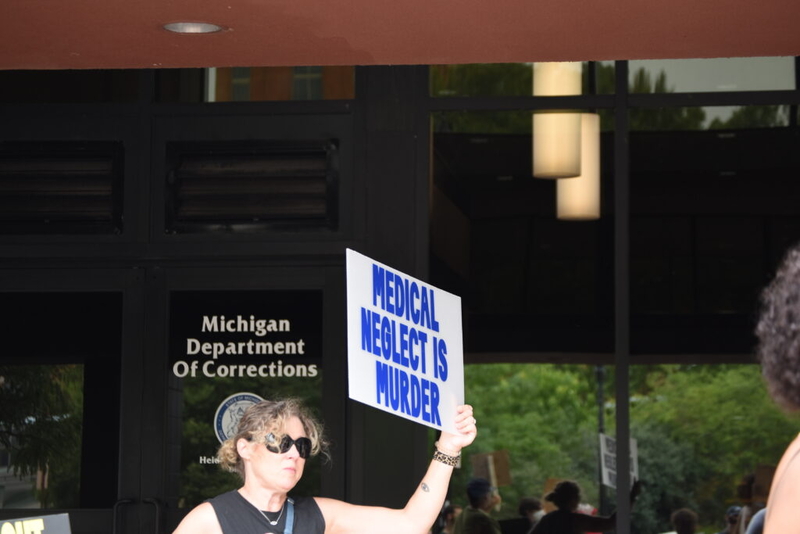
A protester outside the Michigan Department of Corrections headquarters in Lansing. July 31, 2026. | Photo by Katherine Dailey/Michigan Advance.
There is a reason Michigan’s Department of Corrections rarely makes it to the top of the list of political priorities.
Jobs, roads, taxes and schools all make for more comfortable campaign-trail conversations. If there’s any campaign talk of prisons, it’s usually along the lines of “How many more should we build?” The conversation rarely goes much deeper than that, likely because prisons force politicians to confront a much less comfortable question: What does the state owe the people it locks up?
Few politicians want to answer that question with any earnestness. And it’s not a huge mystery why.
The people at the center of the issue are convicted criminals. They have committed crimes, harmed victims and, in many cases, been sentenced to years, maybe even life, behind bars.
That makes corrections an easy problem for politicians to ignore.
Michigan’s next governor will face major challenges at the Department of Corrections
But there is an inconvenient fact that cannot be ignored: inmates are wards of the state. We, collectively, are responsible for their well-being.
Once Michigan takes someone into custody, the state assumes responsibility for that person’s basic safety, health and welfare. That responsibility does not depend on whether the person is popular, sympathetic or deserving of anyone’s applause.
And it certainly does not excuse the state from doing its job.
That is what makes the latest reporting on the Michigan Department of Corrections so troubling — and so important.
As Michigan Advance’s Katherine Dailey reported Tuesday, the next governor will inherit a department facing severe staffing shortages, violence, concerns about conditions inside its facilities and bipartisan calls for new leadership.
Nearly every correctional facility has vacancies, with some facilities carrying vacancy rates above 25%. Corrections officers are working mandatory overtime, in some cases 16-hour days on consecutive days.
This isn’t merely a labor problem. This is a people problem.
And ultimately, it is a gubernatorial problem.
When prisons are chronically understaffed, everyone suffers. Officers become exhausted. Safety deteriorates. Violence becomes harder to control. Basic operations become more difficult.
Incarcerated people can lose access to recreation, meals outside their cells, family communication and programs designed to prepare them for release.
And whether or not you have any sympathy for prisoners, that last point matters.
Remember — most people in Michigan’s prisons will eventually leave them.
The question is what kind of people Michigan is sending back into its communities.
A prison system that cannot reliably provide basic programming, treatment, education and security is not only failing inmates.
It is failing you and me.
It is also failing a group whose interests deserve far more attention: the people who work inside these facilities.
Corrections officers aren’t political abstractions. They are public servants going to work every day in an environment where violence is an occupational hazard. They should not have to choose between serving their state and burning themselves out.
Safety concerns in Michigan prisons grow after pension bills are vetoed
The current staffing situation described by corrections union leadership — including mandatory overtime and prolonged 16-hour shifts — should be unacceptable to anyone who believes government has an obligation to protect its own employees.
This is not a question that can be meaningfully reduced to whether one is “tough on crime” or “soft on crime.”
It should be about whether Michigan’s prison system is competent.
Competence means having enough trained officers to safely operate a prison and providing those officers with competitive pay and benefits.
But just as importantly — perhaps even more so — it means making sure incarcerated people receive the medical care, mental-health services, education, vocational training and other programming the state says they should receive.
And it means recognizing that better conditions for inmates and better working conditions for corrections officers are not mutually exclusive. They are inseparable.
A prison staffed by exhausted employees is not a safer prison. A prison where programming routinely breaks down is not necessarily producing better outcomes. A prison where violence becomes normalized is bad for the person incarcerated, bad for the officer who has to confront it and yes; bad for you and me and the communities we live in to which many of those prisoners will eventually return.
While it is clear that MDOC Director Heidi Washington, who has served in that role for 11 years across two administrations, has outstayed her welcome, simply replacing one bureaucrat with another will not solve the problem.
MDOC reports fourth death at Women’s Huron Valley prison in under two months
The next governor will need to confront this issue with the understanding that there is no magic fix. Even lawmakers quoted by Michigan Advance acknowledge that this will require multiple policies over time.
But the first step is political.
The next governor has to decide that corrections matter.
Not because prisoners are an especially sympathetic constituency. They aren’t.
And not because corrections are a politically fashionable issue. They aren’t.
But because the state cannot take away someone’s liberty and then shrug when the institution responsible for that person begins to fail.
And because the men and women who work in those institutions deserve better, too.
Michigan’s next governor — Democrat or Republican — will inherit this problem.
The real question is whether that governor will finally have the courage to deal with it by enacting systemic change, and not just deciding to add or subtract dollars from its budget.
Lansing, MI