Conservative groups push back on Maine law in latest campaign finance court battle filing
Dec 22, 2025 | 3:28 pm ET
Description
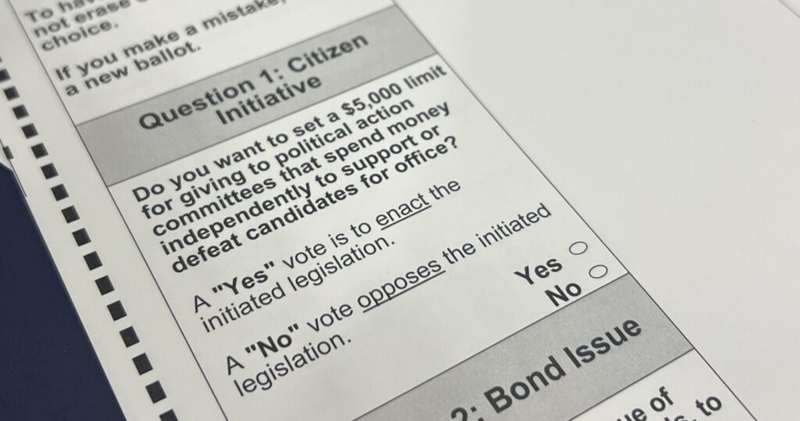
Question 1 on Maine's November 2024 ballot asked voters to limit the amount of dark money spent in state elections. (Photo by Emma Davis/ Maine Morning)
The conservative groups that sued Maine over a voter-approved law that established stricter regulations on money in elections filed their rebuttal on Monday, claiming it violates free speech.
In 2024, Maine voters overwhelmingly passed a law that set a $5,000 limit on contributions to political action committees that independently spend money to try to support or defeat candidates, commonly referred to as super PACs.
Shortly after, two PACs — Dinner Table Action, which was founded by state Rep. Laurel Libby (R-Auburn) and activist Alex Titcomb, and For Our Future, which is run by Titcomb — sued the state.
However, those behind the law welcomed the lawsuit as it was a key part of their ultimate goal: to get the U.S. Supreme Court to regulate super PACs.
After the Maine district court ruled in July that the law was unconstitutional, two appeals were filed in the First Circuit Court of Appeals in Boston. One of the briefs is from Attorney General Aaron Frey on behalf of the state of Maine. The other is from the committee behind the referendum and the non-profit Equal Citizens, spearheaded by legal scholar Lawrence Lessig, who has been attempting to bring this issue to the high court for years.
Latest filings in campaign finance court battle argue Maine has legal right to regulate super PACs
Both make the case that the 2010 Supreme Court decision Citizens United v. Federal Election Commission actually allows for super PACs to be regulated, because of the possibility for donations to a committee that makes independent expenditures to be coordinated with a candidate, meaning there’s a risk of quid pro quo corruption, or a favor for a favor, which can be regulated by Congress.
But the plaintiff’s counsel, Charles Miller of the Institute for Free Speech, said, “You don’t prevent somebody from doing something that’s truly independent because somebody else may do something that’s coordinated.”
Pointing to existing state law that bans coordination, Miller said, “We think that the state should lean into enforcing those rules, instead of trying to stop truly independent speech.”
The First Amendment of the U.S. Constitution protects free speech, and specifically, Miller said, “it protects people’s right to speak on their own. We call that independent speech — or independent expenditures in this context.”
The 2024 law also requires the disclosure of all donors who contribute toward independent expenditures, regardless of amount. Miller argues there’s no chance for corruption in those cases and pointed to Maine law that already requires disclosure for those that spend more than $250 in any one candidate’s election. “People really need to have the ability to make small anonymous contributions,” he said.
The brief from Lessig’s group also made a second argument they characterize as an originalist and typically conservative one: that the original meaning of the First Amendment would not have blocked state legislatures or the people from limiting the size of contributions to political action committees.
Lessig believes the argument would fare well with the current conservative-leaning Supreme Court. He also believes that’s why the plaintiffs want to prevent that argument from getting out of the First Circuit. The plaintiffs filed a motion to dismiss the interveners from the case in October, which the court has yet to rule on.
But the plaintiffs say that argument isn’t really an originalist one, noting that the term “corruption” doesn’t appear in the Constitution.
“When you’re looking to interpret the Constitution and find out original meaning, you should be looking for definitions of the terms that are actually in the free speech clause,” Miller said.
He points to Justice Clarence Thomas’ comments in Nixon v. Shrink Shrink Missouri Government PAC, which upheld that federal limits on campaign contributions also applied to state limits on campaign contributions to state offices. “I would subject campaign contribution limitations to strict scrutiny,” Thomas wrote.
Miller said, “in legal parlance — that’s the whole game. What that means is he would treat contributions the same as he treats expenditures.”
Augusta, ME