Compassionate release expansion among justice reforms with bipartisan state House support
Feb 19, 2026 | 5:01 am ET
Description
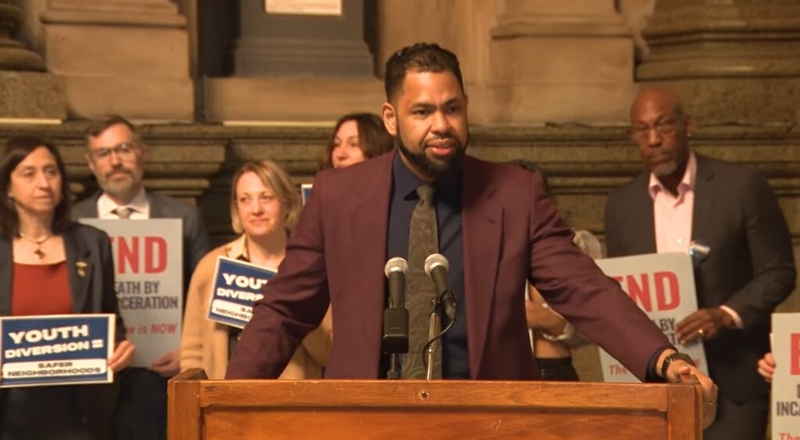
State Rep. Rick Krajewski (D-Philadelphia) talks about justice reforms during a press conference at City Hall, February 18, 2026. (Emily Previti/Capital-Star via Pa. House Video)
Just 54 people have been freed from prison during the past 15 years through Pennsylvania’s system to release incarcerated people with serious medical conditions.
A measure with bipartisan support would overhaul the process, expanding eligibility and saving the state millions of dollars.
Currently, candidates for compassionate release must have no more than a year to live. That would change under the proposal to include inmates with a terminal illness, serious conditions preventing daily living activities, life-threatening illnesses better treated outside prison or serious cognitive/functional decline.
As many as 700 people incarcerated in the commonwealth would be eligible based on that criteria and state Department of Corrections (DoC) records, according to the measure’s fiscal note.
Listen to Emily’s audio recap:
Lawmakers flagged the need for reforms following a report on Pennsylvania’s compassionate release system 20 years ago, noted Roxanne Horrell, legislative director of the decarceration-focused nonprofit Straight Ahead.
“Since that time, nothing has been done. And the elder population in prison has more than tripled,” Horrell said. “The current law does nothing to decrease the prison population [or] allow for the type of relief for the people that are seeking it … because the criteria is so restrictive.”
She spoke during a press conference at Philadelphia City Hall Wednesday alongside elected Democrats and advocates who worked on justice legislation that recently passed the House.
“The creation of the PA Justice Alliance, the passage of [these] House bills, … are the products of years of committed organizing from our movements,” said state Rep. Rick Krajewski (D-Philadelphia)
As for getting the legislation through the GOP-controlled Senate, Krajewski pointed to the House’s bipartisan support of all three measures. His cosponsors of House Bill 150 for compassionate release reform included former Republican Rep. Torren Ecker (whose seat is up in a special election following Ecker’s election to an Adams County Court of Common Pleas judgeship).
Increasing oversight and awareness
Modeled after the federal First Step Act, HB150 also would require courts to rule on petitions within a month, initiate DoC tracking of those petitions (including the number of approvals, denials and people who died awaiting a decision) and standardize the victim engagement process by specifying who gets notified as well as setting notification and response deadlines.
The legislation also includes a provision that would require the DoC to post signs informing prisoners of their right to petition for compassionate release. In the event someone is diagnosed with a terminal illness while incarcerated, DoC would be required to notify relatives within 72 hours and allow visits within a week.
The Abolitionist Law Center’s John Thomspon recalled people he’s known including David Lee, who died after being denied commutation and could have benefited from the proposed changes.
“Death by incarceration continues to exist, and this… will help alleviate some of those people so that they don’t die in prison,” Thompson said. “Not only that, it costs the state way more money to keep them in prison. The medical bills go off the chain. The older you get, the more medical care you need.”
Pennsylvania now spends more than $400 million annually on medical care for incarcerated people. But not all are seriously ill nor would qualify for release under HB150.
The proposed changes would save the Department of Corrections between $1.4 million and $18.9 million per year, according to the measure’s fiscal note. The amount would depend on factors such as how many people who are eligible petition successfully, as well as the extent of their supervision after release.
Improving alternatives for juvenile defendants
As of now, if children are detained while awaiting transfer to their court-ordered placement in a juvenile detention facility or other institution, that waiting period doesn’t count toward time served – at least in Pennsylvania.
That would change under House Bill 1936, which also aims to minimize such delays in the first place.
Death by incarceration continues to exist, and this… will help alleviate some of those people so that they don't die in prison. Not only that, it costs the state way more money to keep them in prison. The medical bills go off the chain. The older you get, the more medical care you need.
Rep. Anthony Bellmon’s (D-Philadelphia) original bill called for a seven-day maximum wait, at which point a court hearing would be held to figure out an alternative. And if that cycle would repeat a few times without successful placement, the court then would release the child to community-based supervision (eg, electronic monitoring), unless they’re determined to be a risk to the community.
The current version of the bill doesn’t contain those requirements, following a narrowly adopted amendment just before the measure passed the full chamber 111-87. Instead, the legislation now presents a 20-day wait time and the option of holding hearings every 10 days.
“I don’t think that change distorts the essence of the bill – and it’s why it saw bipartisan support,” Bellmon said. “It’s to clarify timelines for hearings so cases are resolved quickly, and … it modernizes the review and commitment process.”
Bellmon said he learned about children waiting as long as 18 months for placement from advocates and people who’d been through it themselves – and later testified in Harrisburg in support of the bill.
House Bill 144 would attempt to standardize alternatives to incarceration and parole for minors convicted of non-violent offenses for the first or second time, as the Capital-Star detailed when the legislation cleared the Judiciary Committee last fall.
Five Republicans voted against it at that stage. Two of them – Representatives Kate Klunk of York and John Schlegel of Lebanon – later supported the measure when it passed the full chamber 153-45.
In the interim, Klunk advanced an amendment that expanded on the framework for engaging victims in the diversion process – including holding a court hearing to consider their concerns.
Also, the Indigent Defense Advisory Committee released its first report. It included data on juvenile diversion rates showing wide variation among counties. Supporters of HB144 have previously pointed to other data sets showing the same broad range as a sign that standardized diversion policies and practices would help ensure more equitable access across the state.
Republican Sen. Lisa Baker’s office didn’t respond to questions about plans to bring any of the three bills up for discussion in the Judiciary Committee, which she chairs.

Harrisburg, PA