Community leaders sound alarm over environmental justice as data centers boom across NC
Jun 24, 2026 | 5:08 pm ET
Description
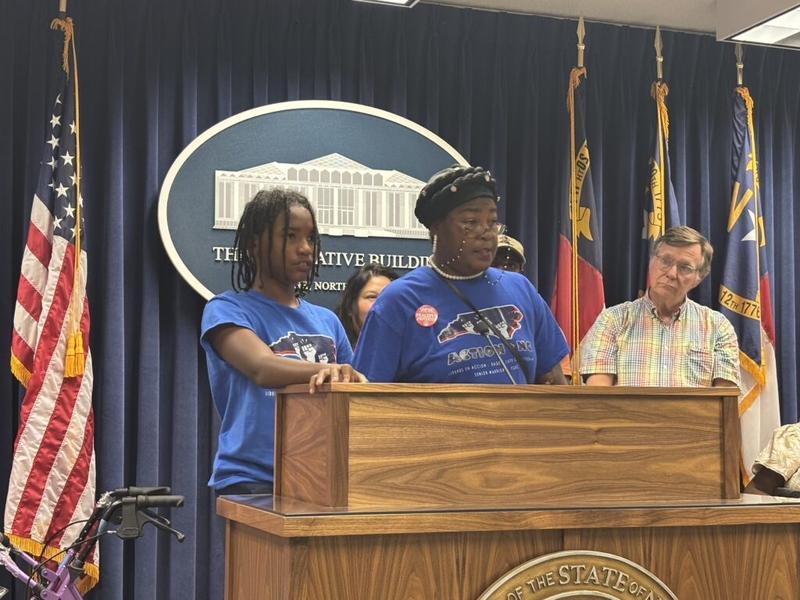
Carroll Olinger, a retired teacher from Fayetteville, said she’s on dialysis due to water pollution by PFAS, or forever chemicals, spoke at the N.C legislative building on June 24, 2026. (Photo: Christine Zhu/NC Newsline)
Environmental justice advocates spoke out about the harmful effects of data centers at the North Carolina General Assembly on Wednesday.
Community leaders joined Rep. Maria Cervania, a Wake County Democrat, to talk about how large-scale data centers are impacting their communities.
Residents across the state are raising concerns about long-term consequences for their communities, Cervania said. These include noise pollution, heat generation, air quality, impacts on backup generators, and effects on public health and quality of life. Around 30 local governments have already enacted moratoriums or zoning restrictions on data centers.
Supporters of data centers say they’re necessary to support the cloud computing and artificial intelligence that American businesses and consumers have come to depend on. They say refusing to allow data centers to be built will leave the U.S. less competitive in global markets and more vulnerable to cyber attacks.
But skeptics say center developers are increasingly choosing to locate their projects in lower-income communities and communities of color because land there is cheaper, and there’s often less organized community resistance.
“Increasingly, data center developers are targeting rural and lower-income communities in North Carolina, because they can access land, water, and energy infrastructure more easily than some other areas in our state, while these projects are often promoted as economic development opportunities,” Cervania said.
Carroll Olinger, a retired teacher from Fayetteville, said water quality is one of her biggest worries.
Most modern data centers use enormous amounts of water for their cooling systems, especially facilities that power artificial intelligence.
Olinger said she’s on dialysis — a treatment that filters excess fluid and waste from blood when kidneys are failing — due to water pollution through PFAS, or forever chemicals.
“It’s a serious thing. It’s in our drinking water,” she said. “My grandchildren’s future is the real cost. Yours too.”
Groups sue Robeson County over PFAS in county drinking water
Rockingham farmer Shaun Ingram said his Black and indigenous ancestors have inhabited the now-Richmond County area since as early as 1769. Generations of his family have lost land through fraud, property manipulation, lack of legal protection, and other factors, he said.
In recent months, Amazon has begun construction on a $10 billion, 20-building data center in the area.
“Let me be clear: We do not need a data center in Richmond County,” Ingram said. “We did not ask for one. Our communities did not ask for one.”
Ingram said it’s about whether his community’s children will inherit clean water or corporate waste, and whether their elders will be respected or sacrificed.
His community isn’t against jobs or opportunity, but members are frustrated with corporations making decisions about their land without their input.
“We reject the idea that economic development must come at the expense of Black, indigenous, working-class, and farming communities,” Ingram said. “We deserve the right to say no — no to environmental racism, no to corporate land grabs, no to development without consent.”
Raleigh, NC