Climate rollbacks risk Marylanders first
May 30, 2026 | 2:06 am ET
Description
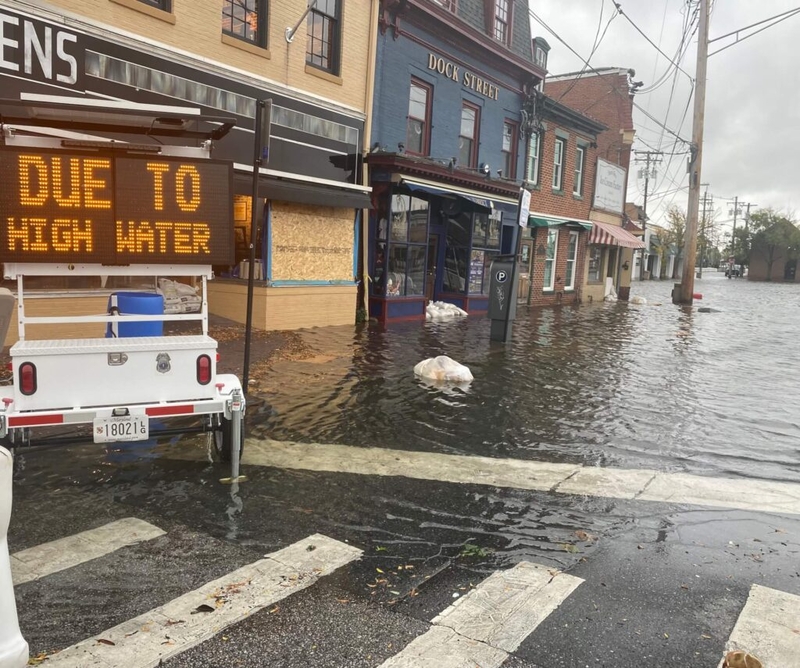
Flooding in downtown Annapolis in October 2021. (Photo by Alexandra Radovic/Capital News Service)
I’ve seen firsthand how climate change is transforming Maryland. Not in some distant land, but here at home.
All along the Chesapeake Bay, we’re seeing that when climate changes, everything changes. In Annapolis, where I live, flooding has become routine, even on sunny days. In Ellicott City, more intense storms have ripped up sidewalks and destroyed shops along Main Street. In Baltimore, heavier rainfall strains aging infrastructure, inundates basements and triggers noxious sewage overflows. And on Smith and Tangier islands, where land is naturally sinking, sea level rise and erosion from climate change are increasingly putting entire communities and cultures at risk.
Marylanders should be worried about the federal government’s recent repeal of the endangerment finding, a landmark finding that heat-trapping air pollution endangers public health and the environment. This weakens work to prevent pollution that’s driving sea level rise, harming the Bay and threatening the pillars of Maryland’s economy.
That is why the Chesapeake Bay Foundation, represented by Earthjustice, has joined a lawsuit to defend the endangerment finding in court.
Your opinion matters
Maryland Matters welcomes guest commentary submissions at [email protected].
We suggest a 750-word limit and reserve the right to edit or reject submissions. We do not accept columns that are endorsements of candidates, and no longer accept submissions from public officials or political candidates.
Opinion pieces must be signed by at least one individual using their real name. We do not accept columns signed by an organization. Commentary writers must include a short bio and a photo for their bylines.
Views of writers are their own.
Climate change is already harming Maryland homes, businesses, tourism, and agriculture. There’s a big price tag, both literally and figuratively. Maryland has lost more than 25,000 acres of forest and about 3,500 acres of farmland to tidal marsh since 1984. Building seawalls to protect Maryland communities from flooding could top $27 billion by 2040, according to a recent study.
Our fisheries, from striped bass to oysters to blue crabs, will continue to suffer, as will the seafood industries they support. Warmer waters and increased polluted runoff create the perfect storm for harmful algal blooms and underwater dead zones where fish and crabs can’t survive.
Maryland recently launched a new study to understand just how much our changing climate will cost the state. But it’s already clear that when the federal government rolls back work on climate change, places like Baltimore, Annapolis and Smith Island pay the price first. We can avoid threats not only to our state’s economy, but to what makes Maryland unique and beautiful.
The path forward is clear. We must build a future Bay where people and nature thrive together. That means fixing failing wastewater plants. It means supporting Maryland farmers in their work to prevent agricultural pollution. And it means holding the federal government accountable when it fails to uphold its responsibility to protect public health and local economies.
The Chesapeake Bay has long been a test of whether we can align science, policy and people to solve a complex challenge. Climate change is raising the stakes.
Winning on the Chesapeake Bay, and across the country, is still possible. That means communities connected to Maryland’s marshes and forests. It means wildly successful oyster restoration. It means local businesses thriving from the bounty of our beautiful waterways. It means a Bay resilient enough to withstand what is coming.
But we can only get there if we work together. When the federal government rolls back climate change protections, it’s abandoning its legal duty to protect the public in places like Baltimore. Maryland leaders and advocates are left with no choice but to go to court.
Think of what’s at stake: clean air, swimmable water, fresh local seafood, entire island communities and family crab feasts for generations to come. These are not abstract ideas. They are what it means to be a Marylander. And they are worth fighting for.
Annapolis, MD