Cleanups removed over 1.5 million pounds of trash from Alaska beaches last year, report says
Jun 04, 2026 | 4:48 pm ET
Description
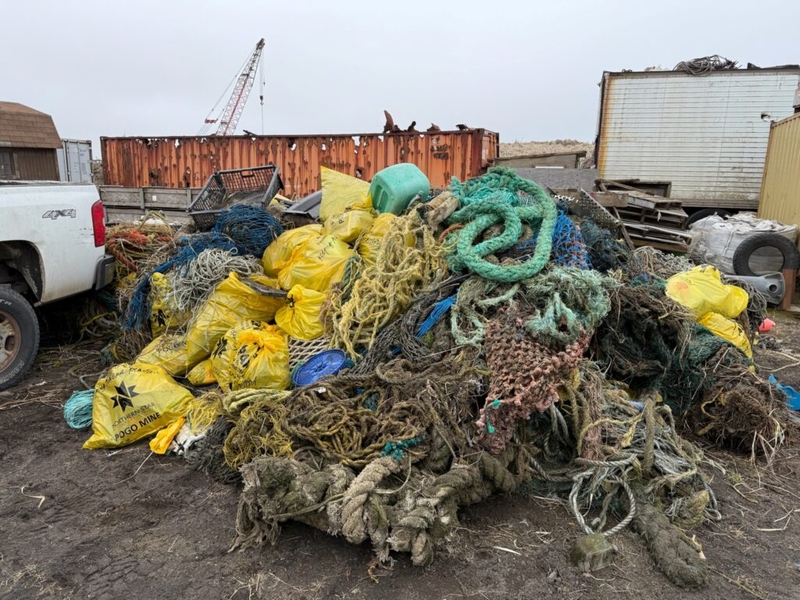
A pile of marine debris colected during the May 2025 beach cleanup campaign on St. Paul Island is dominated by discarded fishing line and netting. Organized community beach cleanups in locations ranging from northwestern Alaska to the tip of Southeast Alaska removed more than 1.5 million pounds of trash in 2025. (Photo by Kristina Tirman/Ocean Conservancy)
Alaskans collected more than 1.5 million pounds of marine debris last year in organized community cleanups involving nearly 1,700 people in total, a new report says.
The report, issued Wednesday by Ocean Conservancy, Alaska Sea Grant and the Sitka Sound Science Center, summarizes beach trash cleanups conducted in 2025 in more than two dozen coastal communities or regions. Sites ranged from the Inupiat village of Wales that is about 55 miles from Russia’s mainland in the northwest to Prince of Wales Island at the southern tip of the Southeast panhandle.
“This report gives us an opportunity to better understand the scale of the marine debris problem in Alaska and highlight the incredible efforts happening in communities across the state,” Kristina Tirman, Ocean Conservancy’s Arctic marine debris manager, said in a statement. “Ocean Conservancy is pleased to support and amplify the work of the organizations and Tribes who have been leading this work to protect Alaska’s coastlines and communities.”
Although there is no comparable annual report that was compiled in past years, according to Ocean Conservancy, an earlier report found that over 3 million pounds of beach debris had been collected from 2006 to 2014 in various cleanups done in different communities.
Fishing-related materials like pieces of netting, line and buoys dominated Alaska’s collected marine debris in past years, according to a report released by Ocean Conservancy last year.

In the Pribilof Island community of St. Paul, for example, over 90% of the 25,888 pounds of marine debris collected last year consisted of fishing net and line material, according to data provided by Ocean Conservancy.
In addition to supporting community cleanups, Ocean Conservancy contributed to an Alaska Marine Debris Action Plan issued last year by the National Oceanic and Atmospheric Administration.
Alaska has about 66,000 miles of coastline, including islands, inlets, coves, fjords and other features, according to the U.S. Geological Survey. That is more than the rest of all other states combined, and most of it is remote and difficult for people to reach. Additionally, much of the marine debris littering Alaska’s shores comes from distant sources. All that makes beach cleanup much more difficult in Alaska than in other states.
Those challenges were cited by Alaska lawmakers, who unanimously passed a measure, Senate Joint Resolution 20, urging additional federal funding to support marine debris removal. The non-binding resolution also calls for better federal and state coordination with coastal communities, tribes, nonprofits and other entities.
The problems associated with marine debris include ingestion and entanglements by birds, fish and marine mammals and interference with fishing and recreation and hazards for mariners, said the resolution, which won final passage on May 19. The problem “is particularly acute in the state because of the state’s rugged shoreline, ocean currents that concentrate debris in remote locations, and ocean dependent coastal communities,” the resolution says.
The approved resolution is now headed to Gov. Mike Dunleavy for his signature.
Juneau