Chamber report calls for fixing budget woes with improved business climate
Nov 19, 2026 | 12:01 am ET
Description
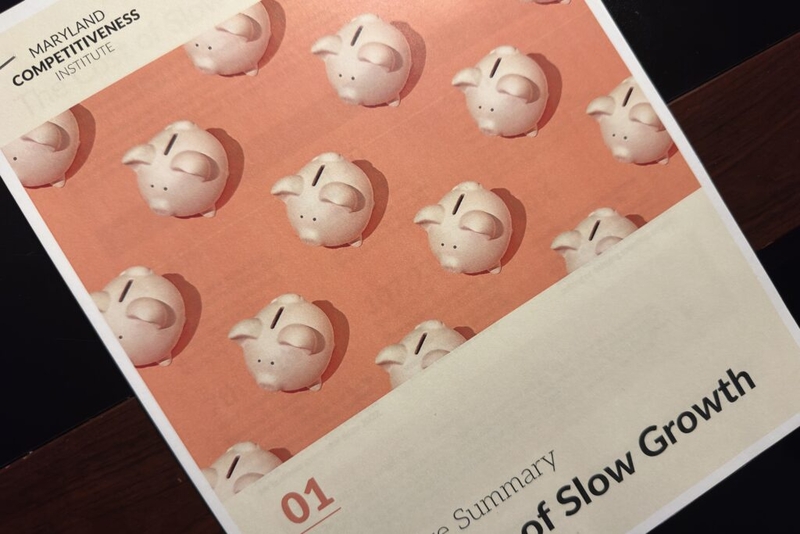
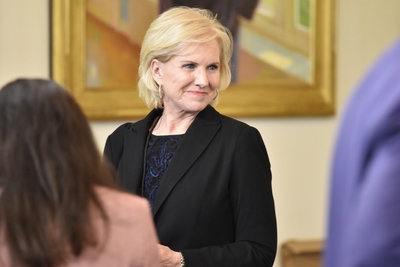
A new report from the Maryland Competitiveness Institute finds the state is falling behind when it comes to business climate. The institute is a new nonprofit research arm of the Maryland Chamber of Commerce. (Image courtesy Maryland Competitiveness Institute)
Maryland’s ongoing budget issues are linked to an economy that has lagged behind the nation over the last decade. A forthcoming report from an arm of the Maryland Chamber of Commerce argues that an improved business climate will grow state revenues over time.
The report is the first from the Maryland Competitiveness Institute, a nonprofit research arm of the state chamber. Both will be officially introduced to the public during a chamber conference Thursday morning in College Park.
The report — the first in a series of expected data dives — comes at the same time that lawmakers and Gov. Wes Moore are looking at four years of project multibillion-dollar projected budget gaps.
“Our biggest concern is they’re going to start taxing businesses to pay for these decisions that were made years ago, and that is not the way to get out of this,” Maryland Chamber President and CEO Mary Kane said in an interview Tuesday. “Our goal is to grow the economy, not tax our way out of this. We will never win if that’s the only way we’re doing it.”
Maryland faces a series of significant budget challenges starting next year, when the projected budget gap approaches $3 billion. The projections worsen over the following three years.
Much of the problem is driven by increasing costs of the Blueprint for Maryland’s Future education program.
“When we budget with aspirations, which we should do, sometimes we find ourselves in a place where we look at now, where we have to have some very, very challenging discussions about what’s available, what additional resources may be available, and what has to be adjusted for growth to match what resources are there,” Senate President Bill Ferguson (D-Baltimore) said during a Wednesday budget briefing.
Kane said improving the business climate must be coupled with realistic budgeting practices.
“It should always be realistic,” Kane said during Tuesday’s interview. “I’m sorry, budgets for states should not be aspirational. What they should be are realistic and attainable.”
The practice goes hand-in-hand with an improved business climate called for by the report, she said.
Among the findings, the report notes that Maryland’s economy grew less than 12% over the decade between 2015 and 2026. That compares with a 25% growth rate nationally over the same period.
“We have to have some realistic discussions about where we’re going forward because we’re losing businesses here,” Kane said.
“There are businesses that are leaving, and that is not the way we’re going to be able to fund our economy. It’s the business community that hires more people, that pay more taxes, that are actually going to grow us out of this problem.”
Additionally, the report finds the state lags behind others when it comes to businesses surviving past a critical three-year mark. It ranked the state 45th in startup businesses that convert into companies that hire new employees.
“Businesses are actually the thing that make for a healthy community,” Kane said. “When people have great jobs, when they can buy houses, when they can raise a family, that’s growing your community.”
The report points to Virginia as a potential model for improving Maryland’s economy. Both states were hit by cuts to federal employees. Maryland and Virginia each saw comparable cuts to federal jobs, though the hit to Maryland represented the biggest percentage of any state.
“A lot of the talk has been about DOGE, and that our economy has been drastically affected by DOGE,” Kane said of the Department of Government Efficiency, the Trump administration effort to slash the size of federal government.
“We went back 10 years,” she said. “Yes, our economy was affected by DOGE, absolutely, as was Virginia’s economy. But what happened? … Why isn’t Virginia in the same position that we are?”
Kane said the goal of the newly formed institute is to gather data to make the case to lawmakers that improving the economy and state revenue picture is inexorably linked to nurturing the business growth.
“Our pitch is competitiveness, and you are seeing them talking more about Maryland being more competitive, we cannot keep passing budgets that we don’t have money to pay for,” Kane said.
“You don’t grow the economy on nonprofits or on government,” she said. “You grow it on having healthy businesses here.”
Future reports will look at housing affordability and taxes in the state.
The relationship between state government and the Maryland business community is complicated.
More than a decade ago, the Augustine Commission found Maryland was a high cost of living state, too dependent on federal jobs, with high utility costs and other factors. And while some early recommendations were enacted, many others were left to gather dust.
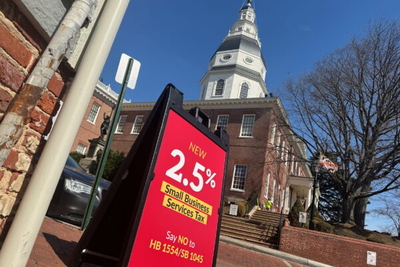
Elected officials acknowledge that economic growth is key to resolving some of the state’s stickier ongoing budget issues.
Business leaders — especially small business owners — say they are frequently vilified by lawmakers. Those same lawmakers then turn to them for new revenue in the form of fees, taxes.
In recent years, businesses have been hit with a series of policies that Kane and others say have made it difficult to compete including taxes on IT and data services and mandatory paid leave programs.
Kane, however, sees reason for optimism.
“When the Senate president stands up and he says, ‘I never forget the fact that people only live less than an hour away from another state if you live in Maryland,’ that’s come a long way,” Kane said. “They’re actually starting to think that way, and that’s our goal.”
Annapolis, MD