Calls for higher voting participation pervade Alaska Federation of Natives convention
Oct 27, 2026 | 9:30 am ET
Description
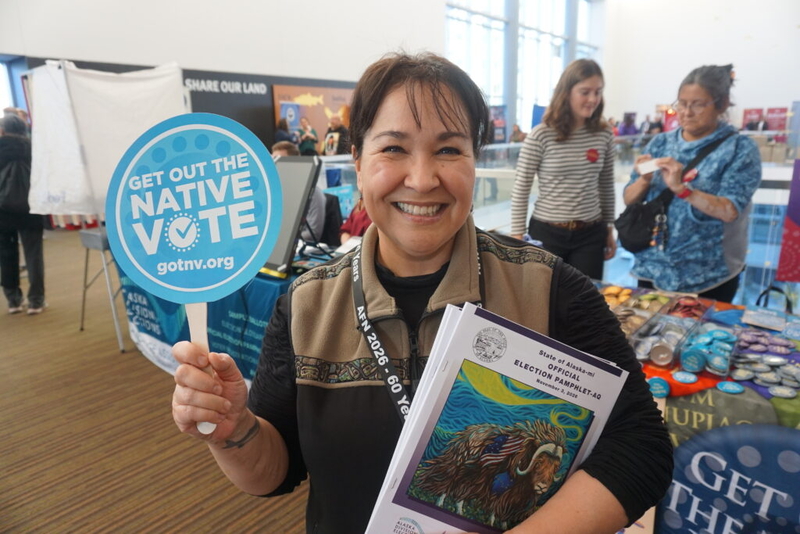
Michelle Sparck, director of Get Out the Native Vote, holds a promotional sign and several Division fo Elections pamphlets in the upper lobby at the Dena'ina Civic and Convention Center during the Alaska Federation of Natives convention on Oct. 22, 2026. (Photo by Yereth Rosen/Alaska Beacon)
From the opening to the closing of the Alaska Federation of Natives convention, speaker after speaker, information booth after information booth and placard after placard had the same message: a call for Alaska’s Indigenous people to vote.

“If my four fingers represented all the voters in Alaska, we’re one whole finger. That’s how important we are,” she said.
Yet voter participation has nosedived since the 1980s, when almost all Native adults in villages voted, she said. In 2024, only 11% of qualified Alaska Natives cast ballots, she said.
“That’s not showing our power. That’s not owning our power,” she said. “If we’re only voting 11% out of 25%, we are not sending a clear message to politicians.”

“We have to be attuned to this, because where you live should not determine whether your voice is heard and whether your vote is counted,” she said in her speech, delivered Thursday.
Outgoing AFN Co-chair Joe Nelson, who closed the convention on Saturday with a speech of gratitude, said he had one request of everyone attending or watching the convention: Vote.
Alaska Native people “take care of everybody. We give, give, give, give, and that’s OK,” he said. “And my only ask here tonight is that every one of you take your whole clan and go give your vote. Vote for the next U.S. senator. Vote for the next U.S. congressperson. Vote for our new governor. And bring your kids along with you.”

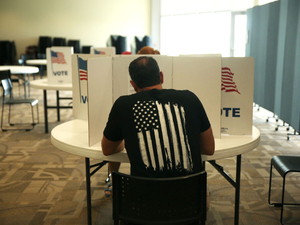
At the convention, speakers exhorted conference attendees to walk from the Dena’ina Civic and Convention Center, site of the AFN event, across the street to Anchorage City Hall, where the Alaska Division of Elections operates an early voting site. Volunteers with Native Get Out the Vote even provided escorts for early voters.
“We’re not going to tell you who to vote for, but we can get you comfortable and confident enough to walk across the street and vote in person,” Sparck said in her speech.
They promoted other early voting sites as well: the busy Midtown Mall site just south of downtown and the Curtis D. Menard Memorial Sports Arena in Wasilla.

More than 1,500 people were airlifted from the region after the storm hit, mostly from the Yup’ik villages of Kipnuk and Kwigillingok.
As the evacuees navigate housing problems, contend with transportation difficulties and make other adjustments to city life, evacuated residents might not consider voting to be a top priority, Sparck said in an interview. That was apparent during the Aug. 18 primary, when only eight total votes, all by absentee, were counted from the two hardest-hit villages, she said.

“For the Halong evacuees, we care about what you’re going through, and we want you to turn out the vote in the midterms,” she said.
For the general election, Native Get Out the Vote is providing rides to polls for the evacuees, she said – and also rides to the Alaska Native Heritage Center on the east side of Anchorage, where there is a stockpile of donated traditional foods that the displaced Yukon-Kuskokwim residents can use to make their lives easier.
More broadly, the voting problems that have plagued voting in rural Alaska, such as unopened or late-opening polling sites, erratic and undependable plane service and mail delivery, continue.

Most of the sites he listed were in Western Alaska. “There is no legal excuse for the failure to open these sites,” he said in a letter he sent Friday to the division.
Alaska lawmakers passed a bill that would have eased some of the logistical challenges for rural voters, but Gov. Mike Dunleavy, a Republican, vetoed the bill. The measure, Senate Bill 64, would have ensured that the state provide postage-paid envelopes for mailed ballots, set up a ballot-tracking system and allowed voters to correct technical mistakes and make other changes.
Despite those ongoing impediments to voting for Alaska Natives from rural communities, there is one positive change that should make it easier for rural Native residents to cast their ballots, Sparck said.

It took a long time to win that service, which had been available at the hospital in the past, Sparck said.
“It took 10 years for us to argue with the Division of Elections to bring voting back onto the ANMC campus,” she said.
That voting site, at a Southcentral Foundation facility on the ANTHC campus, is set to open on Tuesday and continue operating until Nov. 2, the day before Election Day, according to the Division of Elections.


Juneau