Black-footed ferrets aren’t thriving anywhere, but in Wyoming’s Shirley Basin they’re faring OK and even dispersing
Oct 06, 2026 | 6:22 am ET

Description
Photo courtesy of WyoFile
SHIRLEY BASIN—From hundreds of yards away, biologist Daniel Pinneo spotted the telltale green eyes of one of North America’s rarest mammals, before the night’s mission really began.
His Wyoming Game and Fish Department counterparts were still near their trucks staging for a grueling through-the-night field shift.
Pinneo, a biologist at the Tom Thorne/Beth Williams Wildlife Research Center at Sybille, interrupted colleagues going over protocols to search for, and potentially capture the endangered species.
“I think that’s a ferret,” he said.
Game and Fish small carnivore biologist Andy Gygli, the research team’s leader, cast his own spotlight where Pinneo caught the green eyes.
“I think that’s a ferret, too,” he said. “Go figure out what that is.”
Pinneo closed the distance, striding through a prairie dog colony in the dark just west of the Little Medicine Bow River. It was the evening of Sept. 30, 2025, and he spotlighted along the way, narrating the nighttime vibrancy of the arid high desert.
A jackrabbits’ eyes caught his attention to the right of the suspected black-footed ferret, then he noticed another critter on the move.
“That’s a fox — swift fox,” Pinneo said.
The green glowing eyes remained.
“See how low to the ground that thing is?” he said. “I’m almost certain.”
Four minutes later, Pinneo was up close and staring into a prairie dog burrow. The sooty black-and-beige masked face of an inquisitive ferret kit peered his direction.
Mustela nigripes, confirmed.

Although seeing a black-footed ferret anywhere is a great rarity — they were once presumed extinct — the Shirley Basin is about the best place in the world to do it. Ferrets in this ecologically rich complex of state, private and federal land southwest of the Laramie Mountains have lasted longer than any other subpopulation on Earth and they’ve fared well enough that they are even fanning out on their own unassisted.
Wyoming wildlife managers have found pockets of ferrets near Carbon County’s Chalk Mountain and Bone Creek, a drainage northeast of Medicine Bow, where they were never reintroduced, Gygli said. And they’ve also started to detect more dispersers west of Highway 77 south of Casper.
“That’s the other spot we’ve been trying to turn into a population source,” Gygli said. “Every year we find more kits. I’m really excited about that.”
In April 2023, Gygli even learned of a road-killed ferret hit on the highway near Centennial in the eastern foothills of the Snowy Range Mountains. It was an otherwise healthy male.
“Other than the roadkill, it was in very good shape,” Gygli said. “This was a portly ferret doing very well for himself.”
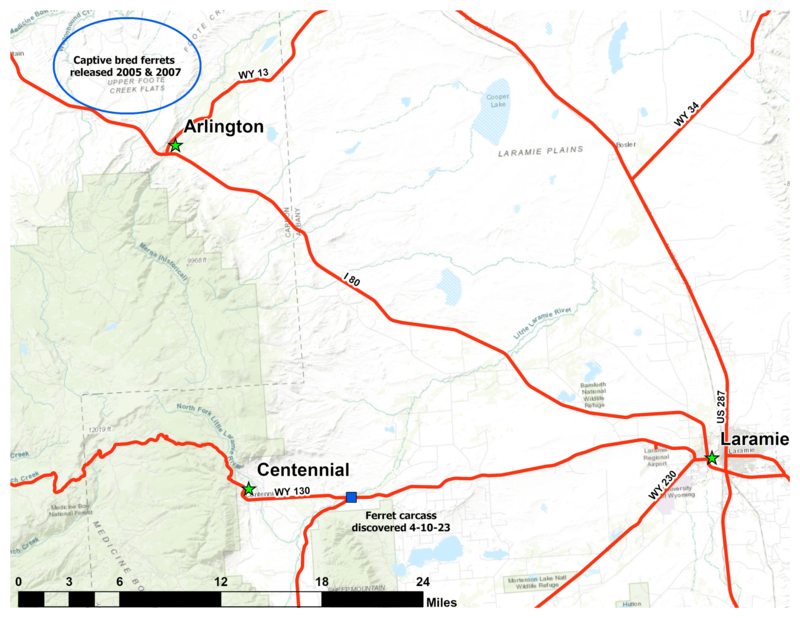
Based on its genetics and geography, the most likely explanation is that the animal journeyed south from the Shirley Basin. While ferrets don’t have the extraordinary dispersing capabilities of their cousin, the wolverine, the Centennial ferret would have had to have traveled dozens of miles, skirted the Snowies, and it even crossed Interstate 80.
“Every now and then, a road-killed one gets picked up,” Gygli said. “Normally, they’re in places that aren’t surprising, but who knows? We might find more Centennial-type ferrets.”
Origins
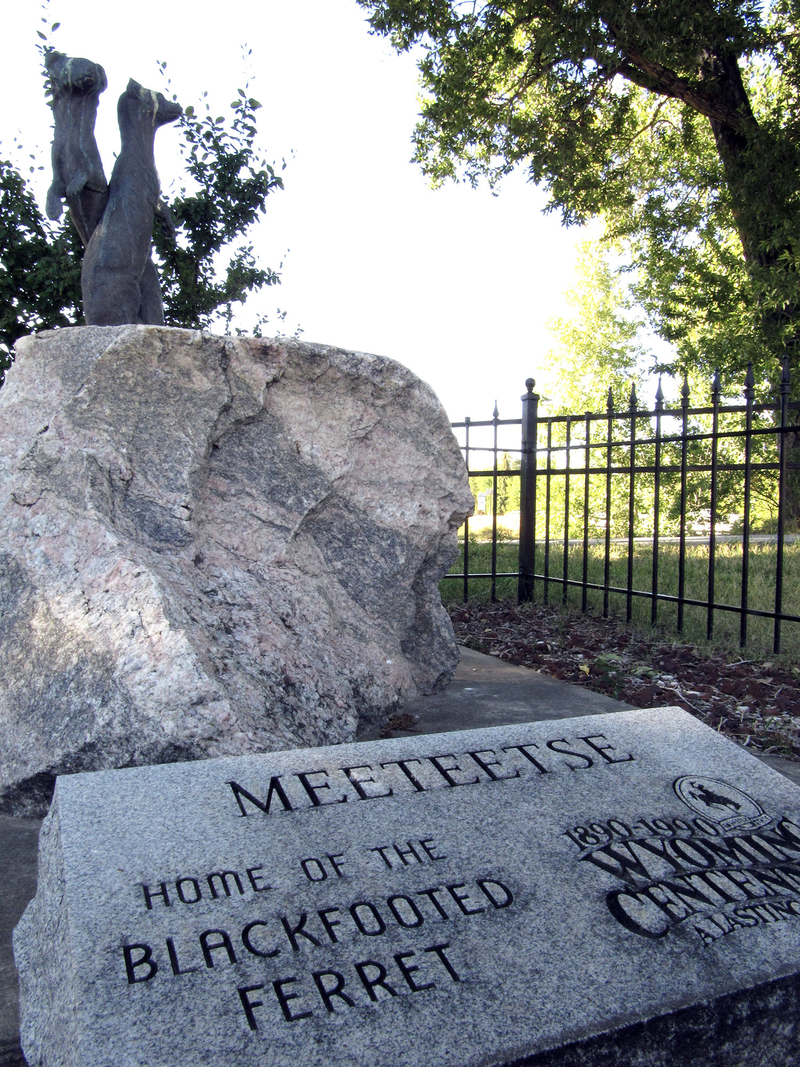
Shirley Basin was the first place where the cryptic small carnivores were reintroduced into the wild after the species’ extraordinary rediscovery outside of Meeteetse. That moment in the fall of 1981 is etched into Wyoming lore: Shep the ranch dog brought a dead weasel-like creature home to his owners, John and Lucille Hogg, then a taxidermist identified it as a black-footed ferret and a month later federal wildlife officials found more living animals. The subsequent decade amounted to a rescue mission. The newfound population was besieged by two nonnative diseases, canine distemper and plague, and 18 remaining ferrets were plucked out of the Bighorn Basin and brought into captivity to create a reproduction program to sustain the species. By 1991, the initial 15 breeders managed to produce enough captive ferrets to give the species another chance in the wild.
“We evaluated like 12 different sites before we selected Shirley Basin,” said Bob Oakleaf, a retired nongame wildlife supervisor for the Wyoming Game and Fish Department. From 1991 to 1994, more than 200 ferret kits were released in the area.
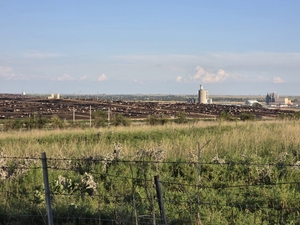
The site was selected because of the cooperation of private landowners, Oakleaf said, and its ferret-friendly attributes. In other words, there were prairie dogs. Lots of them. Today, there are over 280 square miles of active prairie dog colonies, which provide ferrets with a critical source of prey, cover and habitat. In 2024, Game and Fish surveys detected 4.24 white-tailed prairie dogs per acre, which extrapolates out to more than three quarters of a million of the chunky rodents.
Although black-footed ferrets have maintained a presence in Shirley Basin for 35 straight years, it wasn’t always smooth sailing. Plague has been a longtime bane for prairie dogs and ferrets. Wildlife managers didn’t realize that ferrets could actually contract plague until one escaped from the Sybille research lab in the early 1990s.
“It got involved with a prairie dog that had plague, and died from it,” Oakleaf said. “About the same time that happened, plague erupted in Shirley Basin.”
“It’s a double-edged sword,” he added. “They lose their prey, and they also die from preying.”
Hit by the infectious disease, the population “basically crashed” in the early years and wildlife managers almost had to start over, Oakleaf said. But by the late-1990s, prairie dogs and ferrets in the region were plague-free enough that reintroductions resumed and a wild-breeding population took hold.
“They just took off,” Oakleaf said. “We had high hopes of it being successful, and each year our optimism grew.”
There was a lot of work behind the scenes to make it work. Captively raised ferrets, like other species in similar circumstances, struggled to understand the dangers of life outside a cage.
“They were dying at a high rate early on,” said Dean Biggins, an emeritus U.S. Geological Survey scientist who’s been studying black-footed ferrets since their Meeteetse rediscovery. “Coyotes were the biggest problem, by far, but just about any predator you found on a prairie dog town would take a ferret, and that included golden eagles and great horned owls and badgers.”
“Preconditioning pens,” where ferrets had access to prairie dog burrows they could plunge into, helped solve that problem. Captive bred and released ferrets that survived until the next breeding season increased tenfold, Biggins said, jumping from 4-5% to 40%.
“The predator kills dropped way off,” he said. “They were evading the coyotes a lot better.”
Continued maintenance
Even as Shirley Basin ferrets survived, fanned out and started pioneering new habitats in the region on their own, the population continued to get a boost from captive-raised animals. They come from six breeding operations, including the National Black-Footed Ferret Conservation Center outside of Fort Collins, which oversees the recovery efforts.
In 2024, ten ferrets apiece were turned loose at the newfound Chalk Mountain and Bone Creek subpopulations, according to Game and Fish’s most recent nongame species annual report. Based on spotlight surveys, they appear to be on the upswing at Chalk Mountain, but not doing so hot at Bone Creek, where just one wild born male was detected two years ago.
“They’re either not living or not sticking around,” Gygli said.
Keeping tabs on Shirley Basin’s ferret population is an intensive annual weekslong affair. Gygli leads a crew that spotlights through the night, by truck and on foot. The nocturnal mustelid’s most active hours are 2 a.m. to 5 a.m., and the surveying biologists are often up and looking during that span for four straight days. It’s a grind on the human body, Gygli remarked on the front end of one night’s search.
“Particularly on the last day, about 4 o’clock in the morning, sometimes I can’t continue,” he said. “I have to break for my own health.”

Over the course of a field season, the ferret surveyors can check in on 10,000-plus acres in the Shirley Basin (in 2024, their lights combed over 11,871 acres, yielding at least 21 ferrets and four to five litters.) But even with all that effort, they’re covering just a small fraction of the 280 square miles of prairie dog colony in the basin.
Technology could be a game changer. Ferret researchers with the Smithsonian’s Conservation Biology Institute are developing techniques that use drones and artificial intelligence to monitor populations, and they’re trying it out in Shirley Basin.
“If it works, compared to traditional methods on the ground, at least as well, that would really save time and effort and free up tech[nicians] to do other things,” Gygli said.
There are other imperative ferret-related tasks at hand, like monitoring for plague, which remains a constant threat.
Plague patrol
The sylvatic plague that can decimate prairie dog populations and kills ferrets is the same flea-born disease that can infect humans and caused the devastating Black Death pandemic in the 14th century. In modern times, the plague is considered endemic to places like the Shirley Basin. It can hit anytime.
“I just assume it’s always here at a low level,” Gygli said during his nighttime survey. “You just hope that the conditions never quite align.”
With some regularity, a wet spring causes fleas to thrive, and the lethal malady flares up in one or more of the species’ dozens of attempted recovery areas. It happened at Montana’s UL Bend National Wildlife Refuge, where minimum ferret counts tumbled from 24 to one between 2017 and 2019. And it’s been a major factor in swings in western South Dakota’s Conata Basin/Badlands National Park recovery area, a rare self-sustaining population home to roughly half the wild ferrets in the world. Ferret counts there fell from 355 animals before a 2007 plague outbreak to just 49 animals six years later. Another outbreak there was detected in 2024, triggering a massive operation to fog prairie dog colonies with insecticidal dust to knock back plague-spreading fleas.
Despite the effort, around the same time the population cratered.

“In 2024, we had 250 ferrets on 17,000 acres,” said Travis Livieri, a Wisconsin-based biologist and black-footed ferret expert who’s long studied the Conata Basin/Badlands population. “Now we’re down to about 70 ferrets.”
It wasn’t just plague, though. Crushing drought has also been a big factor in Dakota ferrets’ struggles, causing a “massive” breeding failure last year.
“In my 30 years of doing this, I’ve never seen [drought] this bad, where prairie dogs failed to reproduce at a high rate,” Livieri said. “The prairie dogs don’t do well, the ferrets won’t do well. That’s the story of what happened in 2025.”
Wyoming’s been hit in modern times, too. In 2018 and 19, plague hollowed out the Meeteetse ferret population, which had been reestablished with much fanfare in 2016. Between 2018 and 2020, the minimum number of ferrets detected there fell from 26 to one. There have been captive ferret infusions since then, including 18 animals in 2022, but Wyoming’s smaller recovery area has continued to barely limp along.
“It’s not gone,” Gygli said of the Meeteetse population, “but it is not doing as well as I would like.”
During the 2025 surveys, his team found a single animal in two weeks of looking.
“Hopefully, we just happened to miss seeing them,” Gygli said. “Even though we only saw one, chances are there’s more out there.”
In Shirley Basin, Gygli hasn‘t seen a major plague outbreak since he came aboard in 2017. But there have been some scares. In July 2025, a dead prairie dog tested positive to the west of the newfound Chalk Mountain subpopulation. It immediately became a top priority for Game and Fish, and its federal ferret recovery partners.
“We put together an effort to treat [1,000 acres] where our ferret litters are near Chalk Mountain,” Gygli said. “My desperate hope is that we never actually know if our efforts did anything. If things just continue as normal, that’s what I’m hoping for.”
Is this success?
The great lengths Wyoming Game and Fish and the U.S. Fish and Wildlife Service go to keep black-footed ferrets alive in the Shirley Basin is one of the most successful efforts to bring back the native species.
Black-footed ferrets were declared an “endangered species” in 1967, before the Endangered Species Act even existed (they were grandfathered in when the ESA passed in 1973). There are historical estimates of more than 5 million ferrets in the late 1800s, and although biologists believe they were always a low-density species they co-evolved with prairie dogs and have been a part of western ecosystems for over 100,000 years.
Today, verified ferrets in the wild number in the hundreds. The sorry state of the species is inextricably linked to its primary prey, the much-maligned prairie dog, which is simultaneously managed as nongame wildlife and an unprotected pest in Wyoming. The Territorial Legislature classified prairie dogs as a nuisance in Wyoming before the state even existed. As long as prairie dogs aren’t thriving, ferrets won’t either.
“By and large, prairie dogs are not well liked,” said Biggins, the USGS retiree who’s studied ferrets for 45 years. “That’s been a problem in most of the places where we work.”
For black-footed ferrets, the picture of success in the modern era is simply weeks of intense through-the-night monitoring every summer and fall, occasional releases of vaccinated captive ferrets and quick action — and lots of resources on hand — anytime there’s any plague detected.

Just having ferrets continuously on the landscape is a feat in itself.
“Shirley basin has been pretty well occupied the whole time,” said Livieri, the Wisconsin-based black-footed ferret expert.
Most ferret reintroduction sites fail. Out of 35 locations in eight states where Mustela nigripes have been turned loose, only about 15 still actively have ferrets, Livieri said.
Livieri marveled in particular at the geographic enormity of the south-central Wyoming population. Even though the Conata Basin/Badlands population is the largest going by headcount, it’s confined in a much smaller area that he can drive across in a couple hours. And it would have blinked out if not for aggressive annual plague control.
An advantageous and unique feature of the Shirley Basin population is that it’s so spread out — a dynamic that’s continuing as animals disperse.
“Shirley Basin has kind of that metapopulation feel,” Livieri said. “When you only got one basket, and the eggs are all breaking, that’s bad. But when you’ve got a big, big yard with a whole bunch of baskets, if some baskets don’t do well, that’s okay.”
It may be that, even in a place like Shirley Basin, intensive management is necessary forever to ensure the species’ persistence. The reason is plague, said Biggins. It’s a persistent organism that’s put wildlife managers between a rock and a hard place, he said.
“I don’t like these schemes we’ve got for plague management,” Biggins said. “But you have a hard choice to make: You want ferrets, or don’t you?”
Captured
After Pinneo cornered the ferret in the burrow at the onset of the Sept. 30, 2025 survey, Gygli and the ferret surveyors promptly began implementing their capture protocols.
Plastic cups — flagged so they got collected later on — were thrust into nearby burrow openings, so the animal couldn’t surreptitiously escape. A long, rectangular cage trap was jammed into the main entrance and a blanket cast over it, a ferret safety measure that’ll ensure a trapped animal stays warm.
Then it’s time to wait.
“Every now and then, when you walk away, you’ll hear it slam shut and you’ll have a ferret,” Gygli said. “That has not happened this year.”
The trap stayed silent as they walked away. An hour later, Pinneo’s voice emerged from a hand-held radio as Gygli spotlighted from his pickup truck.
“I got a ferret in a trap,” Pinneo said.
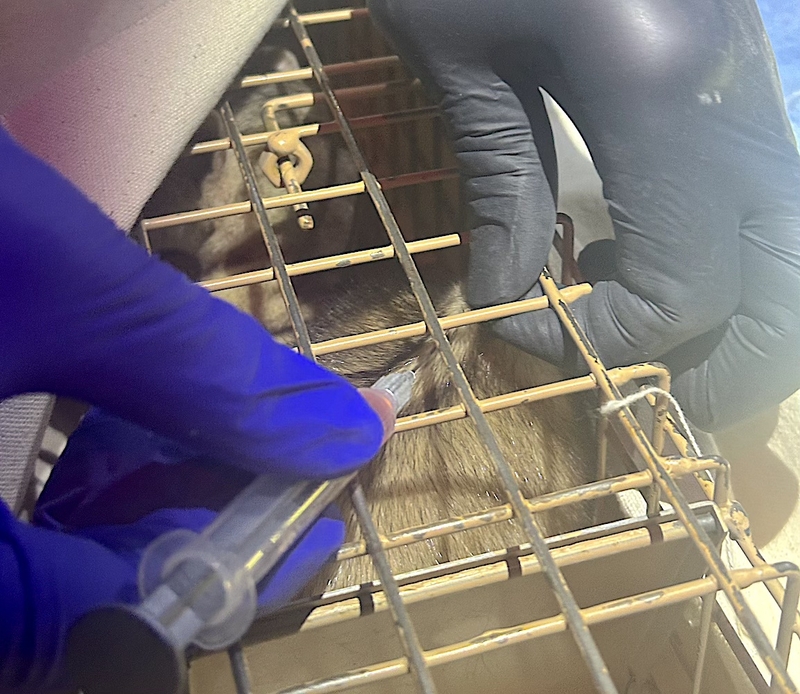

Minutes later, the team of ferret surveyors began a routine examination. The young-of-the-year ferret kit had been born in the wild, and weighed in at just 2.3 pounds. She received two inoculations: one for distemper, the other for plague.
Although trapped ferrets can be plenty irascible, this one was notably subdued. Nevertheless, the research team communicated in whispers to not frighten the animal and wore masks to keep her safe (ferrets can catch COVID-19 from humans).
“She’s behaving very well,” Gygli said. “Just keep doing you, lady.”
Moments later, the ferret kit was gently shaken free from a transfer tube and scurried away into a prairie dog burrow. She was back in the wild in Shirley Basin, site a black-footed ferret success story, even if it houses a population that will likely always be on shaky footing.
Cheyenne, WY