Bipartisan former officials, billionaires defend restrictions on money in politics in Maine lawsuit
Oct 30, 2025 | 12:46 pm ET
Description
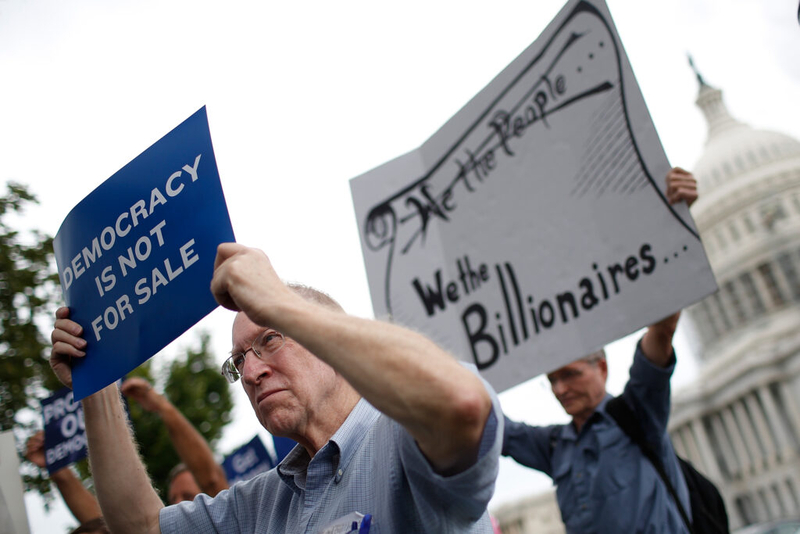
Supporters of campaign finance reform listen as members of Congress discuss a joint resolution proposing an amendment to the Constitution of the United States relating to contributions and expenditures intended to affect elections outside the U.S. Capitol September 8, 2014 in Washington, D.C. (Photo by Win McNamee/Getty Images)
Republican and Democratic former governors and members of Congress, billionaires and democracy reform organizations are coming to the defense of Maine’s law in a case over the legality of campaign finance restrictions.
This broad support was demonstrated in amici curiae, or friend of the court, briefs filed in the First Circuit Court of Appeals in Boston on Wednesday. These briefs add to the arguments made by the State of Maine and another from the non-profit Equal Citizens and the committee behind the successful referendum in their appeals filed last week.
In 2024, Maine voters overwhelmingly passed a citizen’s initiative that placed limits on contributions to political action committees that independently spend money to try to support or defeat candidates, commonly referred to as super PACs.
The state was sued shortly after by conservative PACs, but that had been part of supporters’ plan all along. Their ultimate goal is to get the U.S. Supreme Court to rule that PACs should be regulated.
Latest filings in campaign finance court battle argue Maine has legal right to regulate super PACs
The friend of the court briefs each come at the case in a different way based on each group’s experiences with super PACs.
In one brief, former elected officials described the pressure candidates feel to court super PACs and then serve the interests of their donors.
Issue One, a nonprofit that seeks to reduce the role of money in politics, filed this brief, which was co-signed by 24 former governors and members of Congress — half of which served as Democrats and half Republicans, including former U.S. Sen. Olympia Snowe of Maine. Others include former U.S. Senate Minority LeaderTom Daschle, a Democrat from South Dakota, former Democratic U.S. Sen. Russ Feingold of Wisconsin and former Republican Minnesota Gov. Arne Carlson, who considers himself an independent.
Another brief was filed by a group of billionaires. They argue unlimited super PAC contributions distort markets and reward insider influence.
Among those behind that brief are Steve Jurvetson and Vin Ryan, who were some of the largest donors to the ballot question committee behind the 2024 initiative. The others are businessman and television personality Mark Cuban, who was previously a lead investor on Shark Tank, and LinkedIn co-founder Reid Hoffman.
Several democracy reform organizations filed briefs in which they argued that unchecked super PAC contributions breed corruption. This type of argument was made by the Brennan Center for Justice, the Campaign Legal Center, Demos and Common Cause, Citizens for Responsibility and Ethics in Washington and Mainers for Working Families.
They also argued that the current lack of regulations is not supported by legal precedent, which is the overarching defense the State of Maine and Equal Citizens made in their appeals.
That argument is also fleshed out in an amicus brief filed by the constitutional scholars whose rationale serves as the basis for why those behind Maine’s law believe the Supreme Court will ultimately rule to reinstate contribution limits.
The State of Maine and Equal Citizens both made the case that the 2010 Supreme Court decision Citizens United v. Federal Election Commission actually allows for super PACs to be regulated. It’s a later lower court ruling, SpeechNow.org v. FEC, that they argue is incorrect.
In Citizens United, the high court ruled that corporations and unions have the right to spend unlimited money in elections because they have free speech rights under the First Amendment — unless there is a risk of “quid pro quo” corruption, essentially a favor for a favor.
In SpeechNow, the D.C. Circuit Court upheld that contributions to PACs cannot be regulated, either, so long as the PAC is independent.
In their brief, Harvard Law professor emeritus Larry Tribe, senior fellow at the Brookings Institution Norm Eisen and Chicago Law professor emeritus Al Alschuler (a Maine resident who was part of the group that submitted the original referendum petition) explain that large contributions to PACs inevitably create a risk of corruption because donors and candidates have the opportunity to collaborate even if a PAC is “independent.”
Therefore, the scholars argue, contributions to PACs can be regulated by Congress.
“There are very few solutions in American politics that unite Republicans, billionaires, and Harvard Law professors,” Equal Citizens Executive Director Maia Cook said in a statement on Thursday. “The fact that our initiative to reinstate super PAC contribution limits has received vocal support from amici like Mark Cuban, Reid Hoffman, Olympia Snowe, and Laurence Tribe demonstrates the strength of our argument: Americans deserve a representative government, by the people and for the people.”
Augusta, ME