Big win for racehorse owners, but bettors take a loss in Trump’s megabill
Jul 07, 2025 | 3:09 pm ET
Description
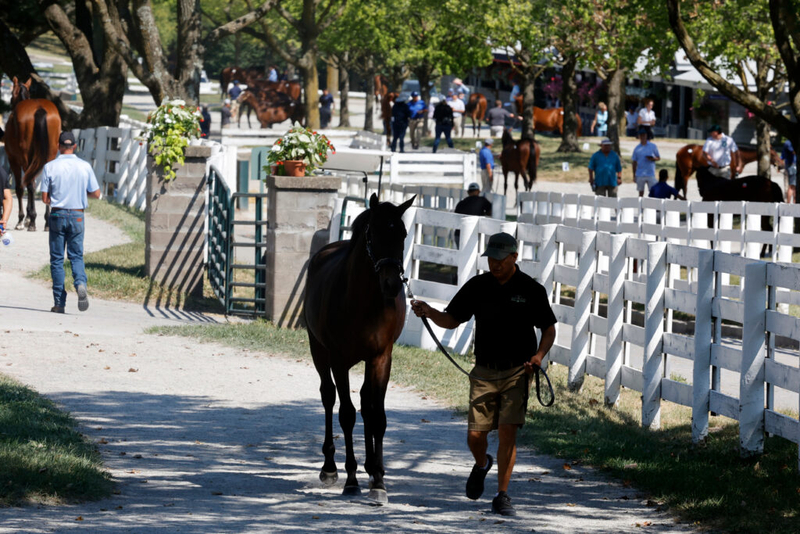
A yearling on the way to the sales ring at the 2024 Keeneland September sale. (Keeneland photo)
President Donald Trump’s massive spending and tax package includes provisions that will affect Kentucky’s Thoroughbred racing and breeding industries — an incentive for horse owners and a provision that makes it harder for bettors to turn a profit.
Republican U.S. Rep. Andy Barr of Lexington is hailing the former, saying it will provide racing with security for generations to come, while Democrats warn the latter will harm the sport by taxing bettors “into oblivion.”
The One Big Beautiful Bill Act, signed by the president on the Fourth of July after Congress gave final passage to the measure last week, makes permanent a 100% bonus depreciation included in the Tax Cuts and Jobs Act of 2017. The National Thoroughbred Racing Association (NTRA) called it “an important incentive for Thoroughbred breeders and owners.”
However, the act also limits the amount of gambling losses that can be claimed as a federal tax deduction, making it harder for bettors to profit. That change, which is to take effect in January 2026, will limit what gamblers can deduct from their income taxes to 90% of their losses in that year. Now bettors can deduct all of their losses up until the losses match winnings. Some gamblers are saying the new law could force them to pay taxes in years when they lose more than they win from bets.
Damon Thayer, a former Kentucky Senate Republican floor leader and horse racing industry consultant, said that the change in the deduction for gambling losses “will likely affect decisions made in the betting industry — both the casino and sports betting, as well as horse racing betting.”
“This is not good,” he said.
Thayer added that he hopes that by the end of the year, the National Thoroughbred Racing Association can work with allies in Congress, like Kentuckians Barr and U.S. Sen. Mitch McConnell, to remove the section affecting bettors.
In its statement about the passage of the bill, the National Thoroughbred Racing Association said “there is still work to be done to offset some losses by horseplayers in their ability to deduct tax losses.” The organization added that it is “committed to working on that fix moving forward.”
Thayer said that Thoroughbred breeders stand to suffer declines in demand if the lower deduction remains in place for bettors. “It could lead to a big decrease in the amount of money wagered on horse racing, which will have a direct effect on purses, and therefore the amount of money people are willing to spend on horses.”
Democratic Congressional Campaign Committee spokesperson Madison Andrus criticized the limit on the amount bettors are allowed to deduct from losses in a statement ahead of Trump signing the bill.
“At every turn this Republican Tax Scam gets worse and worse for Kentuckians. Kentucky’s horse racing industry is a cornerstone of American culture and Republicans are taking a hatchet to it all to pay for billionaire tax cuts. This is yet another example of Republicans’ betrayal of the American people.”
Thayer said the provision “won’t kill the Kentucky horse industry, but it would have a negative effect.” Thayer added that he contacted Barr about the provision.
On the other hand, the permanent 100% bonus depreciation is a “big win for the industry,” Thayer said. Like the other tax cuts enacted during Trump’s first term, the break for horse owners was scheduled to begin phasing out this year.
National Thoroughbred Racing Association President and CEO Tom Rooney said in the organization’s statement that it “can’t be overstated how important permanent 100% bonus depreciation is to the sport.”
“Equally as important was getting the language changing section 461(l) removed,” Rooney said. “Those changes to the excess business loss carryover would have wiped out many gains that those in the horse industry would have seen with 100% bonus depreciation.”
The changed loss carryover section means that horse owners and small farm operators can carry forward excess business losses as net operating losses, according to Barr’s office.
Barr, who is running for U.S. Senate in 2026, said in a statement that OBBBA’s permanent bonus depreciation and protections for small-business loss carryovers “delivers (a) targeted but a critical boost for our signature horse industry,”
“The thoroughbred horse racing industry is a special part of Kentucky, and this bill ensures it will thrive for generations to come,” Barr added.
Keeneland President and CEO Shannon Arvin said in Barr’s press release that the permanent bonus deprecation “is a significant win for the Thoroughbred industry.” Keeneland is a thoroughbred auction house and racetrack in Lexington, which is in Barr’s congressional district.
“These measures provide much-needed stability for owners and breeders, support reinvestment in bloodstock and infrastructure and strengthen the long-term health of our sport,” Arvin said.
Frankfort