The Bath Township school bombing at 99: A tragedy still relevant today
May 18, 2026 | 7:00 am ET
Description
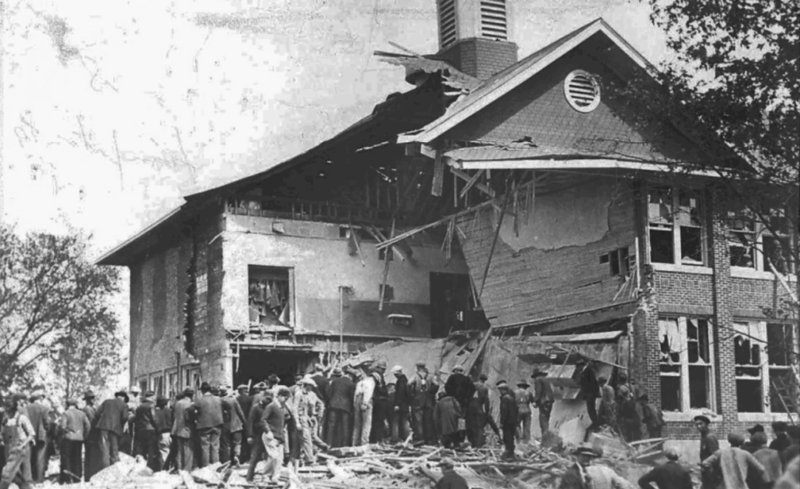
Bath Consolidated School after the May 18, 1927 bombing.
Many may not realize that Michigan’s worst instance of school-related violence happened 99 years ago Monday in a small Clinton County community that will never shake the horror and sadness visited upon them by one disaffected man.
The conditions that man gave for his terrible actions are eerily parallelled nearly 100 years later. The current social and political climate is one of struggle. Inflation and fuel costs plague Michigan citizens. Many feel as if the taxes paid to the state and federal entities are not utilized in a manner that helps the citizenry. Healthcare costs, and access, are out of reach for many people, especially with the rollback of the ACA credits. Michigan citizens, notably farmers, are facing bankruptcies reminiscent of the Great Depression.
The angst, ire, hopelessness, and powerlessness of the situation affect people in many different ways. In recent years, we’ve seen the uptick in mass violence events, especially in schools, wherein a single individual, unable to cope with the pressures of the world around them, engage in large scale violence.
These are usually males that believe they are being held back or denied their rightful place in the social hierarchy. Delusional, of course, and usually sporting a personality disorder if not also suffering from some type of chemical imbalance in a comorbid mental health crisis. They choose a vulnerable population, like a school, and prove to the world that they are important, and matter, and, most of all, are powerful.
We like to think this is a new phenomenon, but history provides a behavioral roadmap. When people believe they are suffering at the mercy of forces outside of the self, and there are mental health issues exacerbating the issue, they can snap.
For example, take the story of Andrew Kehoe.
In 1922, Bath Township, Michigan, voted to increase property taxes in order to build a new school that could accommodate the growing population. Bath was a farming community, largely rural, and farms dotted the area.
One of those farms was owned by Andrew Kehoe. A longtime member of the community, Andrew Kehoe also served as the treasurer for the Bath Consolidated School District. He was staunchly opposed to the new taxes and, even with his position, he could not stop the vote. A new school was needed and funded. The rise in property taxes was a burden on all of the Bath residents, but it was for the common good.
Unfortunately for Bath, that additional burden lit a fuse in Andrew Kehoe that would result in terrible violence.
The combustible elements must have all been there from the beginning. Noted as petty and irascible by neighbors, Kehoe’s reported behaviors examined under a modern lens would indicate he probably labored with anti-social personality disorder and a very low emotional intelligence. He did not explode in violence immediately. In a Machiavellian manner, he planned.
The school was built over the course of years. Kehoe watched this happen all while his assessed property taxes further pushed his small farm into debt. For a number of reasons, the Kehoe farm struggled financially. By all accounts, Kehoe diligently worked the farm for little result. He was deeply in debt and noticeably irritable.
His wife, Nellie, suffered from tuberculosis and required multiple hospitalizations, further driving the family deeper into financial insolvency. He was powerless to affect any of this. He could not save his farm, or his wife, and he viewed the new school as the catalyst for complete failure.
For a number of reasons, Kehoe did not have the capacity to take personal responsibility for his situation, although we cannot discount mental disease or defect. Like modern perpetrators of mass violence, Kehoe blamed external elements for his lack of success: the school, the children that caused the school to be built, his wife, the community, etc.
He blamed all of his deviant actions as a response to his ill-usage.
It is notable that, from a behavioral standpoint, it is the perceived injustice of an event or series of events that are the impetus for mass violence. We can look at vintage examples, like the tragedy at Columbine, or the sometimes-weekly events that play out in 21st century America.
Every time, regardless of mental defect or not, the perpetrators of mass violence are aggrieved in some manner. It would stand to reason, then, that when Andrew Kehoe was hired to install the electricity in the new school that there would be some mitigation of not only his financial woes but also his social utility. Sadly, the appointment only resulted in giving Kehoe months of access to the school building where he could engineer the first large scale incident of school violence in America.
On May 18, 1927, multiple explosions rocked the Bath Consolidated School. Over the course of months, Andrew Kehoe had stored hundreds of pounds of explosives in the walls of the school using his access as electrician. In addition, he had placed farm implements within the walls to act as shrapnel when detonated.
The morning of the explosions, neighbors rushed to the Kehoe farm to help extinguish a fire that had engulfed the buildings on the property. Kehoe left the rescuers to their work, indicating that they would be needed at the school. After battling the blaze, investigators found the horses secured with wire in the burning barn and the corpse of Nellie Kehoe surrounded by burning banknotes. As terrible as this was, Kehoe had just begun.
The first explosion then rocked the school, causing most of the fatalities, injuries, and property damage. The detonation was triggered by an alarm clock at 8:45 a.m. in the north wing of the school soon after the 3rd through 6th grades had started their day. As families rushed to the school, Kehoe arrived in his car and was met by Superintendent Emory Huyk.
Near Kehoe’s car, the farmer and Huyk struggled over a gun. During the altercation, the car exploded, Kehoe’s second blast, killing the superintendent and himself. The explosions killed 38 children and 7 adults, including Kehoe. In addition, 58 people were injured to various degrees.
The Bath Consolidated School suffered dramatic damage, with floors collapsing on one another. It is generally assumed that Kehoe also burned his own farm to the ground and murdered Nellie, adding to the tragedy.
The effect on the community was, of course, massive and long-lasting. Rescue efforts began immediately and, as children and teachers were pulled from the rubble in various states of distress, the families arrived. Mothers, fathers, and siblings all watched or aided the effort, hoping that their child would be found, eerily similar to the families that, in the 21st century, gather at the scenes of mass shooting events praying their children are alive.
The group of men attempting to save Kehoe’s farm arrived and aided in the effort to preserve as much life as possible. The community that came together to build a school had to come together again to push the rubble of that school aside and expose the ramifications of one man’s hatred. The greatest heartbreak is in knowing that the growth of the area, including the expansion of the child population, necessitated the Bath Consolidated School construction.
We should not disregard the story of Andrew Kehoe as an historical footnote or something indicative of a ‘less-enlightened’ populace. The struggles he endured are the same struggles that the people of Michigan, and the nation, encounter in our modern age.
In addition, we also tend to ignore, still, the mental health crises that spark this type of violence. In no way does that validate Kehoe’s actions, or the actions of anyone engaging in mass violence, but recognizing that these social triggers are cyclical, and preventable, are key.
We all know someone struggling or are struggling ourselves. Financial hardships, social pressures, political division, an uncaring government. Whether 1927 or a mere 99 years later, the very same forces that shaped Kehoe’s worldview are the same in modern farmers, teachers, line workers, retail associates, etc. The mixture of perceived injustice, compromised social standing, financial oblivion and personal failing did not go away. It is prevalent more so now than ever. Throw the internet and social media in as an embellishment, unavailable to Kehoe, and we might be able to start determining why the frequency of similar events has increased.
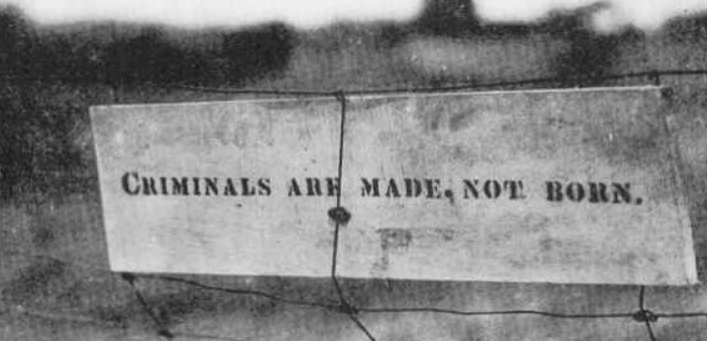
If only we’d paid closer attention nearly 100 years ago. A sign, ostensibly made by Kehoe, was found on the fence of his farm after the bombings. It read, “Criminals are made, not born” and, like his contemporaries, he diffused all fault in the most horrific wholesale slaughter of children in American history up to that point.
If the lesson of Bath has any meaning nearly a century later, it is this: societies that ignore desperation, isolation, and untreated mental crisis shouldn’t be surprised when history repeats itself.

Lansing, MI