Ban on advertising, selling of abortion pills one vote away from governor’s desk
Mar 04, 2026 | 6:09 pm ET
Description
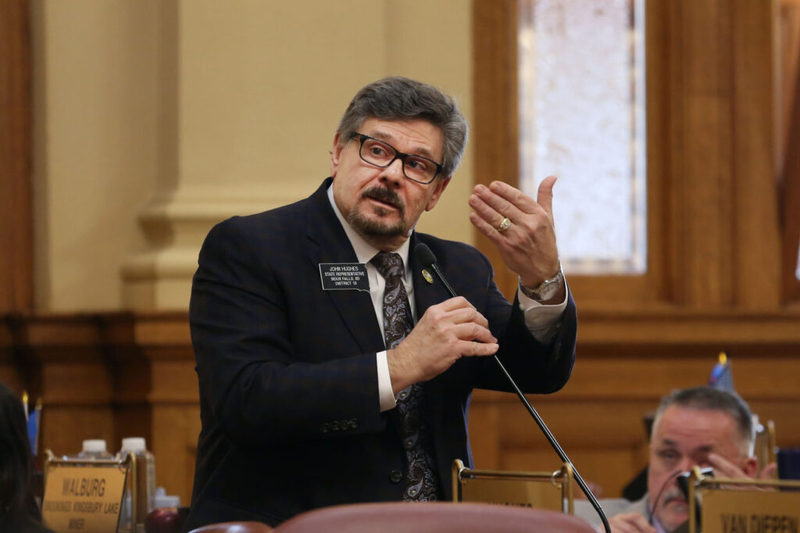
Rep. John Hughes, R-Sioux Falls, speaks on the House floor on Feb. 9, 2026. (Photo by Makenzie Huber/South Dakota Searchlight)
PIERRE — A bill to criminalize the sale or advertisement of “an article or thing” designed to perform an abortion is on its way to the South Dakota Senate.
The Senate State Affairs Committee voted 8-1 Wednesday to advance it. If it succeeds in the Senate, it will go to the governor’s desk for final approval.
The bill would ban the administering, prescribing or obtaining “any medicine, drug, or substance” or using “any instrument or other means with intent thereby to procure an abortion,” unless there’s “appropriate and reasonable medical judgment that performance of an abortion is necessary” to preserve the life of a pregnant woman.
Each violation would be a felony, punishable by two years in prison, a $4,000 fine or both.
The bill, sponsored by Rep. John Hughes, R-Sioux Falls, comes after the state’s attorney general asked a state judge to stop an advertising campaign. Last December, a New York-based nonprofit, Mayday Health, began putting up signs at gas pumps with links to information about abortion pills with the tagline “Pregnant? Don’t want to be?”
“Gas stations and restrooms should stick to advertising condoms and not be used to advertise abortion pills to be delivered to South Dakotans,” Hughes told the committee. “This is reckless and dangerous commercial conduct.”
The bill would also empower the state’s attorney general to sue a person or group that administers, prescribes or procures “any medicine, drug, or substance or uses or employs any instrument or other means with intent thereby to procure an abortion” for a person. A judge could issue $10,000 fines for each violation.
South Dakota Republican Attorney General Marty Jackley and Ian Fury, a senior advisor to Republican Gov. Larry Rhoden also backed the bill.
Supporters said the pills are unsafe and that advertisements advocate that people do not seek in-person assistance or advice from physicians.
Mifepristone and misoprostol, commonly used in medication abortions, are also used for pain management and post-miscarriage care.
Federal judge declines to intervene in South Dakota attorney general’s fight against abortion ads
OBGYN Emma Bye said she struggles now to obtain those drugs for legal and standard procedures. This bill would restrict those drugs further.
“No patient, anywhere in our state should be going through a devastating miscarriage and be made to feel like a criminal, or that they are doing something unlawful while getting treatment for a miscarriage,” Bye said.
In the last twenty-four hours, Bye said she’d performed four separate procedures that used the would-be-banned medications or instruments.
“This bill will make it increasingly difficult to even access or have manufacturers be willing to even ship us needed instruments and medical equipment for fear of retribution,” Bye said.
The South Dakota State Medical Association also spoke against the bill, citing concerns that it would have a chilling effect on healthcare for pregnant people.
South Dakota lawmakers adopted an abortion trigger ban in 2005 that took effect in 2022, after the U.S. Supreme Court overturned Roe v. Wade. Abortions are prohibited in the state, unless the mother’s life is threatened by a pregnancy. State lawmakers also passed legislation in 2022 banning “medical abortion by telemedicine.”
In 2023, medication abortions accounted for 63% of abortions in the country, according to data from the Guttmacher Institute. The drugs mifepristone and misoprostol, commonly used in medication abortions, are also listed on the World Health Organizations’ list of essential medicines. Last year, the U.S. Supreme Court rejected an attempt by anti-abortion medical organizations to overturn the Food and Drug Administration’s prescribing guidelines for mifepristone.
Earlier this year, a federal judge declined to intervene in the state’s ongoing legal case against Mayday Health.
For broadcasters:

Pierre, SD