Ayotte’s 10-year transportation plan veto ignites bigger debate over highway funding
Jul 15, 2026 | 5:00 am ET
Description
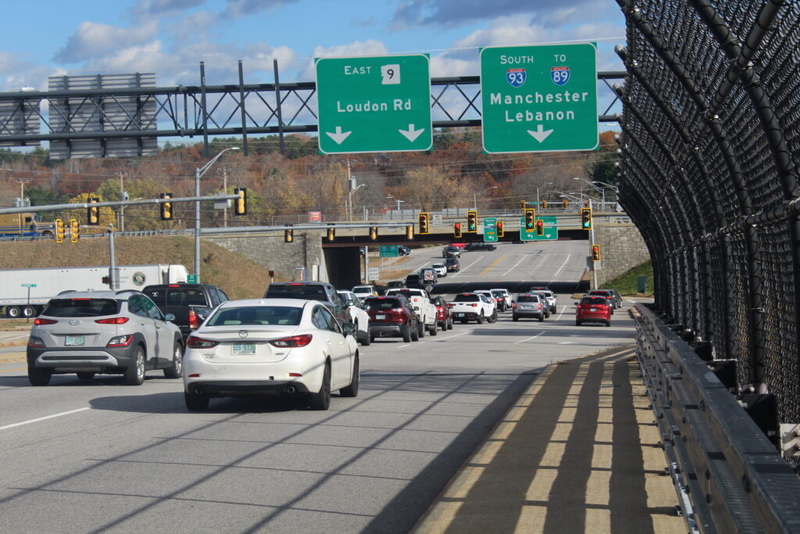
On Friday, Gov. Kelly Ayotte vetoed the state’s latest 10-year transportation improvement plan. (Photo by Molly Rains/New Hampshire Bulletin)
It was an idea decades in the making — and decades in the unraveling. In 1993, New Hampshire Executive Councilor Ray Burton unveiled the “Conway bypass”: a planned extension of Route 16 to circumvent Conway and North Conway and reduce traffic.
The plan targeted congestion concerns dating back to the 1950s, according to the Conway Daily Sun. But years of surging cost estimates, statewide funding shortages, and changing traffic estimates hobbled the proposal, and when the state formally scrapped the plan in 2020, the town manager called it a “fait accompli.”
To some state lawmakers, the Conway bypass saga is a cautionary tale of unrealistic budgeting. And it’s one they say highway planners — and Gov. Kelly Ayotte — should keep in mind today.
On Friday, Ayotte vetoed the state’s latest 10-year transportation improvement plan, taking a stand against a proposal to double toll costs for drivers without a New Hampshire E-ZPass transponder.
The veto has frustrated lawmakers in both parties, who say it will delay key infrastructure priorities, including upgrades to interstates 89 and 93 in Concord and exits 6 and 7 on Interstate 293 in Manchester.
And it has ignited a long-simmering debate over the health and long-term future of the state’s highway funding system and who should pay to support it.
“You want your roads, we’ve got to do something about it,” said Rep. David Milz, a Derry Republican and the chairman of the House Public Works and Highways Committee. “I love the whole ‘Live Free or Die,’ sure, but as far as I’m concerned, changing revenue streams that are already there aren’t giving you new tolls or new taxes. They’re simply taking into effect the inflation.”
To Ayotte, any toll increase is a bright red line. “I do not support raising the tolls,” she said in her veto message Friday. “I will continue to focus on making New Hampshire more affordable for all and a destination for tourists in the region.”
Milz says the reality is not so simple. The state has not increased its tolls since 2007, and construction and materials costs have climbed since then, straining the ability to make needed repairs, he noted.
Milz said he hopes the Republican-led Legislature will override Ayotte’s veto later this year. But whatever happens, he and others say this year’s political tussle has underscored the need for bigger, longer-term solutions.
A spokesperson for Ayotte’s office did not respond to a request for comment.
A $400 million conundrum
The 10-year plan has long been a delicate exercise in balancing. But this year, a $400 million funding shortfall has disrupted that balance.
Every two years, members of the Executive Council partner with the Department of Transportation to hone the state’s infrastructure spending priorities. That panel, known as the Governor’s Advisory Commission on Intermodal Transportation, incorporates hearings and input from regional planning commissions across the state.
The goal: to assess how much revenue the state has for infrastructure upgrades, and which priorities it should focus on for the decade ahead. State law requires all toll revenue be deposited into the Turnpike Fund, where it may be spent only on improvements to portions of U.S. Route 3, Interstate 293, Interstate 93, Route 16, and Interstate 95.
While the plans look forward 10 years, they are updated every two years, allowing the department and council to continue funding some projects, scrap others, and add new ones to the mix as priorities change.
Once the council passes a proposal, it moves to the House and Senate, which must approve the new plan in order to send it to the governor.
Last year, the Department of Transportation informed the Executive Council about the shortfall, a situation promoted by anemic revenues and rising costs. Immediately, the council split on how to respond.
For Executive Councilor Karen Liot Hill, the lone Democrat on the council, the solution was obvious: a toll increase. In an interview Monday, Liot Hill said she had heard “near-unanimous” support for that idea at meetings she held across her district.
“Because residents understood that there were needed safety projects for our highways and felt that it was appropriate for those projects to be paid for through a toll increase that would fall primarily on out-of-state drivers,” she said in an interview.
But Ayotte made clear to the council and reporters that she would not support a toll hike. So the council passed a plan that moved forward without new revenues.
“We made some very difficult choices based on recommendations from the Department of Transportation in order to generate a fiscally responsible, fiscally constrained 10-year highway plan,” Liot Hill said.
When the council’s plan arrived in the House, lawmakers were not impressed. Milz and the Public Works and Highways Committee found it overly optimistic and unrealistic.
At particular issue, Milz says: The council had added about 13 new infrastructure projects to the plan without increasing revenue. Eleven of those proposed projects were reasonable, adding up to about $22 million. But two of them — the upgrade to interstates 89 and 93 and the improvements to exits 6 and 7 — were massive in scope.
“They’re big projects,” he said. “They take a long, long time. They’re almost equivalent to when we widened I‑93.”
Those projects would be possible only with an increase in tolls, Milz and the committee concluded.
“The money just wasn’t there,” he said. He added that the committee was wary of passing a plan that could create another shortfall, potentially shortchanging projects.
“We don’t want to be put in that situation where we have to take a hard look at projects that we’ve already committed to, because towns are expecting them,” Milz said.
Rep. John Cloutier, a Claremont Democrat and ranking member of the committee, agreed. Those two projects are essential; the current infrastructure is “an accident waiting to happen,” he said in an interview. And the council’s proposal for funding them was not realistic, he said.
“We’re trying to be more fiscally responsible,” Cloutier said in an interview. “We’re also trying to be realistic, and just say, ‘Hey, you want these projects? We’ve got to fund them.’”
Aware of Ayotte’s opposition, lawmakers in both parties eventually passed the 10-year plan with the toll increase.
‘It needs a fix’
Reflecting on the decision, Milz says he knew it was bold. Rarely does the Legislature make dramatic changes to the 10-year plan, and even more rarely does it stand against a governor of its own party.
But Milz thought that lawmakers had come to a compromise that Ayotte could accept: The state would collect needed revenue, and New Hampshire E-ZPass holders would pay the same rate. Even out-of-state drivers who regularly commute into the state could obtain a New Hampshire E-ZPass transponder and avoid the increases, he noted. And the final proposal allowed anyone to obtain a New Hampshire transponder for free from Dec. 1, 2026 to June 29, 2027.
“As far as raising the out‑of‑state tolls, in my opinion, that’s almost a no‑brainer,” Milz said.
In the end, Milz thought Ayotte would sign the final plan, especially given the totality of projects it included.
For his part, Cloutier thought sending Ayotte the plan was a gamble. But he argued it was one worth making.
“To me, it was about time. It was way past due,” Cloutier said. “And normally, the governor and council would do it, but they haven’t taken the leadership on this.”
The House will need a two-thirds majority to override Ayotte’s decision on Veto Day, at a date not yet announced. If it does so, the Senate will also need to override it with a two-thirds majority.
Milz predicts enough Republicans will side with Democrats that an override is possible. If the override fails, the Department of Transportation will likely need to continue with its current 10-year plan until lawmakers can make a new attempt, he said. “I am hopeful that we can override it and get 2026 back on track,” he said.
But to Milz and Cloutier, both of whom have spent more than a decade on the typically nonpartisan Public Works and Highways Committee, this year’s incident has revealed glaring structural deficiencies in state highway funding.
Neighboring states have raised tolls in recognition of inflation and other costs, Milz notes. And Cloutier points to a resource disparity: The more the state relies on federal grant money to pay for its highway upgrades, the less of that federal money can go to infrastructure projects in more rural areas of the state. That, in effect, punishes the rural residents who don’t travel the interstates daily to prevent toll increases for those who do, Cloutier argues.
Milz acknowledged the political difficulty of a toll increase. And he noted the ongoing efforts of the Commission to Study Revenue Alternatives to the Road Toll and Vehicle Registration Fees, on which he serves. But to Milz, no matter what the state does down the line, the toll hike is a matter of when.
“It’s a huge problem, and it needs a fix, and people are going to have to accept it at some point in time,” he said.
Concord, NH