Attorney, activists temporarily blocked from entering Kansas City immigration court building
May 29, 2025 | 6:16 pm ET
Description
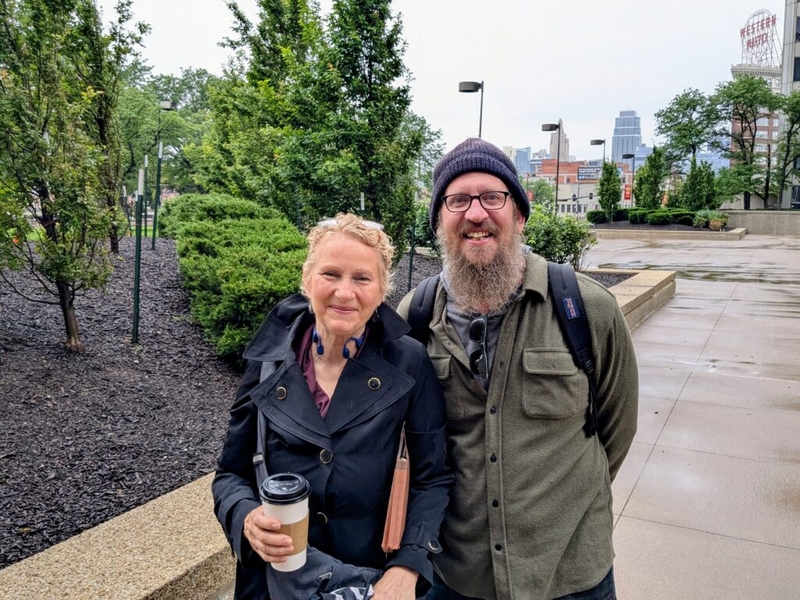
Immigration rights activists Angela Ferguson and Jimbo Gillcrist stand outside the Immigration Court in Kansas City, Missouri, a day after security personnel ordered the volunteers to stop distributing information about legal rights to immigrants arriving for court appointments. (Tim Carpenter/Kansas Reflector)
KANSAS CITY, Mo. — Activist Jimbo Gillcrist helped volunteers hand out flyers on basic legal rights to people headed into immigration court until security guards ordered the group to exit an office-building lobby for allegedly solicitating visitors.
“I’m not asking for anything. I’m not selling anything,” said Gillcrist, a former theology teacher inspired to work on immigrant rights issues. “They responded by saying, ‘Well, it’s private property.’ They told me if I didn’t leave right then, that they’d call the police. We were outside the building, and they came out there and told us to get completely off the property.”
Gillcrist asked immigration attorney Angela Ferguson to advocate for the ousted volunteers Wednesday as security staff moved to lock entrance doors and limit access to elevators used to reach immigration courtrooms in the building on Grand Boulevard. Initially, Ferguson wasn’t permitted to enter the public courtroom.
“If they can do this to me, and lock me out of my livelihood, what are they doing to people that they say have no rights?” Ferguson said.
Judge Jayme Salinardi, one of several immigration judges hearing cases in Kansas City, descended from the fifth floor to intervene in the standoff so observers could regain courtroom access.
Supporters of an immigrant rights organization had protested Tuesday in Washington Square Park across the street from the court. Three immigrants were detained last week by U.S. Immigration and Customs Enforcement after appearing for immigration court appointments in Kansas City, Ferguson said.
The intimidating tactic of ICE agents served to encourage immigrants to skip court hearings, she said.
“They cannot pursue their right to protection, their right to asylum or they can’t have a chance to get legal if they don’t show up for court,” she said. “We want people to come to court and pursue what rights they do have. This is just the wrong way to go about it.”
Expedited removal
On Thursday, Ferguson and Gillcrist returned to the immigration court building to resume sharing information on defendant rights. They did so outside the fifth-floor courtroom but with greater discretion by shrinking a green one-page document to a narrow strip of paper easily passed from person to person.
Inside the courtroom, a U.S. Department of Homeland Security attorney asked Judge Salinardi to dismiss a handful of cases pending against people who were present to fight their removal so the stage could be set for expedited deportation of those individuals.
Salinardi declined to accept oral motions from DHS attorney Ian Tomasic and ruled each had to be submitted in writing by government lawyers.
The judge cautioned targeted immigrants, who resided in Dodge City, Kansas, St. Joseph, Missouri, and Wichita, Kansas, they each had a maximum of 10 days to respond to a motion after it was filed. Failure of a defendant to answer in a timely way could be viewed as abandonment of the case and open the door to swift departure from the United States, he said.
“If you fail to appear at any immigration court hearing, you’ll be ordered deported in your absence,” the judge said.
Salinardi repeated general advice to immigrants appearing in his court: “I recommend you find an attorney immediately.” He urged immigrants to confirm authenticity of people portraying themselves as lawyers because con artists were a plague on the immigration system. “Every week, I have people who are taken advantage of and I don’t want that to happen,” the judge said.
‘Getting blindsided’
Immigration attorney Megan Galicia, who works for a private law firm and spent the morning observing the Kansas City immigration court proceedings, said Salinardi’s preference for written motions was useful to immigrants who continued to press asylum claims. If he had considered accepting the oral motions from Tomasic, she said, defendants representing themselves wouldn’t have been prepared to respond.
“He wants everything in writing, which is very consistent with the way he manages his dockets,” Galicia said. “I’m very pleased to see this because this puts people in the best possible position to be able to fight this. What we’ve heard across the country is that people are really just getting blindsided when they walk into court.”
Galicia said most individuals counseled by the judge to hire an attorney wouldn’t be able to secure legal representation. The Kansas City area, she said, had an insufficient supply of nonprofit legal organizations or attorneys willing to represent immigrant clients. In immigration cases, the federal government doesn’t provide public defenders.
On this day, the judge did offer a briefing on immigration court. His attentive audience sat on church-like pews in the small courtroom and had benefit of an interpreter’s Spanish translation of the judge’s remarks.
“You are before the court because you have violated immigration laws of the United States,” Salinardi said. “In your case, the court will set deadlines. If you miss those deadlines, you’ll lose the chance to file applications or evidence.”

Topeka, KS