Arizona Senate Republican plan for 2026 focuses on affordability
Dec 16, 2025 | 7:58 pm ET
Description
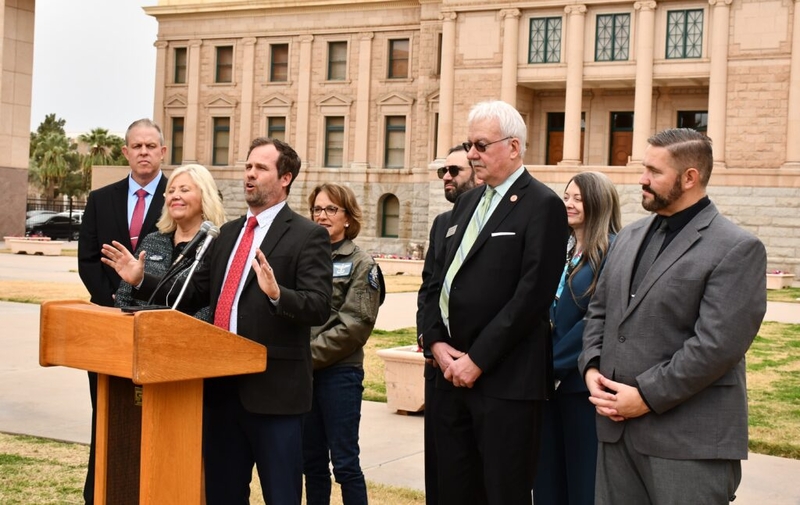
Arizona Senate President Warren Petersen, flanked by other Senate Republicans and officials, speaks to the media at the Capitol on Feb. 13, 2025 in Phoenix. Photo by Caitlin Sievers | Arizona Mirror
Arizona’s Senate Republican leaders say in the coming year they’ll be focused on lowering costs, making communities safer and keeping the state’s economy competitive.
In a lengthy list of priorities for the state legislative session that begins Jan. 12, Senate Republicans heaped praise on President Donald Trump and heavily criticized Arizona’s Democratic Gov. Katie Hobbs, who is running for reelection in 2026.
“Arizonans want affordable living, safe neighborhoods, and a government that strengthens – not weakens – our economy,” Senate President Warren Petersen, R-Gilbert, said in a statement. “While the Governor’s vetoes stall progress, Senate Republicans remain focused on protecting taxpayers, upholding Arizona’s freedoms, and preventing the radical left from turning our state into California.”
In a Monday press statement issued alongside their plan for 2026, Senate Republicans claimed that more Arizonans are moving out of the state than into it, a change that they blamed on policies put in place by Hobbs, who took the governor’s seat in 2023. But the so-called study that they referenced was conducted by the moving company Atlas Van Lines and included only the people who hired the company to help them move.
In its press release about the study and on its website, the Evansville, Indiana-based moving company provided only percentages for their customers’ moves in and out of the state, with no data showing the totals of people the company moved in or out of Arizona over the past year. There was no contact information included in the press release for questions about the report and the only number listed on the Atlas website exclusively directs callers to sales people.
The most recent report from the Arizona Office of Economic Opportunity conflicts with the moving company’s claims, and was published alongside a detailed breakdown of its methodology.
“Arizona is thriving under Governor Hobbs’ leadership, with about 97,000 new residents added in the past year, a 1.2 percent growth rate, and Maricopa County ranking No.1 in the United States for net migration,” Liliana Soto, spokesperson for Hobbs, told the Arizona Mirror. “Arizona’s economy is strong, with nine consecutive months of labor force growth and a 4.2 percent unemployment rate, which is below the national average. This shows not just population growth but also robust job creation.”
Senate Republicans said that people are fleeing the Grand Canyon State because of Hobbs’ vetoes of their legislation and because of high housing prices that they blamed on the governor, a claim the governor’s office rejected.
“While the Senate majority Caucus makes baseless claims and roots against Arizona’s success, the facts speak for themselves,” Soto said. “We are a top state for private sector job growth, making real progress on affordable housing, water security, and creating opportunities for all Arizonans, regardless of their zip code. The governor is focused on results, not rhetoric. We urge the Caucus to channel this same energy into passing her Middle Class Tax Cuts Package if they truly care about providing relief to families struggling with rising costs and the increasing cost of living.”
Senate Minority Leader Priya Sundareshan told the Mirror that Republicans were “cherry-picking” data to match their hypothesis, and that if they worked with Democrats to better fund public education, to stop corporations from buying up housing stock and protect the state’s water future, they could make Arizona a more attractive place to call home.
Sundareshan told the Mirror that Democrats also plan to focus in the upcoming legislative session on making life more affordable for Arizonans and will release their own plan for 2026 in the next few weeks.
“I’m very glad to see that one of their (the Republican caucus) priorities is affordability issues because that’s absolutely what the Democratic caucuses will be focused on,” she said. “And so to the extent that we can find some common ground and achieve some cost of living savings. I’d love to see that.”
Sundareshan acknowledged the Republican caucus’s assertion that inflation was on the rise during Joe Biden’s presidency but disagreed that Trump is “working to bring down prices.”
“Unfortunately, President Trump’s policies have done nothing to reduce inflation and have only served to worsen it because the tariffs that Trump has imposed are, in fact, taxes on everyday products that that Arizonans rely on,” she said. “So I don’t see where President Trump or Republican policies to date are doing anything to reduce inflation.”
Federal Reserve Chair Jerome Powell said earlier this month that reports of higher-than-expected inflation are mostly due to Trump’s tariffs. Inflation across the country increased 1.7% from January to September, according to the U.S. Bureau of Labor Statistics.
The Senate Republicans’ affordability plan for the coming year includes tax cuts “based on the
strongest parts of the ‘One Big Beautiful Bill’” passed by Trump and Congressional Republicans. Included in that bill, which was passed in early July, was the cessation of the Affordable Care Act expanded tax credits, a move that is extremely unpopular and is expected to cause skyrocketing health insurance costs that may force many to go without.
Republicans did not address the ACA insurance costs but said their plan would make life generally more affordable through tax cuts.
“We’ll pair these reforms with disciplined budgeting and a commitment to shrinking government, so Arizona families can finally start regaining the financial breathing room they’ve lost,” Senate Republicans said in their plan.
The Republican caucus also plans to get rid of regulations they say slow down the building process, to increase the state’s housing supply and put home ownership in reach for more young adults and working families.
“We’re committed to increasing supply responsibly, aligning water and housing policy with actual data, and ensuring local governments aren’t blocking the construction of attainable homes,” the Republican Caucus said. “Arizona families deserve a fair shot at homeownership — not a market stacked against them.”
Arizona’s water policy dates back to 1980, and requires certain industries and areas of the state — including home construction in the Valley — to prove they have a 100-year supply of good quality water before they can begin subdividing land for new building.
In 2023 home builders were outraged when Hobbs put a moratorium on residential developments that relied only on groundwater in parts of Queen Creek, Goodyear and Buckeye, even as the state faced a severe housing shortage. The moratorium was prompted by an updated hydrological model for the Phoenix metro area which projected a 4% shortfall in its 100-year water supply.
“Arizonans can’t afford policies that stall development, inflate housing prices, or jeopardize our water security,” Senate President Pro Tempore T.J. Shope said in the statement. “While the Governor creates uncertainty and bottlenecks, Senate Republicans are advancing practical, data-driven solutions that support responsible growth and keep Arizona livable for the next generation.”
Sundareshan told the Mirror that discourse about the moratorium was often misleading, since developments in the heart of Phoenix and other areas of the Valley could still move forward, as could any project served by a water provider that has its own 100-year-water-supply certificate.
The Arizona Department of Water Resources uses complex hydrological modeling that takes into account current and projected future usage, as well as water recharge, to help determine whether a proposed development is eligible for a certificate of assured water supply.
Hobbs, along with Democrats and Republicans in the Legislature, have said water was a top priority for the past two years, and the need for new regulation is even more urgent this year as Arizona fights with other states for its share of Colorado River water. The Colorado River supplies about 35% of Arizona’s water.
For the most part progress on water legislation stalled over the past few years when Republicans and Democrats couldn’t agree on what it should look like, with Republicans looking for fewer restrictions and Democrats saying more were necessary. But a bipartisan group of legislators and Hobbs earlier this year finally passed an “ag-to-urban” law that will allow farmers in increasingly urban areas to retire their land and its grandfathered irrigation rights to be used for development that wouldn’t have to meet the traditional 100-year supply rules.
Proponents of the law said that any residential development would use significantly less water than irrigated farm land.
Other top priorities for the Senate Republicans in 2026 include:
- Major reforms to the state’s justice system in response to a spike in inmate homicides;
- Assisting the federal government in its immigration crackdown by “supporting our sheriffs, bolstering state enforcement efforts, and ensuring Arizona remains a strong partner in maintaining border security”;
- Supporting the state’s $1 billion school voucher program, along with “safeguards that keep inappropriate content out of schools” and banning trans students from bathrooms and locker rooms that align with their gender identities;
- Extending Proposition 123, which provides about $300 million a year to public schools through the state’s land trust;
- An election-reform resolution they plan to send to voters to bypass a veto from Hobbs that would make voting by mail more difficult in the name of election integrity;
- Regulating artificial intelligence by “advancing safeguards that prevent deepfake abuse, protect children online, and ensure state agencies use AI responsibly and transparently”;
- Reforms to the the family court system, including more accountability for judges;
- Increased oversight for the Arizona Health Care Cost Containment System (the state’s Medicaid system), also known as AHCCCS, and the Arizona Department of Health Services, which Senate Republicans said “have been plagued by fraud, waste, and catastrophic oversight breakdowns — from contractors exploiting Medicaid dollars to DCS failures that left children in danger and allowed politically connected insiders to benefit from “pay-to-play” schemes.
Phoenix, AZ