Arizona GOP moves to defund teachers union after it targeted school voucher program
Mar 12, 2026 | 10:30 am ET
Description
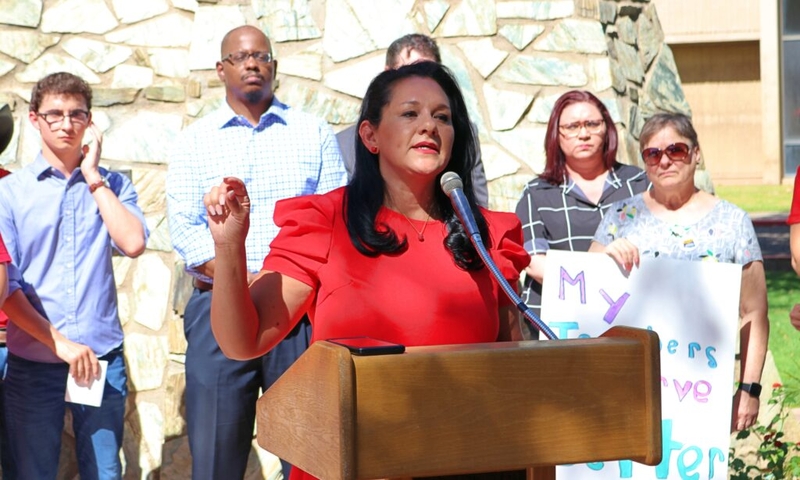
Marisol Garcia, the president of the Arizona Education Association, speaks at a June 15, 2022, press conference opposing an expansion of the state's school voucher program. (Photo by Jim Small/Arizona Mirror)
The Arizona Education Association is the state’s largest teachers union, and it frequently advocates for or against legislation and political candidates on behalf of its more than 22,000 members. Republican lawmakers want to make it harder for the union to exist.
Last month, GOP legislators gutted a bill about minimum wage to create a proposal that would place strict limits on how teachers can organize. And because it’s ensconced in a ballot referral that poses the question to voters, it can’t be stopped by Gov. Katie Hobbs, who has consistently rejected legislation that educator groups oppose.
House Concurrent Resolution 2040 would bar union members from using public resources at schools to meet with or recruit new members. Teachers would be forbidden from using school emails, printing flyers in school libraries or gathering in their classrooms during school hours to advance union goals. And it would also make it more difficult for the union to keep itself afloat financially by prohibiting school districts from deducting membership fees from employee paychecks — even though that is done at the employee’s request.
Republicans have long butted heads with the AEA over public school funding and the content of lessons. While the legislation doesn’t directly mention the group and Republican lawmakers have been careful not to name it during debates, it’s clear that the teachers union and its dozens of local chapters are the focus.
Marisol Garcia, the organization’s president, said she sees the ballot referral as a bid to tell educators to “shut up and teach.”
“This is a partisan political attack against people who are trying to do right by their workplace and the students,” she said.
Support for the referral has split along party lines, with only Republicans backing it and defending it as a necessary protection against the unfair consumption of public resources.
“This is to ensure that no public resources are used for these private organizations,” Rep. Justin Olson said during a floor debate of the legislation on Feb. 25 in the Arizona House of Representatives.
Olson, a Republican from Mesa who sponsored the underlying bill, called accusations from Democrats that it would inhibit the ability of teachers to organize “patently false.”
“This allows freedom of speech, this allows freedom of assembly. What this doesn’t do is it doesn’t subsidize it,” he said. “The state should not be subsidizing these private entities.”
Democrats, however, say the proposal is obvious retaliation for the union’s decision to throw its political weight behind a ballot campaign to curtail Arizona’s private school voucher program, which is a sacred cow for Republicans.
The anti-union ballot referral was unveiled less than two weeks after the AEA announced its plan to send a ballot initiative to voters that could overhaul the state’s universal private school voucher program. The program is the centerpiece of the Republican Party’s education agenda, and Republican lawmakers have adamantly resisted regulating or shrinking it, even as it has ballooned to an annual cost of over $1 billion and Arizona Department of Education records show misspending in nearly 20% of purchases.
During a Wednesday afternoon news conference denouncing the legislation, teachers emphasized the impact organizing has had on their working conditions and the quality of the education students receive.
Rachael Eggebeen, the vice president of the Sunnyside Education Association in Tucson and an 8th grade social studies teacher, said that unions help teachers make gains in salary negotiations and set curriculum standards that benefit teachers, students and school districts alike. The union is best suited to collect data on what curriculum works because it is in constant discussion with members, she said, and that leads to better academic outcomes for students.
Eggebeen added that the Sunnyside chapter recently won a $3,000 raise for the teachers in its district starting next year, which will help shield the district from the state’s persistent teacher retention crisis.
“In a year where 14% of teachers left the profession in this state, and the No. 1 reason given was salary, our union is fighting to keep our teachers by paying them a living wage,” she said.
A September 2025 report from the Arizona Department of Education found that more than 1,000 teachers left the profession that school year, with more than 700 leaving before classes began. And in a 2024 survey of teachers who left after the 2023-2024 school year, 55% of respondents said it was because their salary was too low.
Garcia criticized Republican lawmakers for using “dirty tricks” to restrain the ability of teachers to organize to improve their working conditions and advocate for themselves against culture war legislation. She denounced the legislation as part of a nationwide trend to suppress teacher unions and a blatant attempt to punish the Arizona organization for its opposition to private school vouchers.
“This is a national agenda to make sure that public educators are quiet and don’t fight back and want to hold accountable taxpayer money,” she said.
Even as general union power has greatly diminished over the last several decades, teachers unions are among the most politically powerful across the nation, and they regularly oppose Republicans and their policy priorities. Because of that, the effort to weaken teachers unions by limiting how they pay their membership fees has been a yearslong conservative goal.
In 2018, the U.S. Supreme Court ruled that teachers don’t have to pay union dues if they’re not members, dramatically narrowing the revenue pool for unions. A slate of legislation to make it even harder for unions to collect membership fees followed. In 2023, Kentucky Republicans passed a law that barred some public sector employers, including school districts, from deducting union dues in payroll. The Kentucky Education Association reported that 90% of its membership base was unable to pay their dues and had to find alternative methods. The law was later struck down by a judge who agreed with the group that it unfairly targeted some organizations and exempted others that are typically supported by Republicans, like police and firefighter unions.
Garcia highlighted the paycheck prohibition in the Arizona version as the most concerning provision for her organization. She pointed out that much of the rest of it is unnecessary because most teachers already avoid engaging in union activities during school hours. Many school districts, Garcia added, also have rules in place that prohibit the use of school emails to disseminate union information.
The real problem, she said, is the hostile dialogue that the referral will inspire if it’s sent to the ballot, as voters scrutinize the behavior of their local teachers and Republican lawmakers advocate for its passage.
“It’s a bigger concern of ours that the majority party down here is so interested in this and is going to run an active campaign to speak negatively about educators,” Garcia said. “You’re going to see social media ads talking terribly about your kid’s educators.”
Garcia expects to launch a voter education campaign to defeat the referral if it ends up on the November ballot. And so far, Republican lawmakers appear determined to ensure it does. It was approved by the state House of Representatives last week and is headed next to the state Senate, where it only needs to win the support of the GOP majority to be put before voters in the fall. Garcia said the few Republican state Senators she’s spoken with expressed a willingness to move the legislation forward, despite personal reservations.
“I’ve met with a couple Republican senators who are just like, ‘Yeah, I don’t know why we’re doing this, I don’t know why it’s here, but our party doesn’t like unions, so I’ll probably vote yes,’” she said.
Phoenix, AZ