Appeals court upholds Arkansas’ ban on transgender minors’ health care after SCOTUS ruling
Aug 12, 2025 | 7:06 pm ET
Description
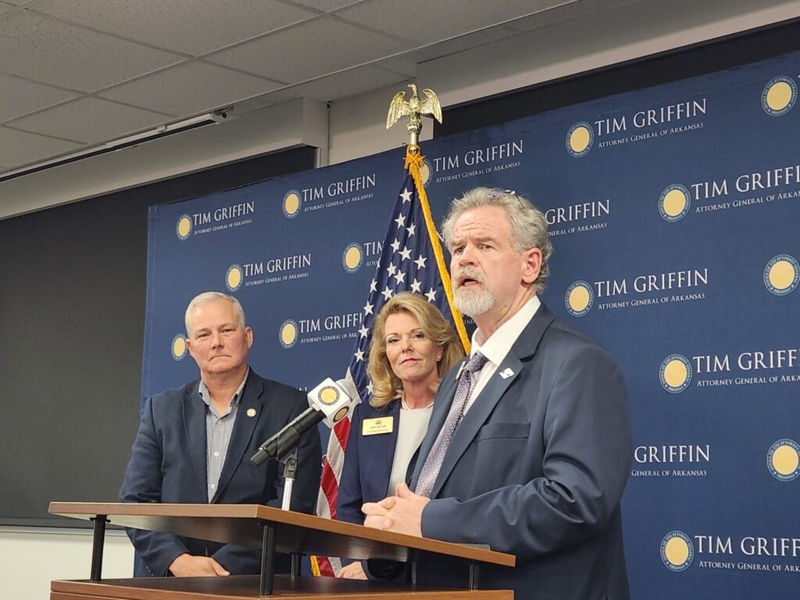
From left: Arkansas Attorney General Tim Griffin, Elm Springs Republican Rep. Robin Lundstrum and Lonsdale Republican Sen. Alan Clark spoke at a press conference on Tuesday, August 12, 2025, praising a federal appeals court's decision to uphold Arkansas' ban on gender-affirming health care for transgender minors. Lundstrum and Clark were the lead sponsors of the 2021 law that was blocked in court before it could go into effect. (Tess Vrbin/Arkansas Advocate)
A federal appeals court lifted the injunction on Arkansas’ law banning transgender minors’ health care, clearing the way Tuesday for it to be enforced after four years.
The 8-2 ruling from the 8th U.S. Circuit Court of Appeals came after Arkansas Attorney General Tim Griffin’s office asked the court last month to take into account the U.S. Supreme Court’s June decision to uphold Tennessee’s similar law. Federal judges previously enjoined both the Tennessee and Arkansas laws.
The Save Adolescents From Experimentation (SAFE) Act, or Act 626 of 2021, banned puberty blockers, hormones and gender-affirming surgeries for Arkansas children with gender dysphoria. Four families of transgender minors challenged the law, and U.S. District Judge James Moody blocked it in July 2021 before it could go into effect.
Several months after an eight-day trial over the law, Moody ruled it was unconstitutional on First and Fourteenth Amendment grounds in June 2023.
The American Civil Liberties Union of Arkansas represented the plaintiffs in the case. Executive Director Holly Dickson called Tuesday’s ruling “tragically unjust” and the SAFE Act “a dangerous law that harms children” in a news release.
“As we and our clients consider our next steps, we want transgender Arkansans to know they are far from alone and we remain as determined as ever to secure their right to safety, dignity, and equal access to the health care they need,” Dickson said.
Federal judge strikes down Arkansas ban on gender-affirming health care for transgender youth
Griffin lauded the ruling in his own news release.
“I applaud the court’s decision recognizing that Arkansas has a compelling interest in protecting the physical and psychological health of children and am pleased that children in Arkansas will be protected from risky, experimental procedures with lifelong consequences,” Griffin said.
The court’s opinion
After the state appealed Moody’s ruling, the U.S. 8th Circuit Court of Appeals heard oral arguments in the case last year in St. Louis.
In June, the appeals court asked both sides for supplemental briefs in light of the U.S. Supreme Court’s ruling on the Tennessee law. The plaintiffs’ brief asked the appeals court to send the case back to the U.S. District Court for the Eastern District of Arkansas, and Tuesday’s ruling granted this request.
Both sides asked the court for rational-basis review, which means analyzing whether a law is rationally related to a legitimate governmental interest. The standard is less rigid than strict scrutiny, which analyzes whether a law is narrowly tailored to a governmental interest.
The SAFE Act “prohibits medical care on the basis of sex,” in violation of the Equal Protection Clause of the Fourteenth Amendment to the U.S. Constitution, Moody wrote in his 80-page ruling. He also wrote that the rational basis test “does not apply when a classification is based upon sex.”
The appeals court disagreed, stating in its 35-page opinion that the SAFE Act “classifies based on age and medical procedure, not sex” and “regulates a class of procedures, not people.”
Moody also ruled that the SAFE Act violated the Fourteenth Amendment’s right to due process because the state did not provide sufficient evidence to support its claim that gender-affirming medical care is unsafe for minors.
The parent plaintiffs asserted that the law infringed upon their right to make informed decisions about their children’s medical care, but “parents do not have unlimited authority to make medical decisions for their children,” the appeals court stated.
The court also disputed Moody’s claim that the SAFE Act violated the First Amendment right to freedom of speech by prohibiting physicians from referring patients to other health care professionals for gender-affirming care. Moody called this an unconstitutional “content and viewpoint-based regulation.”
U.S. Supreme Court precedent allows states to regulate professional conduct that “incidentally” includes speech, and the law’s use of the word “refer” should be applied narrowly to a formal medical referral rather than the broad interpretation of “merely informing patients about the availability of procedures,” according to the appeals court’s opinion.
Responses
The appeals court has yet to issue a mandate for the state to enforce the SAFE Act, but Griffin said at a Tuesday press conference that he expects the order within the next couple of weeks.
State Rep. Robin Lundstrum and Sen. Alan Clark, the primary sponsors of the SAFE Act, joined Griffin at the press conference. Lundstrum, an Elm Springs Republican, thanked the conservative Family Council for its support of the SAFE Act, and the organization called Tuesday’s ruling “amazing news” in a news release stating that it expects the law to be enforced.
Lundstrum praised her fellow lawmakers for supporting the law, which had 64 cosponsors in the 135-member Legislature, and for voting to override then-Gov. Asa Hutchinson’s veto.
“They put their political futures at risk by saying children are more important than politics,” Lundstrum said.
Arkansas was the first state in the U.S. to ban gender-affirming health care for transgender minors, and 26 more states followed suit, including Tennessee. Officials in both states have claimed transgender health care for minors is rooted in activism and experimentation rather than evidence-based science. Lundstrum and Clark, a Lonsdale Republican, repeated these sentiments Tuesday.
Clark cited his experience as a former youth pastor as a reason not to “affirm” gender dysphoria “instead of doing the real psychological work” to determine the root of a child’s dysphoria.
“Teenagers believe one thing one day and one thing the next day,” Clark said.
Transgender teen shares experience with gender-affirming care in trial against Arkansas law
Lundstrum said she introduced the 2021 legislation after hearing from “grandparents concerned about their grandchildren” and has been asked consistently in the past four years when the law will go into effect.
“The adults are walking back in the room on this issue and saying… ‘We don’t chemically or surgically castrate a child,’” she said.
Two physicians who have treated transgender minors at Arkansas Children’s Hospital are among the plaintiffs challenging the SAFE Act. They testified at trial in 2022 that they do not perform breast or genital surgeries on transgender minors or refer them for such procedures elsewhere.
Arkansas Children’s did not respond to a request for comment about the ruling Tuesday.
One parent of each of the four minor plaintiffs shared their experiences with their children’s gender transitions at the trial. Three of the four minors have since turned 18. The fourth, Brooke Dennis, is 13 years old. The Dennis family has moved from Bentonville to another state in which Brooke’s health care is not in jeopardy, according to court documents.
In 2023, the Legislature passed the Protecting Minors from Medical Malpractice Act, which created a 15-year window for malpractice lawsuits against doctors who provide transgender minors with any of the same treatments the SAFE Act sought to ban. A 2025 law added mental health care professionals to the list of providers that can be sued under the 2023 law.
An effort to create civil liability for Arkansas adults who assist transgender minors’ transitions failed to advance in the Legislature after lawmakers, Griffin’s office and members of the public expressed free speech concerns in March.
Little Rock