Appalachian Ohio and its people don’t exist to be exploited by politicians and industry. Stop.
Sep 29, 2026 | 3:35 am ET

Description
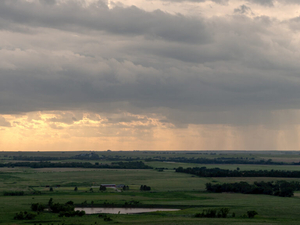
Sunrise over the Appalachian Mountains. (Stock photo from Getty Images.)
More and more people are expressing their discontent with hyperscale data centers. A recent Gallup poll showed 70% are against hosting a large data center in their community. Concerns include: utility costs, water usage, environmental and health effects, and the use of these centers for AI surveillance.
The data centers of the early 2000s functioned like an interactive library/storage facility and were about 0.2 MW in size. Today’s hyperscale data centers cover 500+ acres of land, use more than 100MW of energy, and require billions of gallons of water each year.
A proposed data center in Pike County (the PORTS Technology Campus) will cover 3,700 acres and will be the largest in the world at 8 GW: equivalent to the power used by all homes in Ohio.
Some politicians like Govs. Greg Abbott (Texas) and Josh Shapiro (Pennsylvania) have pulled back on their support for data centers, while Ohio Republican U.S. Sen. Bernie Moreno warns there is backlash against data centers.
However, Trump and many of Ohio’s politicians, including the current Republican governor candidate Vivek Ramaswamy and state Reps. Kevin Ritter and Justin Pizzulli, have favored building data centers across our communities.
In order to avoid pushback from farmers in Ohio who object to using prime farmland for massive data centers, some politicians like Reps. Ritter and Pizzulli are suggesting that brownfields (areas with significant contamination issues) be used for data centers. Brownfields can be abandoned mines and shuttered industrial sites, and many are located in the Appalachian regions of the state.
Rural communities near brownfields have been exploited in the past; why allow data centers to once again extract their water and energy and use their land?
Additionally, brownfield sites like the retired R.E. Burger coal-fired power plant in Belmont County must secure funding for clean-up efforts.
JobsOhio spent 70 million to clean up the R.E. Burger site and demolish the plant to pave the way for a plastics-making ethane cracker. The cracker was never built.
For decades the Ohio Valley has experienced pollution and health effects from industries, power plants, and steel mills that occupy both sides of the Ohio River.
Until the fracking boom, coal was the energy source for those industries. Coal combustion emissions include: carbon dioxide, sulfur dioxide, nitrogen oxides, particulate matter, and toxic heavy metals like mercury.
In 1976, I worked as a college intern on the prominent Harvard School of Public Health Six Cities Study. The study focused on pollutant particles less than 2.5 microns in diameter because these travel deep into the lungs.
Steubenville, Ohio was chosen as a city for the study because of the high levels of air pollution. One of the main conclusions of the study was that “Exposure to air pollution contributes to excess mortality.”
The results were so substantial that they led to a revision of air quality standards by the EPA. The combustion of methane (fracked gas) also releases many air pollutants, and is the energy choice of most data centers in Ohio.
The emissions from a gas turbine include: 2.5 micron particulate matter, carbon monoxide, carbon dioxide, nitrogen oxides, and formaldehyde.
A recent study, “Air Quality, Health, and Economic Impacts of the Proposed MZX Tech Facility,” discovered that emissions from the proposed methane gas turbines (1.2-GW MZX Tech) for xAI’s Colossus 2 data center would result in increased risks of heart disease, stroke, respiratory illness, asthma exacerbation, and premature death for local citizens.
Several environmental groups, including Earthjustice, filed a lawsuit against the U.S. Environmental Protection Agency for fast-tracking the approval of two data center chemicals classified as PFAS compounds.
PFAS chemicals are toxic “forever compounds” that do not break down in nature.
The EPA acknowledged that “both chemicals pose potentially severe risks to public health”, but the EPA “does not know the level at which the chemicals are acutely lethal or cause other serious health damage.”
The EPA granted approval for immediate use anyway.
Additionally, PFAS compounds are used in immersion cooling systems for data centers, and while this cooling technique does reduce water usage, it significantly increases exposures to; toxic hydrofluoric gas, endocrine disrupting compounds, and reproductive toxins.
These chemicals not only affect workers who are involved in manufacturing the components, but also the data center workers and local communities living near data centers.
Reps. Ritter and Pizzulli failed to mention anything about the health and safety issues associated with data centers.
The huge PORTS data center will be located at the site of the radioactively contaminated Portsmouth Gaseous Diffusion Plant.
This facility enriched uranium in Pike County from 1954 to 2001.
Will the PORTS data center bring more illness to a region already suffering from legacy pollutants?
Data centers will not make our communities a “benefit zone,” but rather a sacrificial zone, and communities will not be “measurably better off.”
Data centers also pose potential risks in the form of fires and exposures to toxic compounds.
Local firefighters and emergency personnel, many of whom are volunteers, are often excluded in the preparation of Emergency Response Plans for these mega facilities. “Contributing causes of such fires include electrical faults, battery failures, cooling system malfunctions, and human error.”
Recently, Moreno touted the Trump Administration’s $45 million dollar grant directed at breathing life into the coal-fired Cardinal plant which sits along the Ohio River; close to where I grew up.
Once again, propping up a dirty fossil fuel project to increase power availability is disingenuous given Ohio’s politicians killed 5.3 GW of wind and solar projects in the past dozen years.
Additionally, Moreno’s claim that data centers do not drive-up utility costs for consumers has been proven false by peer-reviewed studies.
Trump’s Executive Order 14318 was a gift to data center CEOs; allowing “qualifying projects” to by-pass the National Environmental Policy Act, modify the US Environmental Protection Agency (EPA) regulations and environmental protection statutes, and find ways to work around the Endangered Species Act.
Finally, the elephant in the room is the ridiculous amounts of carbon dioxide generated from using fracked gas for data centers’ electrical production.
Whether centers tie into the PJM grid, which is heavily invested in fossil fuels, or use behind-the-meter methane fuel cells or gas-turbines, they will be using an energy source that has multiple health and environmental issues associated with it.
The PORTS center could emit 53.4 million tons of greenhouse gases annually at full capacity.
Appalachian communities are tired of false promises of jobs and money from outsiders and corporate PR representatives.
President Trump might think we are “backwards and poor” but we realize data centers are just another extractive industry that will pollute our land, water and air, take our resources, and leave us with the health effects.
Columbus, OH