North Dakota Supreme Court hears arguments over oil royalty deductions
Oct 02, 2026 | 5:15 pm ET
Description
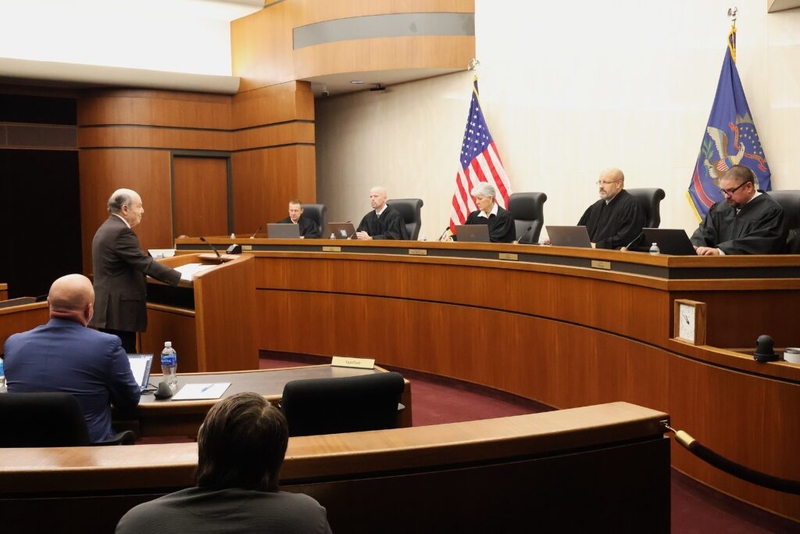
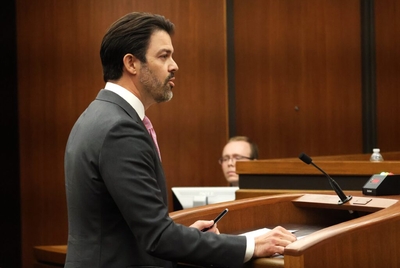
Plaintiff attorney Bruce Bowman makes oral arguments to the North Dakota Supreme Court on Oct. 2, 2026. (Photo by Michael Achterling/North Dakota Monitor)
The North Dakota Supreme Court is poised to make a key decision in a case where one of the state’s largest oil companies is accused of withholding excessive amounts of money from the royalty checks it pays to mineral owners.
The mineral owners, led by Diana Skarphol, are appealing a district court’s decision to dismiss the case against Hess, the oil company that pays them royalties, before a jury trial could take place. They allege the oil company is withholding unreasonably large sums of money from the royalties paid on oil and gas production in North Dakota.
The Supreme Court’s ruling will decide whether the case moves forward or not.
North Dakota mineral owners say oil companies unfairly keep millions from checks without oversight
Justices expressed skepticism of the legal arguments made by the mineral owners’ lawyers, led by Texas attorney Bruce Bowman, during Friday’s oral arguments. Bowman argued Hess has the responsibility to prove they are in compliance with North Dakota law and failed to do so. But Justice Jon Jensen said putting that obligation on the defendant would overturn existing contract law.
“Why are we switching the obligation?” Jensen asked. “It’s your client’s burden to demonstrate that.”
North Dakota law often allows oil companies to pass on a share of their expenses to royalty owners by deducting postproduction costs like transportation and processing from the monthly royalty payments.
The mineral owners in this case allege the deductions taken by Hess are much higher than those imposed by other companies and are therefore commercially unreasonable.
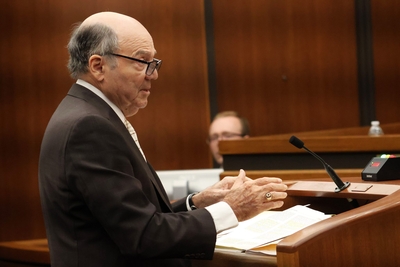
In court documents, Bowman has argued royalty statements going back to 2014 showed deductions from royalty checks surged from under 2% to over 30% and that Hess uses subsidiaries and affiliated companies to artificially increase the costs royalty owners pay. He noted they have reports from experts stating the deductions are excessive.
Bowman argued they have presented sufficient evidence to show Hess’ deductions are excessive under North Dakota law and that a jury should have an opportunity to determine the amount of damages his clients are owed by the company.
“The jury is going to be the expert in this case,” Bowman said.
Ragan Naresh, a Washington, D.C., attorney representing Hess, said evidence has not been presented in this case to show that Hess is passing on significantly higher costs than other oil companies. He argued the mineral owners have failed to show Hess’ deductions are excessive.
“The evidence of damages is completely missing,” Naresh said.
The court took the case under advisement.
The North Dakota Monitor and ProPublica published a joint investigation in 2025 showing some oil companies frequently deduct more than 20% of a royalty check for postproduction costs. More than a dozen mineral owners shared royalty statements that showed postproduction costs would subtract more than half of a royalty check in some months.
The North Dakota Petroleum Council said at the time it would be impossible to calculate an average of how much was being deducted but suggested it couldn’t be more than 7% to 10% based on the cost of transporting oil to markets out of state.
There is no official accounting of how much money is deducted by companies.
Postproduction deductions potentially affect as many as 300,000 people, the industry’s estimate for the number of people who own oil and gas mineral rights in North Dakota.
Not all states take North Dakota’s approach to what postproduction costs can be shared among royalty owners and the oil companies. Courts in states like Colorado, Oklahoma and Kansas require a company to make the commodities “marketable” and limit what costs can be shared with royalty owners. West Virginia doesn’t allow deductions unless a lease explicitly allows a company to take them.
Lawmakers in Wyoming, Nevada, Michigan and West Virginia have taken action to limit postproduction deductions in various forms.
North Dakota lawmakers have rejected legislative proposals to address royalty owners’ concerns. Legislators have argued that these disputes should be settled in the courts.
North Dakota Monitor reporter Jacob Orledge can be reached at [email protected].
Bismarck, ND