At Anniston town hall, Doug Jones fields variety of questions from 300 attendees
Sep 09, 2026 | 5:59 am ET
Description
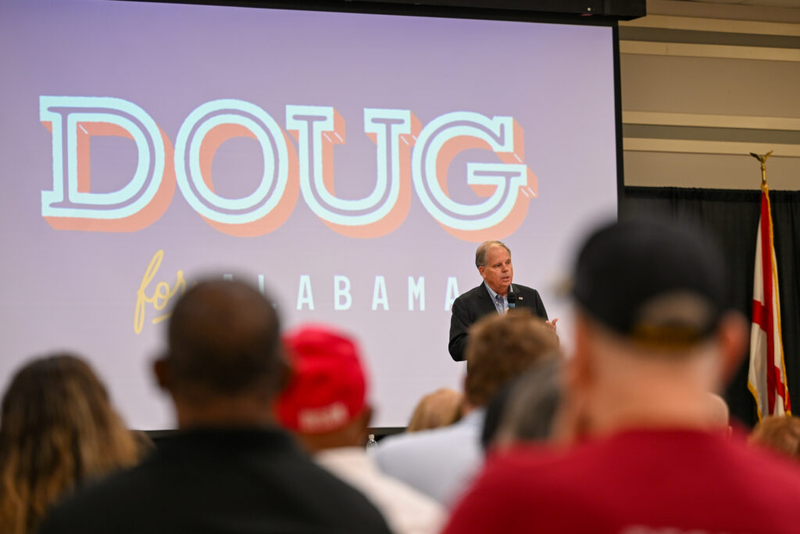
Democratic gubernatorial nominee Doug Jones speaks at a town hall focused on veterans' issues in Anniston, Alabama, on Sept. 9, 2026. Jones answered a host of questions Tuesday evening after a short Q and A with former Alabama Department of Veterans Affairs Commissioner Kent Davis. (Anna Barrett/Alabama Reflector)
ANNISTON — It was billed as a veterans’ town hall, but Democratic gubernatorial nominee ended up fielding a host of other questions from more than 300 people at the event Tuesday evening.
The town hall was the latest for Jones, who has traveled around the state holding similar events, and topics included education, data centers, transgender athletes, women’s health and the mental health of veterans, which Jones discussed after a Q and A session with former commissioner of the Alabama Department of Veterans Affairs Kent Davis – who sued Gov. Kay Ivey after she removed him from the board in 2024.
“We clearly need to do more when it comes to mental health. We are losing way, way, way too many veterans to addictions, to suicide and other mental health issues,” Davis said. “We’re not taken care of.”
Davis said that the biggest issue facing veterans are the “invisible wounds” of war. According to the U.S. Department of Veterans Affairs, veterans die by suicide at a higher rate than those who have not served in the military, both in Alabama and nationwide.
Following Davis’ firing, the legislature reorganized the Alabama Department of Veterans Affairs and made the commissioner a member of the governor’s cabinet. Jones said the move politicized the department and promised to repeal it.
Davis said politicizing the department was not a good move for the more than 300,000 veterans in Alabama.
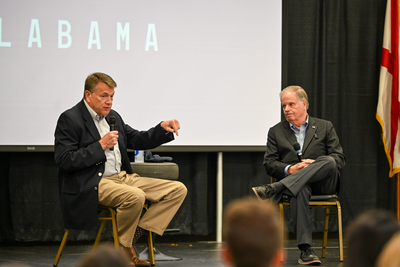
“I get nervous when Veterans Affairs is politicized. I worry in my gut, is that person going to be able to be an objective advocate for veterans?” Davis asked. “Someone who’s every day going to be willing to fight for veterans and what they need and address the tough topics, especially mental health.”
Neither Jones nor Republican nominee Tommy Tuberville are veterans. Jones said that his father, who served in the Navy after World War II, taught him to “talk the talk” and “walk the walk.” He accused Tuberville of just talking.
Tuberville promised to donate his $174,000 U.S. Senate salary to veterans during his 2020 campaign, but there is no record of such.
“Talk is cheap, but somebody has got to walk the walk,” Jones said.
Attendees did not limit their questions to veterans’ issues. Jayson Deese, a student at Jacksonville State University studying to be a teacher, asked Jones how he would improve the quality of public education and increase teacher pay in Alabama.
According to the National Education Association, teacher pay in Alabama starts around $48,000, 25th in the nation. Jones said that he would advocate for a lottery in Alabama and use the revenue to fund teacher and retiree raises first.
“How that money is used is going to be a different story, because Georgia did that, I think primarily for scholarship money,” Jones said. “I’m not sure that is the best use of Alabama’s taxpayer money right now. Not when our retired teachers haven’t had a (cost-of-living adjustment) raise in 20 years. Not when our teacher pay is still below where it should be.”
Another attendee was going to ask about a lottery, but instead noted how many Alabamians cross state lines to participate in neighboring states’ lotteries. Jones used the opportunity to reference ongoing challenges to Tuberville’s residency at the Alabama Supreme Court.
“There’s people streaming east to Georgia, north to Tennessee, west to Mississippi, and they’re probably even creating a traffic jam so Tommy Tuberville can’t get home from Florida,” Jones said. “We’ve just got to have the right champions in there to do it, and I think we’ll figure it out.”
Artificial intelligence data centers have emerged as a top issue for voters across the ideological spectrum. Residents and experts are concerned about transparency with public officials, and public health and environmental impacts the 24/7 facilities could have. One attendee asked Jones what his plan is.
Jones has consistently called for a one-year moratorium to put guardrails in place for the hyperscale facilities. Tuberville previously said that Alabamians’ concerns were “bull crap” and the state is “going to do data centers.” He shifted his position slightly by promising that data center developers and operators would pay for all infrastructure upgrades needed to operate.
He also promised to give communities more power and put the facilities in the state’s highest property tax bracket. Alabama’s Constitution significantly limits the powers of county governments, and giving them powers to reject or regulate data centers could require a constitutional amendment. The governor has no direct role in that process.
“If you read Tommy Tuberville’s plan for data centers, just know that it’s not something that he just came up with,” Jones said. “It’s basically the things that we’ve been saying for six months, and he has, on the other hand, said we’re going to do them regardless.”
Tuberville has challenged Jones to talk about “men in women’s sports” in public statements dating back to June. The U.S. Supreme Court in June ruled that states can ban transgender athletes from participating in women’s and girls’ sports teams. The president of the NCAA said in 2024 that there are fewer than 10 transgender athletes across all of its colleges.
Town hall attendee Brian Rich asked Jones point-blank.
“I’m opposed to that,” Jones said. “We’ve had a law on the books for a long time, which has support and has been upheld in the courts.”
Another attendee asked Jones how he would ensure that her daughters’ rights would be protected. Jones said his view on women’s reproductive rights has been shaped by his wife Louise and other women in his family.
“Expanding Medicaid will get women’s health issues. I think more than any other thing except for maybe mental health front and center, because there are so many places in this state that have lost rural hospitals and they have lost the ability to have labor and delivery services, and women have to go so far for labor and delivery,” he said.
Alabama’s infant mortality rate (7.1 deaths per 1,000 live births) is likely linked to a lack of access to adequate healthcare for expectant mothers.
The Alabama Legislature in 2024 quickly passed a law protecting in-vitro fertilization (IVF) from criminal or civil liability after the Alabama Supreme Court ruled that embryos are children. The legislature also expressed interest in creating a commission to further study the issue, but it was never formed.
“We talk about walking the walk,” Jones said. “If (the legislature says) they want to protect IVF, let’s have a constitutional amendment that protects IVF.”
Montgomery