Alaska gubernatorial candidates vow support for the seafood industry while revealing some splits
Sep 10, 2026 | 9:00 pm ET

Description
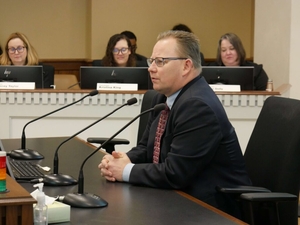
udience members are packed into the Gerald C. WIlson Auditorium at Kodiak High School on the evening of Sept. 9, 2026, to listen to the four remaining gubernatorial candidates discuss seafood-related issues. Every election year, the Kodiak Chamber of Commerce holds debates that are focused solely on fisheries. Kodiak is one of the nation's main seafood portss, and fishing is a mainstay of its economy. (Photo by Brian Venua)
At a fisheries forum held Wednesday night in Kodiak, all four candidates remaining in Alaska’s gubernatorial race found plenty of common ground.
Former state Rep. Jonathan Kreiss-Tomkins, a Democrat, and the three Republicans, former Anchorage Mayor Dave Bronson, former state Attorney General Treg Taylor and business owner and talk-show host Bernadette Wilson, described the seafood industry as a pillar of the state’s economy and fish as part of the state’s identity.
All four gubernatorial candidates, who are set to face off in the general election in Alaska’s ranked-choice voting system, said they consider bycatch — the accidental interception of nontargeted species — to be an urgent problem for salmon runs.
All said they want to appoint a special adviser on fisheries, something that past governors have done but that current Gov. Mike Dunleavy has not.
All said they wanted to appoint members of the North Pacific Fishery Management Council, the panel that oversees practices in federal waters, and the Alaska Board of Fisheries, which has jurisdiction over state waters, who would represent state interests broadly, including non-commercial interests.
All vowed a commitment to science, support for the state agency that markets Alaska’s seafood and investment in the infrastructure in coastal communities.
But there were differences that emerged at the event, sponsored by the Kodiak Chamber of Commerce. Those started with the candidates’ personal connections to and knowledge of seafood issues.
Kreiss-Tomkins, who is from the coastal town of Sitka in Southeast Alaska, which he called “a community that was built by fisheries,” provided evidence of the closest connection to fishing and the seafood industry. He spent summers during his college years working as a fishing crew member, and he is the only one of the four candidates who has personal experience fishing commercially and participating in the seafood industry, the Kodiak event revealed.
Wilson said she was connected to the fishing industry through her family. Her grandmother was born in the Bristol Bay community of Naknek, and her father operates a business “that is responsible for hauling all of the fish out of Valdez.”
Republicans Treg Taylor and Dave Bronson, who live in Alaska’s largest city, indicated in a lightning round held near the start of the forum that they had personally engaged in both sport and subsistence fishing; Wilson indicated sport fishing experience but not subsistence experience.
Taylor, who spent part of the debate talking about non-fishery issues like crime, confessed to a certain lack of knowledge about the subject. “This is admittedly an area that I’m not an expert in,” he said. He learned a lot preparing for the Kodiak forum and even “learned a ton during this debate listening to the responses from the other candidates up here,” he said.
Much of the event focused on trawling, the practice of using large nets in the midwater zones or bottom-water zones to scoop up large amounts of pollock and other groundfish. The pollock harvesters in particular have been accused of damaging the state’s salmon runs through bycatch, the accidental harvesting at sea of fish that would be otherwise returning to in-state spawning areas.
Pollock, which is caught mostly in federal waters, is the top-volume seafood harvest in the nation and accounted in 2023 and 2024 for 60% of the Alaska commercial seafood harvest volume, according to the most recent industry report by the McKinley Research Group, a consulting company. But pollock is a low-priced fish species, and the state’s pollock harvest accounted for only 29% of the value of the state’s total commercial seafood harvest, according to the McKinley Research Group. In contrast, salmon, caught mostly in state waters, accounted for only 13% of the volume but 31% of the total value of Alaska’s commercial seafood harvest in those years, according to the McKinley Research Group.
Bycatch a hot campaign topic
In different ways, candidates at the Kodiak event discussed what they consider to be the threats to salmon from bycatch in the trawl fisheries that target pollock and other groundfish species.
It is a hotly debated issue because it pits different sectors of the fishing industry against each other, including in Kodiak, a community dependent on both trawl harvests and salmon harvests.
Bronson defended his broad anti-trawling stance, which he admitted might not be popular among some people in Kodiak, including some audience members at the forum, which was held in the Kodiak High School’s auditorium.
Drastic reductions in trawling are needed to protect faltering runs of salmon, such as Interior Alaska river king salmon runs that have collapsed, he said.
“We’ve been trying to fix this by pushing all these little buttons. We reduce limits on sport, on subsistence, and we’re doing all this, and it’s not working,” he said. “Where are the kings? Where are the king crab? They’re gone. It’s time to start pulling the big levers, the big ones, and it’s going to devastate some people.”
There are already established areas of federal waters where trawling is banned. None of the candidates named any specific federal areas where they believe new bans should be established.

Wilson also criticized the trawling practice, but she said there has to be a distinction between the large-scale industrial operators and the “mom and pop” small-scale operators.
To address bycatch, she called for some new efforts to bring together different parties. She called for the establishment of a task force and a symposium to “get everybody to the table, all the different user groups, all in one spot.”
She also called for incentives to spur industry’s use of better technology and practices to mitigate bycatch. “We need to talk about the gear that’s being used. We need to talk about observers that are on boats. We need to talk about how we can bring AI into that conversation,” she said.
NOAA already has a program that funds the development of bycatch reduction technology, and it was not clear if Wilson was referencing that.
NOAA’s national Bycatch Reduction Engineering Program, which distributes grants annually to companies and agencies working on innovative technology, has been in existence for two decades. Technology developed includes trawl nets with features that allow accidentally caught salmon to escape; a 2024 scientific study identified ways to improve the design to protect more salmon.
Taylor used some strong language to describe bycatch, though he did not offer specific suggestions for action.
“We have to end practices that destroy our habitat, and we’ve got to get a handle on bycatch issues throughout the state,” he said.
Kreiss-Tomkins expressed skepticism about Wilson’s symposium and task-force suggestions.
“I’m not so bullish on task forces. I’m more bullish on action,” he said. He pointed to improvements that have already started to ease the bycatch problem. He cited, as an example, his advocacy more than a decade ago of stricter numerical limits for Chinook salmon bycatch in the Gulf of Alaska fisheries, which were approved by the North Pacific FIshery Management Council. He also cited his advocacy for stricter limits on halibut bycatch, which the council approved through an “abundance-based management” system that went into effect at the start of 2024.
Among the responses to a question about the state ferry system and investments in coastal infrastructure, Kreiss-Tomkins provided the most specifics.
Along with bolstering the troubled ferry system and using the Alaska Department of Transportation and Public Facilities’ Municipal Harbor Grants Program to support communities, he had other suggestions. The Alaska Industrial Development and Export Authority should prioritize investment in coastal communities and the seafood industry, something it is not currently doing, he said. Additionally, “general obligation bonds can help build out the waterfronts and harbor infrastructure in Alaska,” he said.
On environmental science, some differences emerged.
Kreiss-Tomkins said the state can respond to the challenge of climate change by investing in research, particularly at the University of Alaska Fairbanks. UAF’s College of Fisheries and Ocean Sciences “has incredible capacity and worldwide renown,” he said.
The Republican candidates demurred on the question of climate change.
Wilson and Bronson said changing conditions in the ocean are nothing new and that there is nothing the state can do about them.
Wilson referred to her Naknek-born grandmother, who advised that “the waters were constantly warming and cooling,” affecting fish runs that would change in size year to year. “It is an ongoing issue that we’ve been well aware of for decades,” she said.
Bronson made a similar comment. “Whether it’s North Pacific or North Atlantic or any other body, oceanic body of water. The temperature is always on cycles, and it’s always changing,” he said.
Taylor said it is important for the state to invest in scientific research to counter federal efforts to impose burdensome environmental regulation. He referenced his own legal fights as attorney general against the Biden administration, particularly concerning NOAA’s 2022 designation of nearly 160 million acres of marine territory as critical habitat for bearded and ringed seals. Both populations are protected with threatened listings under the Endangered Species Act.
Taylor claimed success in the fight. Those critical habitat designations “would have shut down mass portions of Northern and Western Alaska. We beat that with good sound data,” he said.
Taylor’s seal information is outdated. While U.S. District Court Judge Sharon Gleason ruled in 2024 in the state’s favor, finding that the designation was overly broad, the state ultimately lost in the case. The 9th circuit court of appeals in March ordered the reinstatement of the seal species’ designated critical habitats. The day before the Kodiak forum, the appeals court rejected a state petition to revisit the decision.
Outside of the judicial system, the Trump administration has been pushing to reduce the scope of Endangered Species Act protections in general. In July, the administration issued a rule limiting future critical habitat designations.
The Kodiak Chamber of Commerce is set to hold two more fisheries-focused candidate forums on Saturday, one for contenders in the U.S. Senate race and the other for the U.S. House contenders.

Juneau