Alabamians to vote on 4 statewide constitutional amendments in November
Aug 05, 2026 | 5:59 am ET
Description
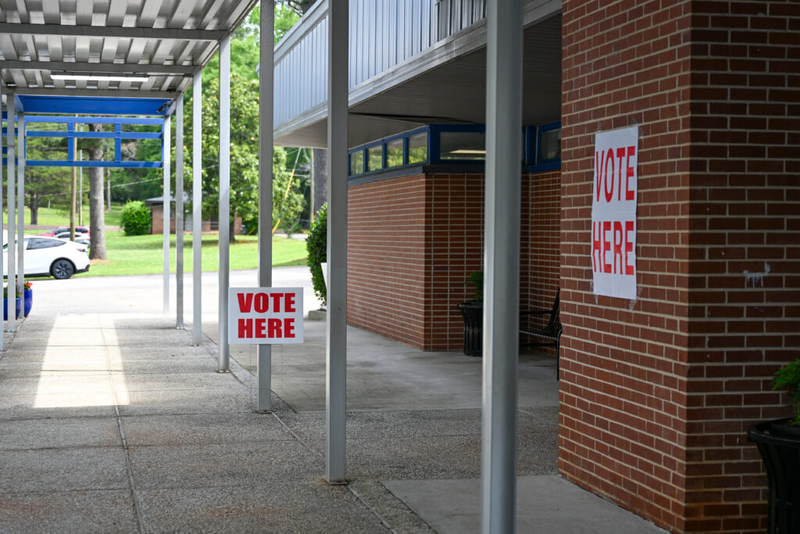
A sign saying "Vote Here" is seen at the Dean Road Recreation Center in Auburn, Alabama, on May 19, 2026. Voters in November will decide on four constitutional amendments, each were approved by the Legislature this spring. (Anna Barrett/Alabama Reflector)
The Alabama Fair Ballot Commission on Tuesday approved language to describe four statewide constitutional amendments that will be on the statewide ballot in November.
The amendments, all approved by the Legislature this spring, range from methods to filling a vacancy in the lieutenant governor’s office to requiring schools to regularly play the National Anthem.
The language that appears on Alabamians’ ballots, chair of the commission Patrick Moody said in an interview after the meeting, will remain identical to the language in the bill passed by the Legislature.
“The goal of the commission was to try to write those on about an eighth-grade reading level, because that was the average reading level for the voters in the state,” Moody said during the meeting. “It sounds easy sometimes, but it is hard to put something that’s nonpartisan and concise.”
The explanations of the amendments will be available on the Alabama Secretary of State’s website by the end of the week and at polling locations on Election Day.
Statewide Amendment 1 provides for a method of filling a vacancy in the lieutenant governor’s office, if the vacancy occurs more than 60 days before the next general election, which is usually every two years.
The amendment, sponsored by Sen. Sam Givhan, R-Huntsville, passed unanimously in both chambers.
It also allows the Legislature to set the pay of the lieutenant governor and legislative officers by joint resolution.
Givhan said in a phone interview Tuesday that he proposed the amendment when questions of Republican gubernatorial nominee Tommy Tuberville’s residency arose. He said that should there be a vacancy – by death, resignation or otherwise – in the beginning of a four-year term, there was no way for the lieutenant governor’s office to be filled until the next midterm election.
“The president pro tem of the Senate does not automatically become lieutenant governor. No one automatically becomes lieutenant governor,” he said. “As far as the president of the Senate, under our rules and statutes, yes, the pro tem would serve lieutenant governor, but the pro tem’s got a lot of other things to do.”
After Gov. Robert Bentley resigned in 2017, then-Lt. Gov. Kay Ivey became the state’s chief executive. The lieutenant governor’s chair remained empty until 2019; then-Senate President Pro Tem Del Marsh presided over the Alabama Senate in the interim.
The amendment would allow the lieutenant governor’s office to be filled without spending any additional taxpayer money, Givhan said.
“This was kind of a Band-Aid approach, but I’ll probably be coming back with another solution when there’s more time to think about it,” he said. “It’s just an opportunity for the people to elect a lieutenant governor if there’s a vacancy during the last two years of the quadrennium.”
The commission unanimously adopted the language after some minor changes.
Statewide Amendment 2 creates a process for county school boards of education to merge, and requires the State Board of Education to conduct an impact study before a merger. It also ensures a process for protest and requires a referendum election.
“We want people to know that there is a way for people to protest this action or at least have a voice in trying to stop the action, so it’s not an automatic merger,” Moody said.
According to the explainer, if at least 25% of registered voters in an affected county school system submit a written protest, a majority of voters would need to approve the merge at the next general election.
The amendment, sponsored by Rep. Terri Collins, R-Decatur, passed 96-2 in the House and unanimously in the Senate.
A message seeking comment from Collins was left Tuesday afternoon.
The commission unanimously adopted the language after some minor changes.
Statewide Amendment 3 would require Alabama school boards of education to adopt a policy requiring public K-12 schools to say the Pledge of Allegiance daily, and allow school boards to adopt policies allowing student-initiated and student-led prayer.
Students who do not want to participate would be allowed to leave the classroom during the prayer and the pledge. According to the U.S. Department of Education, students may pray in school as long as it does not disrupt school activities.
The amendment, sponsored by Rep. Reed Ingram, passed the House 94-4 and unanimously in the Senate.
A message seeking comment from Ingram was left Tuesday afternoon.
The commission unanimously adopted the language after no discussion or changes.
Statewide Constitutional Amendment 4 requires local school boards of education to adopt policies requiring public K-12 schools to broadcast the first stanza of The Star-Spangled Banner once per week.
Under the amendment, the national anthem can be performed by a school-approved band, choir, vocal group or vocalist, as long as they use the version archived by the Library of Congress.
The amendment, sponsored by Sen. Gerald Allen, R-Cottondale, passed the Senate 22-5 and the House 75-27.
A message seeking comment from Allen was left Tuesday afternoon.
The commission unanimously adopted the language after no discussion or changes.
Moody said that the commission’s work is challenging because they have to explain the amendments clearly, in a nonpartisan manner and at an eighth-grade reading level.
“Trying to just make it simple, everyday language, sometimes that’s hard if you’re talking about things like bond issues or sometimes even constitutional amendments,” Moody said. “That’s a complicated term, but we just try to take it and work with our different commission members and everybody’s different backgrounds, and try to think about our friends and family and what they’d want to know if they’re voting yes or no on something.”
Voters will see all four amendments on the Nov. 3 ballot. Each requires a simple majority of votes to pass.
Montgomery