Alabama works to protect voucher recipients from consequences
Sep 15, 2025 | 7:59 am ET
Description
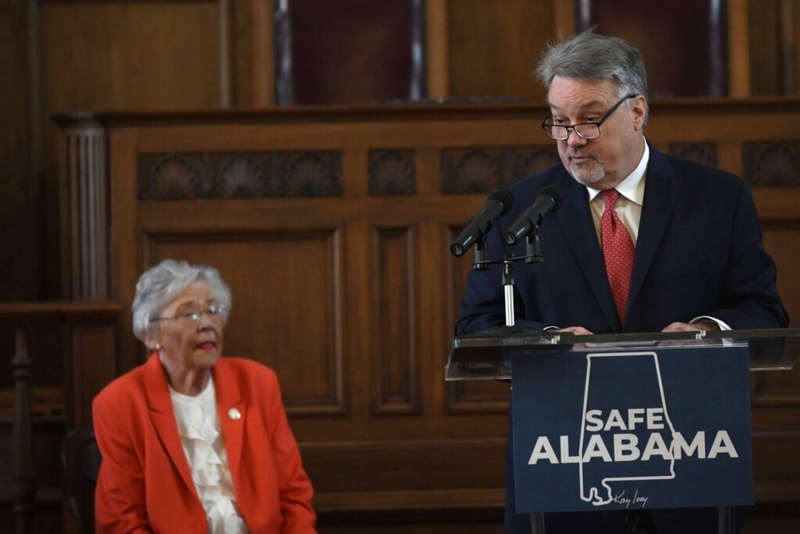
Alabama House Speaker Nathaniel Ledbetter, R-Rainsville, speaks at a press conference promoting a package of law enforcement bills at the Alabama State Capitol on Feb. 12, 2025 in Montgomery, Alabama. Alabama Gov. Kay Ivey listens in the background. (Brian Lyman/Alabama Reflector)
There’s a lot to dislike about the CHOOSE Act, Alabama’s effective voucher program.
Like forcing poorer Alabamians to pay for a wealthy family’s private education. Or the lack of income eligibility limits. Or state leaders cheering the “popularity” of the program, which has a real chance of blowing a hole in the Education Trust Fund budget in the coming years, as happened in Arizona.
In light of all that, Gov. Kay Ivey and Alabama House Speaker Nathaniel Ledbetter’s demands that CHOOSE Act athletes get special treatment may seem minor. But they’re also revealing.
Like most Alabama political crises, this started with someone daring to make an obvious observation. The Alabama High School Athletic Association (AHSAA) considers the tax credits awarded to recipients of the CHOOSE Act — up to $7,000 per child — a form of financial aid.
Hard to argue with that. The CHOOSE Act covers “non-public education expenses,” but the data shows the program is an effective subsidy for private school tuition and homeschool expenses.
And because it’s financial aid, the athletic association until earlier this month required CHOOSE Act athletes to sit out one year.
For good reason. You don’t want a bunch of deep-pocketed private schools — or a person with deep pockets creating St. Sebastian’s School for Blue Chip Offensive Linemen — luring athletes from smaller public school programs with scholarships or tuition breaks, draining talent from multiple levels of high school athletics.
But not everyone sees this as an issue. In a lawsuit filed earlier this month, Ivey and Ledbetter effectively argued that CHOOSE Act recipients deserve special treatment.
“Enforcement of AHSAA’s financial aid rule as currently written would deprive affected students of invaluable or irreplaceable experiences and competitive opportunity that cannot be recovered once lost,” the lawsuit said.
The proper response to this? Too bad. Parents make choices. There are rules governing those choices. If you decide that enrolling your child in a private school is the best thing for your child, you live with the consequences.
But in Alabama, consequences only affect the bottom 99%. The state got a temporary restraining order against the provision earlier this month, a sign that Alabama is likely to prevail in the case. The way legislators wrote the law — with a clause saying that the act will not affect athletic eligibility — the athletic association might have a hard time making its argument.
Montgomery Circuit Court J.R. Gaines said the association’s other financial aid regulations remain in effect, but good luck enforcing those now. Just tell a promising young athlete at a small school that they can go to a well-endowed private one, and the floodgates will open up. Public schools will suffer more for the convenience of private ones.
Which is what the CHOOSE Act is all about.
Forget the nonsense supporters broadcast about this student or that one getting “rescued” from some public school. Most recipients are already out of the state public school system. And let’s not forget these self-styled saviors uphold a state tax system that ensures a handful of public schools get adequate resources, while many poor and rural ones do not.
This is at a time when there are some very mild restrictions on who can access the CHOOSE Act. Those caps expire in 2027. And so will the benevolent pretenses of the law.
Even now, the income tax credit doesn’t cover the average yearly cost of Alabama private school tuition (currently about $8,300). It will cover even less of it in two years, thanks to inflation and the mounting evidence that laws like the CHOOSE Act result in private schools raising their costs.
The CHOOSE ACT by its very nature provides help to those who don’t need it. Its main purpose is and always will be welfare for the wealthy. And we can’t have fairness ruining that.
But that’s Alabama’s approach to public schools. Our state believes that some people deserve a good education, and many more do not.
The white planters who created our modern state government in the 1870s had no interest in letting Alabamians govern themselves. They wanted to hoard money and power. They particularly hated the thought of any wealth they extracted from Black labor going to educate Black workers’ children.
That’s why we have property tax caps. That’s why there’s no right to a public education in our state constitution. That’s why we force Alabamians to pay high sales taxes, even on our food.
And it’s why we have the CHOOSE Act. Our lawmakers don’t see public education as a civic virtue, but as a leech on privilege. Or at best, a profit opportunity.
In that light, it’s no surprise we spent public resources finding another carve-out for the children of Alabama’s big mules. Fears of corruption matter less than the terrifying thought of a private school kid being inconvenienced.
And there’s no bigger inconvenience to elite privilege than public education.
Montgomery