Alabama lawmakers drafting bill tying some higher ed funding to outcomes
Nov 12, 2025 | 3:53 pm ET
Description
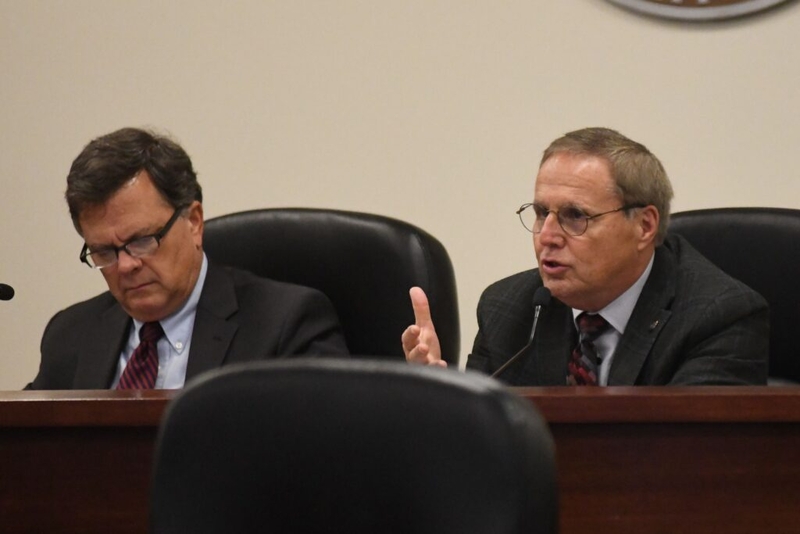
House Ways and Means Education Committee Chair Danny Garrett, R-Trussville, asks a question as Senate Finance and Taxation Education Committee Chair Arthur Orr, R-Decatur, listens during a budget presentation to lawmakers on Feb. 5, 2025 at the Alabama Statehouse in Montgomery, Alabama. Both legislators are working a bill to modify funding for higher education that is tied to outcomes. (Brian Lyman/Alabama Reflector)
The chairs of the Alabama Legislature’s education budget committees are drafting legislation that could change the funding mechanisms for higher education.
Senate Finance and Taxation Education Committee chair Arthur Orr, R-Decatur, said after a hearing on the proposal before the Joint Modernizing Higher Education Funding Committee on Wednesday that they were working on criteria for the model, aimed at linking some public funding to education outcomes.
As a model, Orr cited the Renewing Alabama’s Investment in Student Excellence (RAISE) Act, passed earlier this year, which allocates more money to K-12 schools to help educate certain classes of students, such as English Language Learners and students in poverty.
“With each institution, how can we help you, emphasis on help, improve your outcomes,” Orr said. “One that the Legislature would like to see –- and I am filling in a blank — would be jobs that the state of Alabama needs. One of them is educators or teachers, one is nurses or more qualified people in health care. We need more lab technicians, who are going to be junior colleges and not universities. What are the needs that our state has, and how can we help you with additional funds to increase your numbers for those particular outputs.”
Orr said that the model would apply to two-year colleges, regional institutions of higher education as well as universities engaged in research. The model would be tailored to each of the three categories.
Orr said that the portion of the funding that is tied to outcomes will be in addition to the total that states already receive for their operations and expenses. About 30% of the funds allocated to implement the RAISE Act, he said, were intended for higher education
The senator’s comments came after a series of presentations to members of the education budget committees on how outcomes-based funding works in other states.
Consultants with ExcelinEd, a national nonprofit founded by former Florida Governor Jeb Bush, a Republican, that focuses on education policy told lawmakers Wednesday that lawmakers should tie funding to their priorities for higher education and allocate additional money for students with additional needs.
Matthew Joseph, senior policy advisor for education funding with ExcelinEd, said the model must provide sufficient funding, right outcomes and some focus on higher need students to be a success. Kentucky, he said, saw “an immediate impact” from adopting the guidelines.
“If you looked at their graduation rates in the last 10 years, what you see is their growth just stalled, it just wasn’t growing very much,” he said. “Then they fine-tuned, upgraded their outcomes-based funding, and they saw a significant boost in their graduation rates, 50% higher change from year to year, over the last five years.”
Metrics could include attainment goals or ones geared toward a particular priority of the state, such as workforce goals.
House Ways and Means Education Chair Danny Garrett, R-Trussville, kept repeating workforce development as an issue, particularly Alabama’s lower labor force participation rate.
“We just created the Department of Workforce,” he said during the meeting. “We have the lowest labor force participation rate in the country, and so we are trying to focus on connecting with the business community and the consumer to find out what our job needs to be. I believe the universities need to be part of that.”
Jim Purcell, executive director of the Alabama Commission on Higher Education, said in a statement that colleges and universities must have flexibility to offer courses, “include those in the humanities and liberal arts, which are essential to developing critical thinking and civic engagement.”
“The key will be balance and ensuring that policy encourages responsiveness to workforce needs while preserving the full educational mission and integrity of Alabama’s colleges and universities,” the statement said.
Montgomery