Alabama Department of Corrections: Staffing efforts show concern with prison violence
Sep 09, 2026 | 6:01 am ET

Description
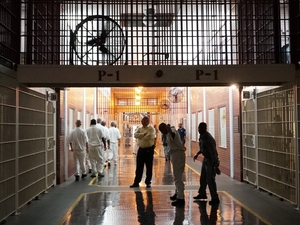
An officer is seen in the yard of Holman Correctional Facility in Atmore, Alabama on Oct. 22, 2019. The Alabama Department of Corrections is seeking summary judgment in a long-running lawsuit over violence in state prisons, arguing its efforts to increase staffing show a commitment to addressing the problem. (Brian Lyman/Alabama Reflector)
Attorneys for the Alabama Department of Corrections and the state last week filed a motion for summary judgment in a long-running federal lawsuit over violence in Alabama’s correctional facilities, around the same time as the U.S. Department of Justice.
Bill Lunsford, an attorney representing the state, argued that the state had worked to address staffing issues and safety within Alabama prisons, “belying any claim that the state has historically acted with indifference or continues to act with any level of indifference on these issues.”
Lunsford said in the motion that the state reviewed its current staffing levels and worked to expand recruitment and retention, executed the policies that it had in place for use of force through “training, investigation, discipline, and criminal referral” and developed a system to classify people in its custody that included screening, risk assessment, regular review and where staff would house people in their custody.
A message seeking comment was sent to the U.S. Department of Justice on Tuesday.
Alabama prisons have suffered from violence and overcrowding for decades. The U.S. Department of Justice sued the state in 2020 after a series of reports detailing physical and sexual assaults of inmates, saying conditions in state prisons violated inmates’ Eighth Amendment protections against cruel and unusual punishment.
The U.S. Attorney’s Office filed a motion for summary judgment of its own last Wednesday, asking U.S. District Judge Harold D Mooty III to rule that the ADOC failed to protect people in prison from physical violence, sexual violence and excessive force by correctional staff and failed to provide safe conditions for people while incarcerated.
The 260-page filing provided a litany of incidents in arguing that violence within the prisons was unconstitutionally high and that the ADOC did not do anything to address the issues. The motion also accused correctional staff of routinely using excessively force and said leadership in the department was “deliberately indifferent to the serious risk of substantial harm.”
Lunsford wrote in his motion last week that the state ‘responded reasonably” to the threats of violence and could not be found to have shown deliberate indifference.
ADOC and Alabama, Lunsford argued, had an inmate classification system and tried to address staffing issues outlined in the DOJ’s charges.
“In the face of a persistent and ongoing national correctional staffing shortage readily acknowledged by Plaintiff’s retained experts, the state invested hundreds of millions of dollars and countless hours of time from members of ADOC’s leadership focused solely upon the recruitment and retention of correctional officers,” the motion states.
And because of that, “ADOC’s correctional staffing numbers increased substantially and continue to do so. ADOC reconsidered, revised, and improved its policies with the intent of improving officer training, performance, and outcomes within its prison system.”
In the most recent quarterly report, ADOC had about 1,400 correctional officers on staff at the end of February, about 200 more than they had at the same time in 2025.
At a legislative budget meeting in 2024, former Commissioner John Hamm said there are 2,400 budgeted correctional security positions across all the facilities, and that 365 were vacant at the time.
Lunsford wrote that the agency launched an advertising campaign and hosted numerous events to boost recruitment. The motion states that in 2020, ADOC hosted “14 hiring events with 849 total attendees.” In 2021, ADOC hosted 17 events with more than 400 attendees.
The motion stated full-time staff at Bibb Correctional Facility increased from 74.5 to more than 136 from 2022 to 2024, an increase of almost 90%, according to the motion.
The increases at other facilities were more modest. At Donaldson Correctional Facility, correctional staff went from 122 FTE to about 150 FTE. In other facilities, staff declined. At Easterling Correctional Facility, it went from 76.5 FTE to 65 FTE from 2022 to 2024.
The motion also states that the ADOC had policies in place to address allegations of excessive use of force and that staff followed the procedures.
“As of June 5, 2023, correctional staff received training at ADOC’s APOSTC Academy, which consisted of a 400-hour written curriculum that included use of force,” the motion states.
Lunsford included a graphic in the motion that indicated that the number of reported excessive use of force complaints declined, going from 2,213 in 2020 to about 1,000 in 2023.
Montgomery