AG McCuskey takes issue with Kanawha County policy on Hope Scholarship and special ed students
Aug 25, 2026 | 6:00 am ET
Description
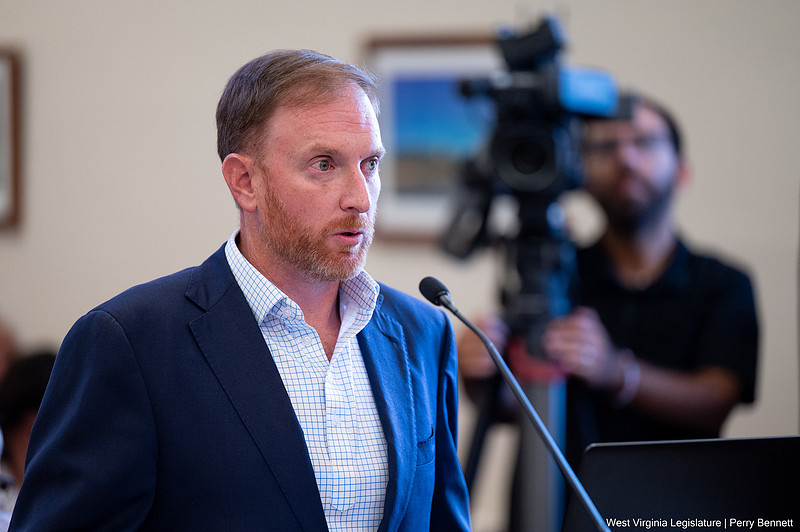
West Virginia Attorney General JB McCuskey has asked state school officials to intervene with Kanawha County Schools policy regarding the Hope Scholarship and students with disabilities. (Photo by Perry Bennett/West Virginia Legislative Photography)
West Virginia Attorney General JB McCuskey has asked state school officials to intervene after his office learned of a Kanawha County Schools policy regarding the Hope Scholarship and students with disabilities.
The Hope Scholarship is West Virginia’s education voucher program, and it gives students around $5,400 to pay for education outside of public schools.
McCuskey said that his office recently learned that Kanawha County Schools told parents that children with disabilities who use the Hope Scholarship lose their special-education eligibility and have to be reevaluated if they choose to reenter the public school system.
The policy could subject those students “to discipline without state and federal protections,” McCuskey wrote Aug. 18 in a letter to State Schools Superintendent Michele Blatt and State School Board President Paul Hardesty.
“That position cannot be squared with federal or state law, and its consequences fall on some of West Virginia’s most vulnerable students,” McCuskey wrote.
“It is bad enough to impede any student’s education but it is worse that local officials might try to withhold important disability-related services because of their disagreement with the Hope Scholarship Program,” he added.
McCuskey cited a letter from KCS to parents of special education students that read: “Parents are often surprised to learn that if their homeschooled or Hope Scholarship child later returns to public education, they are no longer eligible for special education services.
“When a student returns to public education and the parent requests that the student be re-enrolled in special education, this is treated as a request for initial evaluation. Unless and until this occurs, the district is not deemed to have knowledge that the student is a student with a disability. The student may be disciplined as a general education student … “
McCuskey argued that the standard application for the Hope Scholarship, which was launched in 2021, doesn’t include any revocation of special education status. The notice of intent, McCuskey said, is a form used for determining scholarship eligibility.
“Although (Kanawha County Schools) treats it as an implied revocation, a regulation that requires a writing forecloses implication,” McCuskey said. “A parent who signs a scholarship form has not been informed she is surrendering her child’s services because she actually isn’t.”
The student’s Individualized Education Plan should be reconvened on reenrollment into public schools if the student is no longer using the Hope Scholarship and staff should conduct a reevaluation if necessary, McCuskey argued.
“The lack of any rational justification for the county’s approach-combined with the letter’s fixation on the Hope Scholarship raises a question about the county’s motivations,” wrote McCuskey, who is a Republican.
A spokesperson for KCS declined to provide a comment to West Virginia Watch.
McCuskey asked the West Virginia Department of Education to direct KCS to rescind the letter to parents of students with disabilities and identity students that were denied services or reentry because of the county’s current policy.
Blatt and Hardesty were also asked to respond to several questions about the KCS policy, including whether they agreed with the policy and if any other county had issued similar letters to parents of students with disabilities.
The education department had no comment at this time, according to a spokesperson from the department.
In response to McCuskey’s letter, West Virginia Treasurer Larry Pack said that the state needs a school system “that puts addressing each child’s unique needs at the forefront so we can improve educational outcomes.” The Treasurer’s Office manages the Hope Scholarship program.
“We recognize that many regulations limit the authority of school administrators, but we must shift from a restrictive approach to one offering flexibility and innovation,” Pack said. “Regardless of the current burdens placed upon our school systems, we need administrators who understand and recognize that education must evolve on a national and local scale.”
“Ultimately, punishing a child for choosing a different educational pathway is unjust and unnecessary,” he continued. “As we continue to define the future vision of our schools, all levels of government must come together to focus on best serving their constituents. We must avoid waging proxy wars over policy disagreements.”
There are more than 25,000 students using the Hope Scholarship this school year. The education voucher has opened up to all West Virginia students for the first time since it launched five years ago.
Lawmakers this year allocated $277 million for the Hope Scholarship to account for any student who uses the program in the 2026-27 school year.
Pack also called policymakers to have a serious discussion about West Virginia’s school aid formula, which mostly doesn’t account for required special education expenses. Local school leaders have reported that their counties are millions of dollars in debt due to special education costs; in some counties, special education students account for a quarter of all students enrolled.
Charleston, WV