After learning about the Burnt District, apologies from this Kansas Jayhawk
Dec 19, 2024 | 4:33 am ET
Description
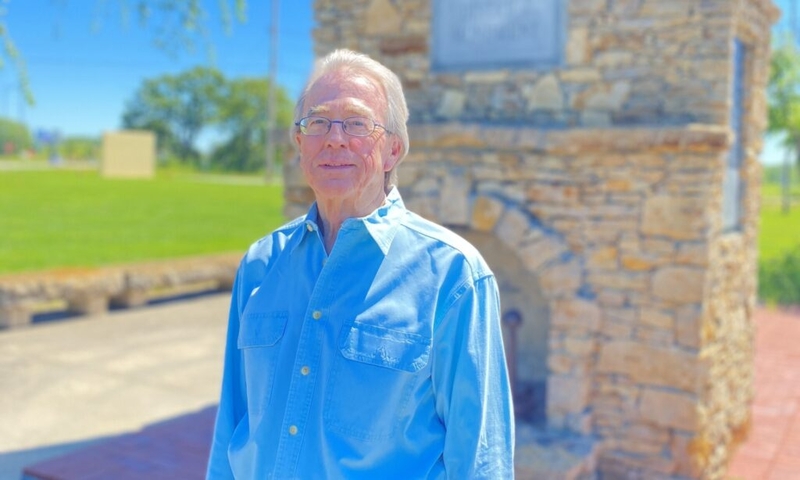
Missouri historian Tom Rafiner grew up in Jackson County, within the Burnt District boundaries, but the event was never referenced in public schools. The monument behind him was part of a chimney, the only portion of hundreds of homes that remained standing following the destruction by fire. (Frank Barthell photo)
I’ve lived in Lawrence since 1987, so I consider myself a fully vetted Jayhawk. For what I’m about to write, however, I might be refused service at the Free State Brewery or permanently banned from Massachusetts Street.
I owe the state of Missouri an apology.
Working on this Border War series led me to Harrisonville, Missouri, to learn about General Order No. 11. Just four days after William Quantrill and his murderous guerillas left Lawrence, Union Gen. Thomas Ewing Jr. issued a decree ordering 25,000 Missouri residents to abandon their homes in the space of two weeks.
For decades after learning the full scale of Quantrill’s Massacre, I assured myself that no acts of violence by Union troops or Kansas Jayhawkers in Missouri would justify Quantrill’s attack on my city. I had no clue about General Order No. 11; had never heard of Missouri’s Burnt District. Most people still haven’t.
Missouri historian Tom Rafiner has written both a moving intimate account and a well-documented history entitled “Cinders and Silence: A Chronicle of Missouri’s Burnt District, 1854-1870.” Apparently, many people use the massacre for excusing their ignorance about what took place in Missouri during that time period.
“The Lawrence Raid has seemingly justified all that came before and all that followed,” Rafiner writes.
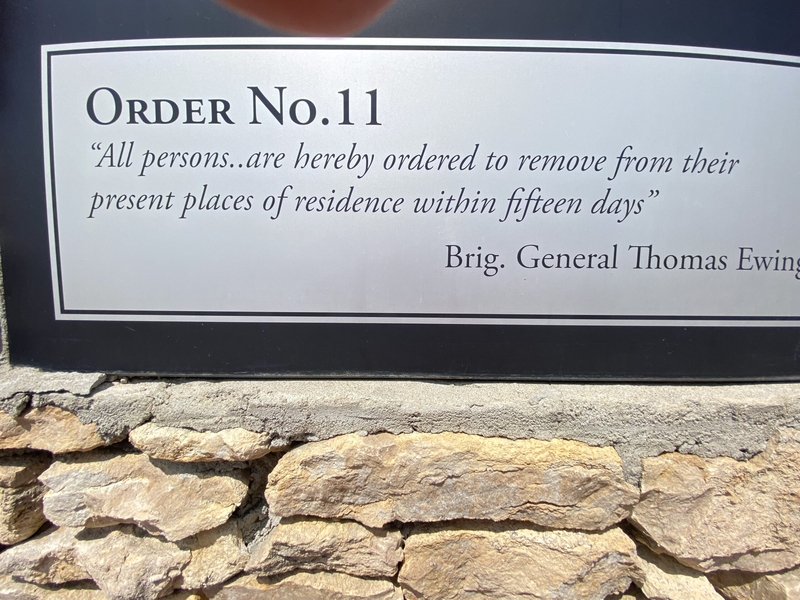
General Order No. 11 reads: “All persons living in Jackson, Cass, Bates Counties, Missouri, and in that part of Vernon included in this district … are hereby ordered to remove from their present places of residence within fifteen days from the date hereof.”
The formal order included residents of the northern section of Vernon County, but excluded residents who could prove their Union loyalty living within one mile of the city limits of several communities in these counties.
In June, I accompanied Rafiner on a short drive on Route 7 south from Pleasant Hill to Harrisonville. Here are some of his observations:
“This is the route refugees would have followed to leave Cass County after the Order No. 11. … The average temperature would have been 95 to 102 degrees. It had not rained for six weeks. There were many ponds. Streams were pretty much dried up. The oxen pulling the carts were known to stampede once they caught a whiff of water. The refugees were not permitted to stop to get food or water … dust was everywhere. Children walking behind the carts wore kerchiefs to keep the dust from their eyes. … The Kansas 9th Cavalry was searching among the refugees for boys or men who might have ridden with Quantrill. If you were even suspected, you were shot on sight.”
It’s heartbreaking, but only after your anger subsides over the treatment of refugees by Union forces.
“In July 1865, twenty-two hundred square miles of western Missouri lay totally destroyed,” Rafiner wrote. “Twenty-eight hundred farms as well as numerous towns and villages had disappeared in conflagration. Three and half counties along Missouri’s western border, once the home to almost forty-thousand civilians lay mostly devoid of humans. … The western edge of Missouri transitioned from a storied national step westward to a burnt district. By 1870, now repopulated, less than one in five of the burnt district’s residents had any personal memory of the burnt district’s Civil War history.”
In a letter home in October 1863, a federal soldier wrote: “Chimneys mark the spot where once stood costly farmhouses, cattle and feral hogs destroying large fields of corn, prairie fires are burning up miles of good fencing.”
A Union officer at the time, Missouri artist George Caleb Bingham tagged Ewing’s edict “a crime against humanity.”
A replica of his painting “Martial Law” hangs in Kirk Hall in the Kansas City Central Library.
It took nearly 150 years. But a memorial was finally established. On April 26, 2009, the Burnt District Monument was dedicated just west of Harrisonville.
Carol Bohl, then executive director of the Cass County Historical Society, said: “When we come to this place, let us listen with respect to the stories of both Missourian and Kansan. Bushwhacker and Jayhawker. Union and Confederate.”
My apology to Missouri isn’t simply for my ignorance. More to the point, I felt no curiosity or empathy about the state’s border war experience.
But as Civil War historian David Schafer has written, “Certainly, there were no “saints” on either side of the conflict. But I have come to more deeply believe that the institution of slavery — with all of its shameful impacts and human misery — needs to be front and center when interpreting the history of that era.”
Here’s what I learned in my time in the Burnt District with Tom Rafiner. I hate, condemn and accept no excuses for the practice of slavery in Missouri. In the end, residents paid a very high price for accepting this evil in their state.
Yet I also feel compassion for the Missouri people who suffered so terribly for so many years. To feel both simultaneously? It is not only possible. It’s human, and a valuable skill for navigating through today’s political firestorms.
Frank Barthell is a former video producer at the University of Kansas. Through its opinion section, Kansas Reflector works to amplify the voices of people who are affected by public policies or excluded from public debate. Find information, including how to submit your own commentary, here.

Topeka, KS