Homeless encampments and the unsatisfactory feeling of unsolvable problems
Nov 11, 2026 | 7:00 am ET
Description
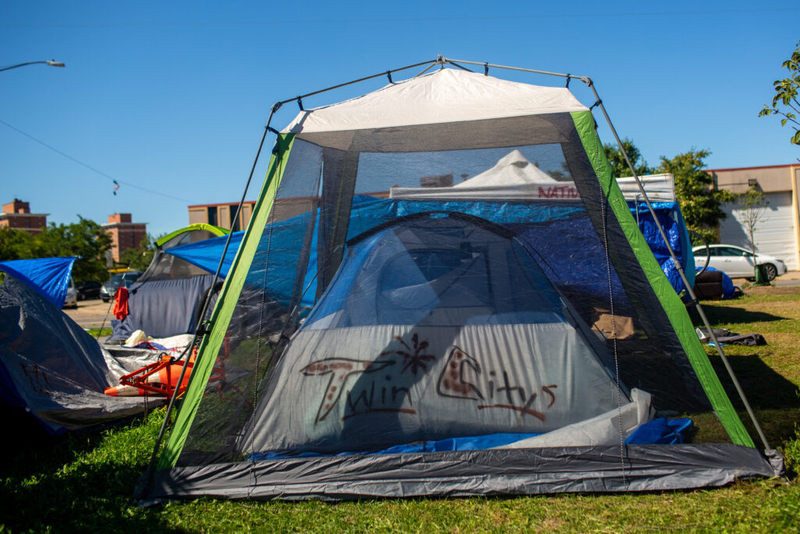
A tent with "Twin Citys" spray-painted onto it sits in an encampment along Franklin Avenue near Cedar Avenue Tuesday, Sept. 7, 2021. (Photo by Nicole Neri/Minnesota Reformer)
Our nation’s homeless problem is very visible to anyone who lives in a large metropolitan area, including the Twin Cities.
We see unhoused people wandering the streets, on public transportation and at intersections soliciting money.
Not all unhoused people face the same challenges. Some experience temporary homelessness — moving to shelter or temporary housing, often on their way to permanent housing. Others may spend years chronically unhoused, often in and out of shelters or temporary housing before returning to the streets.
Over the past several years the problem of chronic homelessness has manifested in a different way: encampments.
The emergence of fentanyl on the streets — and in some encampments — has elevated community safety concerns of encampments, often pitting advocates for those living in the encampments against advocates for those who live in the surrounding community.
From one perspective the encampments are people who — failed by our social service systems — have created communities to support and protect one another.
From another perspective, encampments are trespassers who pose a threat to the safety and wellbeing of their residents and those living in the surrounding community, often communities that also struggle with poverty and inadequate housing.
It is the sort of contentious, complex public policy issue that frustrates both the public and policymakers.
We like to think that all problems are solvable, but that confidence can vanish when confronted by the limitations of politics and policymaking.
Despite our wishes and best intentions, politics and public policy are imperfect tools for solving many problems. In policy school you learn that most policies are second-best solutions. There are always trade-offs — necessary political compromises, administrative barriers or budgetary constraints that work against getting to the best solution.
The limitations of policymaking are particularly visible with the most complex problems, like what to do about homeless encampments.
It is not just a housing issue. It touches on multiple policy domains, including poverty, mental health, substance use disorder, disabilities, veterans’ services, law enforcement, courts and health care, and crosses multiple jurisdictions and service providers.
Many of the people living in encampments face multiple health conditions, often including mental illness and/or substance use disorder, conditions that can make rehousing challenging. In addition, encampments create tension with others who live in the community. On top of that, encampments can vary widely in size, needs of the people, and degree of tension with the community.
When faced with complex problems we tend to default to simple solutions. Everyone thinks there is some panacea, something no one else has thought of or had the courage to try.
For homeless encampments, the simple solution fallacy can be illustrated by two ideas from opposite ends of the political spectrum.
Some on the right advocate a law-and-order approach, arresting everyone living in the encampment and plowing it down, while some on the left advocate that encampments be designated as safe spaces for people to use alcohol and other substances.
Neither solution addresses the challenge of improving the services that have failed many of the encampment residents, and both avoid the difficult question of how to balance the rights of different groups. One solution criminalizes people for being unhoused, while the other ignores the rights of those who live in the surrounding community, as well as the public health risks of encampments.
Each serves their ideology while avoiding the practical challenges of policymaking.
Another approach frequently offered for complicated problems focuses on the root cause of the problem.
On the surface this seems like a smart approach; solving a problem at the root can prevent the problem from recurring.
Social psychologist Steven Pinker, in his book “Enlightenment Now,” calls this phenomenon “root-causism.” It seems attractive, but oversimplifies the problem and the solution. The reality is that the root causes of any social problem are usually just bigger, more deeply ingrained social problems.
For example, I’d argue the root causes of homeless encampments are poverty, extreme income inequality, a fractured health care system and racism. We should solve these problems, but that’s a challenging and lengthy undertaking.
In the meantime, though, we still need to do something about homelessness encampments.
Although we’ve long been led to believe that treating symptoms is insufficient, Pinker advocates just that.
Do what’s doable.
And that’s pretty much what we have been doing with homeless encampments.
Minnesota has a robust and effective strategy to re-house people experiencing homelessness. Thousands of people are rehoused every year. Outreach workers connect with unhoused people on the streets or in encampments to help them access housing.
The challenge for encampments is that many of the residents face health, mental illness and/or substance use disorders, factors that make rehousing them more complicated.
Many would benefit from supportive housing, a model that combines housing with services and ongoing care.
But substance use disorder remains the biggest challenge to stable housing, and to any solution for encampments. We have struggled to establish viable models for housing people who are using substances.
The best path to making a dent in the encampment problem is to improve the social services needed by chronically homeless people, including those living in encampments.
Perhaps most critically, we need better community care for people experiencing mental illness, including more supportive housing. We need more robust addiction treatment programs. And we need to reduce the frequency of unhoused people cycling through the criminal justice system.
But those improvements take time and money. It won’t happen overnight.
In the meantime, we address encampments as we have been, continuing housing outreach, ensuring basic sanitary conditions and safety for people experiencing homelessness, and ensuring the availability of clean needles and overdose medication for those who continue to use substances.
But that’s not all. When encampments become dangerous for their residents or for the local community, we should remove them, offering shelter to all who are willing to take it.
And continued success also depends on political leaders who dig in and do their part to support these efforts rather than engaging in endless arguments.
It may be frustrating that we can’t do more, that a better solution seems so elusive.
But this is not giving up.
It is doing what works and striving to do it better.

Saint Paul, MN