An affluent southern Vermont town considers adding housing — or keeping green space
Nov 02, 2026 | 5:15 am ET
Description
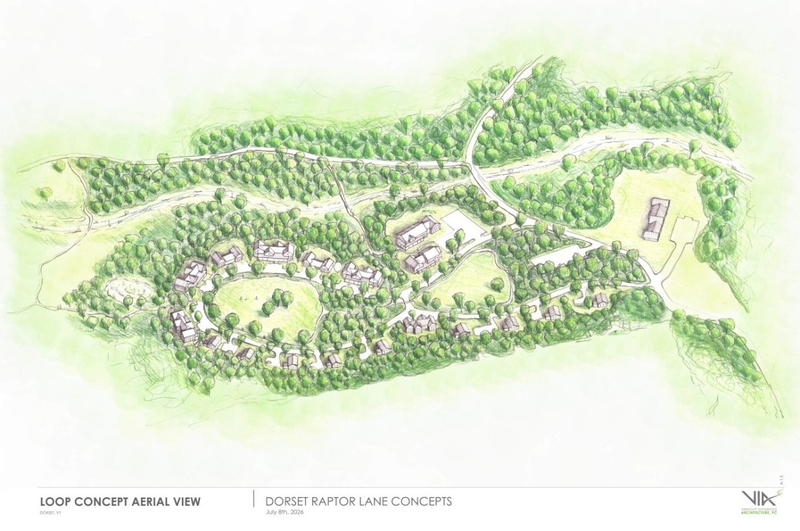
A rendering of a potential housing development on Raptor Lane in Dorset.
Vermont Integrated Architecture/Courtesy of Town of Dorset
Carly Berlin covers housing and infrastructure for Vermont Public, in partnership with VTDigger.
On Tuesday, voters in the affluent Bennington County town of Dorset will decide whether the town ought to move forward with a housing project on municipal land.
Local officials hope to encourage homebuilding at the site on Raptor Lane, citing Dorset’s need for smaller, more affordable homes for local teachers and older residents looking to downsize. But an organized opposition campaign is urging residents to vote no, arguing that the land adjacent to the town forest should be preserved as green space.
Steven Zoric moved full-time to his family’s vacation home in Dorset from New Jersey during the pandemic. He helps lead an anti-development effort called Friends of Dorset.
“Keep Dorset the way it’s always been,” Zoric said in an interview. “We want to keep this as a pristine resource that the town has.”
The town acquired the land along Raptor Lane in 2018 in a bargain sale, said longtime town manager Rob Gaiotti. Shortly afterward, officials asked residents what they hoped to see come of the site, and identified recreation, new town offices, housing and energy generation as priorities. Then the town built out a network of mountain biking trails there, and relocated its municipal building. Last year, it turned to housing.
A recent housing market analysis solicited by the town found that a typical home price in Dorset is $709,000 – double the value before the pandemic and triple what a local teacher’s salary can afford. Most homes in town are large single-family houses, and many serve as second homes or short-term rentals.
In response to a 2025 request for proposals for the Raptor Lane site, the Rutland-based development firm S.M. Graves proposed constructing around 120 homes at a mix of price points.
But many residents balked at the scale of that project for a town of just over 2,000 people. The town tabled the idea and went back to the drawing board, studying other possibilities and asking residents what they wanted to see built. At the same time, some residents pushed for a townwide vote.
Tuesday, voters will consider a pared-down vision for the site: up to 35 homes constructed on 30 acres, about 10% of the town-owned land. Town officials have indicated that they now hope to seek out a nonprofit homebuilder, since the smaller scale of the project makes the math for workforce housing difficult for private developers.
The vote is a preliminary step. The ballot item asks for voter approval to convey the land for the development of homes in the future.
Gaiotti, the town manager, said a “yes” vote gives the select board the go-ahead to start conversations with developers “a little more in earnest.” A “no” vote would make the town reconsider its direction for housing at the site altogether, he said.
One alternative option the town could look at, Gaiotti said, would be selling off individual lots to build single-family homes. The town currently doesn’t reap any property tax revenue from the land because it’s municipally owned, he said.
The vague language of the ballot item has opened it up to criticism from naysayers like Zoric, who argue that voters should know more details about future development plans and costs.
At the heart of the issue, though, is whether residents want to see the town grow.
Ben Weiss, a retired software developer who’s lived in town for over three decades, has served on town committees studying the development potential at Raptor Lane. He sees the town’s vision for a denser housing project as a unique opportunity – and worries that if his neighbors vote it down, any developer will be wary of trying to build there. Yet he’s watched as the project’s opponents have gained momentum.
“I think that some of those groups are organized by people who, you know, were very scared of this large development going in in their backyard,” Weiss said. He’s seen some relenting, though, as the scale of the project shrinks.
Read the story on VTDigger here: An affluent southern Vermont town considers adding housing — or keeping green space.
Montpelier, VT