Texas Democrats won big with little-known underdogs. Here’s how they pulled it off.
Nov 05, 2026 | 11:19 am ET
Description
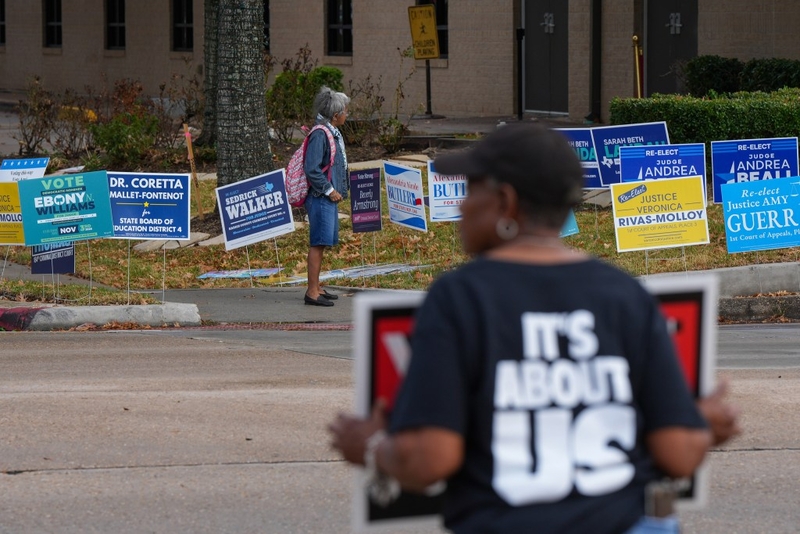
A woman looks at campaign signs at Wheeler Avenue Baptist Church in Houston on Election Day, Tuesday, Nov. 3, 2026. (Jon Shapley for The Texas Tribune)
Last year, with the midterms fast approaching, some Texas Democrats began talking about putting together a “super ticket,” a dream team of battle-tested franchise players who could raise big money and drive turnout across strategic demographic groups.
They wanted the Avengers. They got Miracle on Ice.
But just like Team USA facing the Soviets in the 1980 Olympics, the ragtag group of scrappy underdogs the Democrats put together ended up pulling off the impossible, beating seemingly insurmountable odds to win not just one major contest, but every statewide seat.
A group of little-known state legislators and one millennial farmer unseated longtime GOP powerbrokers and their wealthy backers, reversing the state’s entire political power structure in one night.
At the top of the ticket, Austin state Rep. James Talarico managed to haul in record-setting amounts of money for the U.S. Senate race and build a national brand through his social media presence. His colleague, Austin state Rep. Gina Hinojosa, saw fundraising and attention surge in the home stretch of her challenge to Gov. Greg Abbott.
But the rest of the ticket struggled to build the branding and get the funding needed to break through in a state the size of a small country. Less than a month before the election, about half of likely voters did not know enough to have an opinion on the Democratic nominees for lieutenant governor, attorney general, comptroller and railroad commissioner, according to the Texas Politics Project.
All of them will assume office come January.
These candidates benefited from a blue wave that routed Republicans across the country, and specific factors in each race tilted the scales in their favor. But for the first time in a long time, Texas Democrats had also “built the sails to catch the wind when it comes,” Katherine Fischer, the executive director of the Texas Majority PAC, a Democratic group, said Wednesday.
Democrats ran someone in every seat, creating a “reverse coattail” effect to get the word out about the whole ticket, even in districts where local candidates were sure to get walloped. They made significant investments in voter turnout, especially in purple counties. And they went all in behind the ticket they had, even if it was not the star-studded list they’d originally imagined.
These newly elected candidates will now have to decide how to govern offices they themselves may not have been sure they would win, and introduce themselves to the Texans who just voted them into office.
“Small crowd by small crowd by small crowd, they all introduced themselves to the state of Texas,” said Wendy Davis, a former state senator and Democratic candidate for governor who organized voter turnout efforts this cycle. “Now they’ll have to do that on an even bigger stage.”
How did Texas turn blue?
It was the day after the May runoff election, and Nathan Johnson was feeling disgruntled. The Dallas state senator had just won the Democratic attorney general nomination in a landslide, but many news outlets, including The Texas Tribune, had focused primarily on the more expensive, higher-profile GOP runoff.
Johnson had just barely missed the cutoff to win the primary outright, so his 20-point victory had seemed to be a relatively foregone conclusion. The Democratic race was also, frankly, a lower-profile contest. Over three decades, Republicans had turned the agency into the crown jewel of a national conservative legal movement, And Middleton had a seemingly bottomless pit of money to keep it red.
But the day after the runoff, Johnson wanted reporters, pundits and donors not to write this race off as a foregone conclusion. “I intend to win this race,” he told a reporter.
It’s a promise many down-ballot Democrats have made over the years before falling short in the face of better funded, better known Republican candidates backed by the party in power. It’s part of why Democrats initially hoped to field candidates who came into the race with name power, like U.S. Rep. Joaquin Castro, D-San Antonio, who expressed interest in the position. But after he and former congressmen Beto O’Rourke and Colin Allred couldn’t settle on who would run for Senate versus the other open seats, Castro abandoned the plan.
Johnson entered the race feeling like he had about a one-in-three chance of overcoming GOP dominance and getting his name out there enough to win, he said Wednesday. Those odds only improved in his mind as he stumped around the state and managed to get enough money together for a few ads.
“When something has been a certain way for a long time, everyone assumes that it’s permanently that way,” he said Wednesday. “Someone said to me recently, ‘Texas has been red for 30 years. Those are daunting odds.’ Those aren’t odds at all. That’s just a description of the state of things. It’s not permanent.”
“We found common ground”
Johnson is not the only defiant Democrat now taking victory laps with anyone who doubted their ability to flip these seats. Clayton Tucker, a 35-year-old political newcomer, ran for agriculture commissioner, a seat that has not been held by a Democrat since the year he was born — and an office no Democrat currently holds in any of the 12 states that elect their agriculture commissioner.
Tucker, a farmer and progressive political organizer, faced honey magnate Nate Sheets in a race that likely would have been over before it started in a typical year. But as outrage grew over data centers, especially in rural areas, Tucker’s campaign caught fire. A candidate unrestrained by the shackles of the political machine, Tucker campaigned with the Republican incumbent, Sid Miller, who offered doomsday predictions for his own party on data centers, Flock cameras and unabated growth.
“Had you told me a year ago that I would be at an event with Sid Miller saying we agree on anything, I would have asked what the hell you were drinking,” Tucker said Wednesday. “We got a lot of pushback from people in both our parties for talking about data centers, but we found common ground, put party aside, and there’s something refreshing about that.”
Other candidates benefited from similar campaign twists. Dan Patrick, the head of the Texas Senate, suffered for pushing a ban on THC, allowing his mild-mannered opponent, Austin state Rep. Vikki Goodwin, to pick up a cross-section of supporters. Jon Rosenthal, the sleeper candidate for Railroad Commission, saw a modest surge after Bo French proudly posted racist comments about the University of Texas on social media. In the comptroller’s race, Austin state Sen. Sarah Eckhardt hammered interim Comptroller Don Huffines for overhauling the agency in the few months since he took over.
None of these issues on their own radically changed the outcome Tuesday night. But combined with powerful national trends, they helped facilitate a sweep that seemed entirely unlikely just a few months ago.
These individual indicators — not polls, not funding, not name recognition — are what made Johnson so confident these seats were winnable in ways they never had been before. The Republican Party was overconfident, and when something went wrong that they would have to be responsible for as the party in charge, they wouldn’t have the “means, the interest or even the vocabulary” to address it, he said.
“I knew the Republican Party was going to drop the needle on their worn-out old phonograph and start talking about their old culture war issues,” he said. “And people were going to start asking, ‘What did all that hate, anger and suspicion get me? Did it open a hospital? Did it get my kid a job?’”
Why things were different
Texas Democrats have had opportunities like this before, to be sure. In 2008 and 2018, they watched jealously as Democrats across the country seized statehouses and statewide offices from GOP control, trying to take comfort in their smaller wins.
But this time was different, Democratic organizers and candidates say. And not different in the way Democrats always promise things will be. Actually, actually different.
The Texas Democratic Party worked closely with the Texas Majority PAC to field candidates in every seat, covering campaign start-up costs and helping them staff up. They also undertook what they are calling the largest coordinated campaign in Texas history, opening field offices, sharing voter files and vendor agreements and sending more than 30 million mailers.
Each of these candidates stumped for themselves and the whole Democratic ticket, focusing on invigorating low-propensity voters to turn out and vote for candidates they’d likely never heard of before entering the voting booth.
“We were very focused on telling people to vote for all Democrats up and down the ballot,” Fischer said. “We were targeting people who were likely to support Democrats, so we thought that if we could turn them out, they would likely go down the ballot, so name recognition would not be as critical.”
Blueprint PAC, another Democratic initiative led by Davis and other strategists, took on a similar project targeting Tarrant County. By investing in state legislature and local county commissioner candidates, they were able to drive up Democratic turnout county-wide, Davis said.
“Even more so, we had very little drop-off between the top of the ticket and the bottom of the ticket,” Davis said. “Pushing that vote out helped the bottom of the ticket, and the top, by delivering the kind of governing majorities that will make Gina’s job much more impactful.”
On the campaign trail, Hinojosa tried to temper expectations by explaining that, if elected, she would likely be governing from the minority with little support from other statewide elected officials or the Legislature. Tuesday night’s sweep has radically rewritten that outlook. She’ll now have help from a Democratic comptroller controlling the finances; a Democratic attorney general defending the state in court; a Democratic lieutenant governor overseeing the Senate; and a Democratic-controlled state House.
Even if many Democratic voters don’t know the names of the leaders they elected down ballot or the role they’ve been elected to fulfill, they’re going to feel the change they are ushering in, Davis said.
“[The candidates] have been asked and tasked by families across the state to address the problems they’re facing,” she said. “It’s going to be remarkable what they’re able to accomplish together.”
Austin, TX