Abortion access may not mobilize voters unless they hear more about threats to it, poll suggests
Jul 29, 2026 | 7:27 pm ET
Description
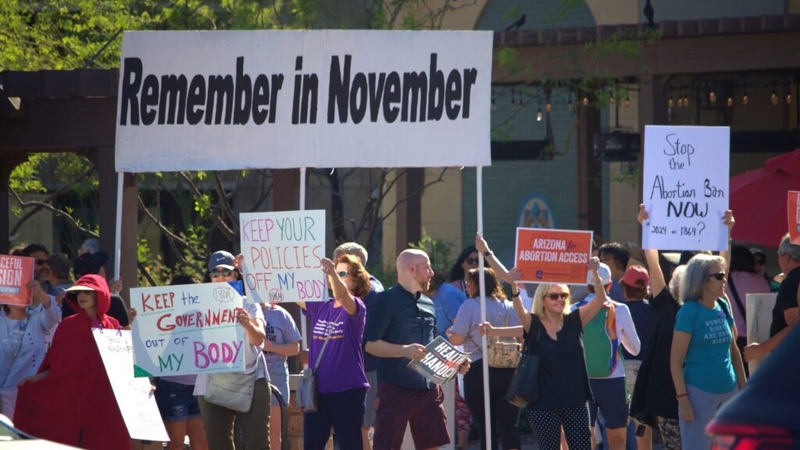
Protestors hold signs at an April 14, 2024, protest in favor of reproductive rights and abortion access in Scottsdale. (Photo by Gloria Rebecca Gomez/Arizona Mirror)
A survey of voters in three battleground states, including Arizona, found that abortion remains a deciding issue in choosing which candidates to support.
Impact Research, a public opinion research company that frequently works with progressive organizations, partnered with Reproductive Freedom for All to gauge how abortion might affect how voters in Michigan, Nevada and Arizona view candidates in the November midterms. Abortion rights advocates are hoping concern over the procedure’s access will sway voters in an election year when its continued legality turns on the outcomes of multiple races.
Arizona made abortion a fundamental right in 2024, with 61% of voters approving Proposition 139, which added the right to the state constitution. But who wins the contests for governor and attorney general in November could lead to new restrictions.
Gov. Katie Hobbs and Arizona Attorney General Kris Mayes, both staunch abortion rights supporters, will face off against longtime congressman Andy Biggs and state lawmaker Warren Petersen, respectively. Biggs has repeatedly backed federal legislation that would ban abortion nationwide, while Petersen has pushed anti-abortion laws at the state-level and directed the legislature to defend a near-total ban from 1864 in court.
That stark difference on abortion may prove to be a key factor as voters consider which candidates to back. Impact Research’s study found that 8 in 10 voters in the three battleground states believe it’s important for lawmakers to protect access to the procedure. Less than one quarter of respondents, just 22%, said they would like to see more restrictions on abortion care. And 43% said they would refuse to vote for a candidate who supported a national ban.
But alarm over future impediments to abortion access are secondary to other concerns, making it unclear if abortion is the mobilizing issue reproductive rights advocates hope it will be. Voters in all three battleground states ranked concern about Medicaid cuts and rising taxes as more important than abortion restrictions. According to researchers, that’s partly because of a “believability gap”: Voters simply don’t think that abortion bans are as likely to happen as deep cuts to Medicaid spending or increasing the tax burden on middle-class families.
“Most battleground voters are not hearing about the issue of abortion, so while many express concerns about Republican policies that restrict access to abortion, they also believe these policies are unlikely to happen,” reads the research memo.
An overwhelming majority of voters, about 76%, reported fearing that congressional Republicans would move to cut Medicaid funding. And 61% said they strongly believed that could happen.
In a bid to put abortion access at the forefront, Democrats and reproductive rights groups are investing in voter outreach efforts and trying to draw contrasts with their Republican foes.
For instance, Hobbs has made countering her opponent’s anti-abortion track record with examples of her work to protect access to the procedure a pillar of her political strategy. And Reproductive Freedom for All, which helped propel Arizona’s abortion rights amendment to success, is investing millions in voter messaging and canvassing efforts to keep the topic in the spotlight. The organization launched a $23.5 million campaign in June dubbed “My Body. My Ballot.” An initial $2 million of that will be spent across four swing states: Arizona, Michigan, Nevada and Georgia.
Athena Salman, the director of the Arizona chapter of Reproductive Freedom for All, urged voters not to become complacent about the right to abortion care, saying that the only way to guarantee continued access to the procedure is by rejecting candidates who seek to restrict it.
“Even with the protections we have fought hard to pass here in Arizona through Proposition 139, we know our reproductive freedom is under attack. Arizona Republicans continue to propose some of the most extreme anti-abortion legislation in the country,” she said in an emailed statement. “Voters will have the opportunity to hold them accountable for their anti-abortion extremism that puts lives in danger.”
- July 30, 202612:27 pm***UPDATE: The headline has been updated for clarity.
- July 30, 202612:08 pm***CORRECTION: This story has been corrected to show that Reproductive Freedom for All is making an initial $2 million investment across four swing states, including Arizona.
Phoenix, AZ