The 2026 legislative session is over. Here’s what passed, failed, and what is already Iowa law
May 04, 2026 | 11:16 am ET
Description
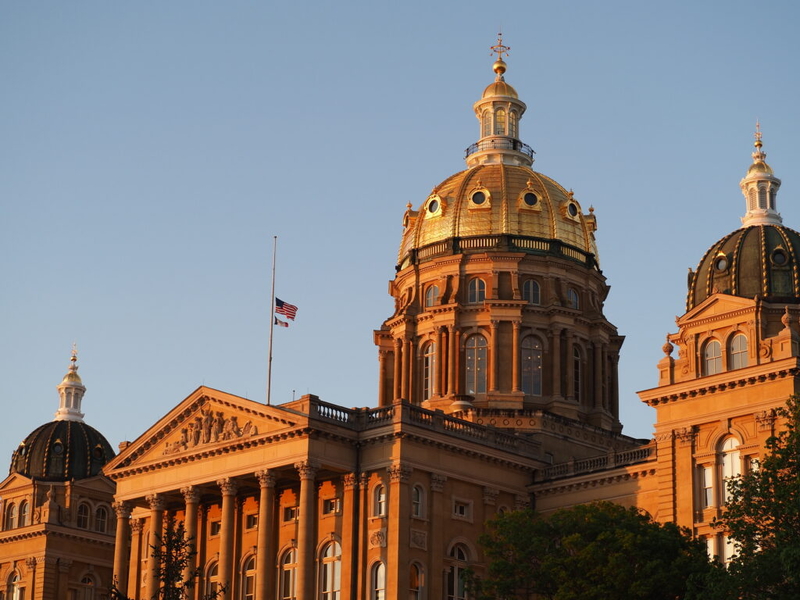
The Iowa State Capitol as seen May 3, 2026. (Photo by Robin Opsahl/Iowa Capital Dispatch)
Republican legislative leaders and Gov. Kim Reynolds celebrated the approval of many of their priorities for the 2026 legislative session on issues including property taxes, crime and healthcare as lawmakers wrapped up their work for the year.
Over the weekend, lawmakers sent a $9.6 billion state budget to the governor’s desk, as well as legislation restricting access to abortion-inducing medication by requiring the drugs to be prescribed in person.
One of the largest issues legislators found a compromise on in the final hours of the session was property taxes. Reynolds, Senate Republicans and House Republicans had all released their proposals on how to best address high property tax costs in the state early in session, but struggles to find a consensus on the issue was one of the main reasons lawmakers went into overtime after their goal end date of April 21.
Legislative leaders in both chambers said they were pleased with the property tax legislation sent to the governor’s desk Sunday. Senate Majority Leader Mike Klimesh said in a statement he was proud of the Senate Republicans’ months of work in crafting legislation that he says will lower property tax costs.
“Senate Republicans introduced legislation on the very first day to bring overwhelming property tax relief to Iowa homeowners and modernize Iowa’s property tax system,” Klimesh said. “We made great strides in reining in local government spending, reforming the property tax system, and now Iowa homeowners will see billions in property tax relief over the next several years.”
Klimesh also said he was proud of what Senate Republicans passed on a variety of other issues since convening in January.
“At the beginning of the legislative session, I laid out a vision for our state,” Klimesh said. “I wanted to spend our days here focused on growth and investment and ways we can show the world that Iowa is the best place to live, the best place to grow your family, and is open for business. My goal was to have conversations about tax reform, affordable energy, infrastructure and how we can help our state thrive. I am proud we have focused on that vision throughout this legislative session. “
House Speaker Pat Grassley told reporters after ending the legislative session he also believed House Republicans accomplished many of their goals for 2026.
“When we started session, we laid out a few priorities that I think that we made some tremendous strides on,” Grassley said. “Obviously, property taxes … but also looking at some of our ‘tough on crime’ packages and (making) sure Iowa is a safe place … I think there were a lot of the things that we laid out in the beginning of session that we were able to accomplish while this property tax piece kind of hung over everything else.”
One issue that did not make it to the governor’s desk through any legislation was eminent domain, a yearslong priority for House Republicans and top issue for several Senate Republicans. Last year, a group of Senate Republicans had refused to pass budget bills unless an eminent domain bill was debated on the Senate floor.
Eminent domain involves forcing unwilling landowners to accept easements on their property for projects deemed in the public interest for payment set by the government. The Summit Carbon Solutions pipeline across Iowa has been the catalyst for much of the debate.
This standoff did not occur this year, though the group of GOP senators had continued to state their support for bringing the issue up. Grassley said he understood some Iowa landowners’ frustration with the Legislature for not being able to push forward a bill in 2026.
“This is an issue that I really wish we would have been able to make more progress on, but I will only speak on behalf of House Republicans — we’ve tried, probably, I’m guessing, around a half dozen bills to try to find a level of a solution on this issue, to give some certainty to property owners in the state of Iowa. And again, we share your frustration and we’re unable to get something. But that doesn’t mean that that’s something our caucus won’t continue to fight for as we move forward.”
Democrats said many of the measures passed by the GOP-controlled Legislature are proposals that will raise costs for Iowans. Senate Minority Leader Janice Weiner said in a statement the “harm” caused by Iowa Republicans’ policies will not expand after lawmakers leave the Capitol for the year.
She said many of the policies passed this year raised costs for Iowans. Democrats have criticized measures like raising premium taxes for Health Maintenance Organizations as well as the state’s public K-12 education funding package as measures that will lead to higher costs and reduced services across the state.
““Iowans’ healthcare access is shrinking and their premiums are soaring; their monthly budgets are tightening and too many are living paycheck to paycheck; their public schools are unsupported and their childcare costs an arm and a leg,” Weiner said in a statement. “Instead of taking action to provide real, substantial relief on any of the kitchen table issues that truly matter to Iowans, Senate Republicans only made things worse.”
Democrats have also routinely criticized Republicans’ budgeting practices this year. The March Revenue Estimating Conference estimated the state expects to bring in roughly $8.5 billion, less than the $9.6 billion appropriated through budget bills this year, with plans to draw from reserves and the Taxpayer Relief Fund to account for this difference. Republicans have repeatedly stated the loss of revenue was expected as a result of income tax cuts approved in previous years.
But House Minority Leader Brian Meyer said he believes the spending approved this session shows the state budget is “in serious trouble” as lawmakers appropriate more than $1 billion than the state is taking in through revenue.
“That’s kind of scary, because the economy in Iowa and the farm economy especially, is not getting any better, and so we really have to do something to address this problem moving forward, because those reserves will only last two to three more years,” Meyer said.
The 2026 session also marks an important milestone for Reynolds, as it is her final legislative session as governor. In a news release Sunday, she celebrated reaching a deal on property taxes, as well as the Legislature’s passage of policy proposals she laid out at the beginning of session, like her “Make America Healthy Again” proposal, legislation on charter schools and on child care assistance.
She also celebrated the passage of her water quality package, unveiled Friday, that passed as part of the state’s agriculture and natural resources budget in the final days of session.
“Throughout my time in office, the commonsense, conservative policies we’ve enacted will ensure our state remains strong, prosperous, and vibrant for generations to come,” Reynolds said in a statement. “That has been my commitment to Iowans since day one, and I will continue to serve with that same purpose during my final months in office.”
In the coming weeks, Reynolds will be tasked with reviewing and deciding whether to approve legislation sent to her by lawmakers this year. The governor has 30 days from the end of session, June 2, to sign bills from the 2026 session into law.
With the Legislature adjourned for the year, here’s a rundown of some notable bills that made it to the governor’s desk, bills that have been signed into law and some that did not cross the finish line.
Signed by the governor
Childcare assistance: Beginning July 1, Iowa’s Child Care Assistance (CCA) program will become permanently available to parents who are child care workers as the governor signed House File 2514 into law. The measure makes the CCA pilot program that has been in place since 2023 permanent, allowing child care workers to access this assistance program regardless of income.
CDL English tests: Senate File 2426 requires applicants for Commercial Driver’s Licenses (CDL) to pass an English proficiency test in order to receive their license. The test would be administered through a computer-based exam, which only needs to be passed once, and could be taken multiple times. Truck drivers found to not meet English proficiency standards while operating a commercial vehicle would face a serious misdemeanor charge and civil penalty of $1,000 under the bill, and commercial motor carriers found to employ drivers not proficient in English would be subject to a simple misdemeanor charge and a fine of $10,000 for each violation. The measure would also issue an “out of service” order for companies found in violation of the proposed law, preventing the company from operating within the state.
DNR Department bill: House File 2215 allows the Iowa Department of Natural Resources to have offices offsite from the Capitol complex. It also lowers the age a person can hunt with a pistol or revolver without adult accompaniment from 20 to 18, and shifts powers over state preserves to the DNR.
Emissions lawsuits: House File 2527 limits lawsuits against farmers for the “alleged actual or potential” impacts of greenhouse gas emissions on the climate. Proponents for the bill said the legislation would help shield farmers from “frivolous” climate lawsuits.
Foreign ownership of health care facilities: Senate File 572 bans citizens, businesses and government entities from China, Russia and North Korea from being licensed to own and run health care facilities like hospitals and nursing homes in Iowa.
Foster care training: Senate File 2096 makes multiple changes to foster care licensing requirements in the state, including removing current requirements for foster parents to receive 30 hours of training and six hours of additional training annually. Instead, prospective foster parents would have to receive training based on their own “relevant training and experience,” as well as the “circumstances of the child” who would be placed with the prospective parent. Foster parent training under the bill would include an overview of child welfare, biological parent contact and supporting their family of origin, as well as behavior management, the effect of trauma on child development and issues like attachment, grief and loss, and could be administered through approved programs offered by both public or private agencies.
Health insurance premium tax increase for HMOs: House File 2739 raises premium taxes on health maintenance organizations, known as HMOs, from the current rate of 0.925% to 3.5% retroactively between Jan. 1 and Sept. 30, 2026. The rate lowers again to 0.95% beginning in October. Health insurance providers offering HMO plans, a type of privately offered Medicaid Advantage plan, said the law will result in higher premiums for Iowans, but Republican lawmakers said the tax hike is needed to cover the Medicaid shortfall caused by the COVID-19 pandemic.
The law also includes a provision moving $89 million from the state’s general fund to the Iowa Department of Health and Human Services for the state’s Medicaid program to address the shortfall in FY 2026, and transfers almost $350 million from Iowa’s Taxpayer Relief Fund to make up for revenue loss from tax cuts made at the federal level in 2025.
Local civil rights codes: Senate File 579, signed by Reynolds March 10, restricts local governments from implementing civil rights protections for groups not listed as protected classes under the state Civil Rights Act. Democrats called the bill an expansion of the 2025 law removing “gender identity” from the state civil rights code, saying it targets the 14 Iowa cities, as well as unincorporated areas of Johnson County, that have enacted local protections on the basis of “gender identity.”
Local identification cards: Local governments are also no longer allowed to issue community ID cards under measure signed into law by Reynolds. House File 2296 would specifically impact Johnson County’s community ID program, which lawmakers said is a program that aids law enforcement officers and first responders when a person does not have a driver’s license or nonoperator ID. Counties are still allowed to issue forms of ID like driver’s licenses, nonoperator’s identification cards and identification devices for persons with disabilities under the law, and local governments can still issue employee IDs.
Repealing state-mandated programs: House File 2359 would repeal state-mandated higher education programs like the College Bound program, Minority and Women Educators Enhancement Program and others. Reynolds signed the bill April 30.
Shellfish: A bill would create an individual category for shellfish in Iowa’s animal feeding operation code. House File 2534 adds shellfish as a separate category to the state definition of animal feeding operations, allowing for the regulation of shellfish producers in the state.
Subacute mental health care: House File 2543, passed unanimously through both chambers, aims to improve access to subacute mental health care – in-person, intensive mental health treatment for individuals who are not at high enough risk to need emergency hospitalization. The measure was brought up in response to suggestions made during a January Subacute Mental Health Care Services Interim Study Committee.
House lawmakers from both parties, as well as Senate Democrats, said they preferred the version of the bill passed by the House in March, which eliminated a current 10-day limit in state code for receiving subacute mental health care unless HHS gives approval for a longer period of stay. It also would have banned preauthorization requirements for a person to be admitted and receive care for the first 15 days of treatment at subacute mental health care facilities, and restricted when Managed Care Organizations could review the “medical necessity” of this treatment. Senate Republicans significantly changed this proposal, removing the language related to insurers and MCOs, and instead setting new requirements for HHS to respond to insurance authorization requests. Though some lawmakers expressed consternation about the Senate amendment, lawmakers agreed the change would still improve Iowans’ ability to access subacute mental health care.
Transmission lines in interstate right-of-ways: Senate File 2214 allows for transmission projects to be built in interstate right-of-ways, requiring the state Department of Transportation to engage in conversation with transmission line operators on potentially using highway and interstate easements.
Transmission line land restoration: House File 2227 requires electric transmission line owners to repair tile drains, till impacted soil and reseed cover crops or other ground cover after the initial construction of electric transmission lines in easement areas.
Transmission line safety plans: Transmission line operators will also be required to submit independent emergency response plans to the Iowa Utilities Commission under House File 2583. This requirement will ensure other entities involved in Iowa’s electric grid “abide by the same rules and laws as our electric utilities,” Rep. David Young, R-Van Meter, said.
Veteran tuition waiver: House File 2491, which saw unanimous support from the House and Senate before being signed by Reynolds, establishes a tuition and fee waiver for veterans with a 100% disability rating from their service as defined by the U.S. Department of Veterans Affairs.
On Reynolds’ desk
Agriculture
Iowa Farm Act: Iowa Secretary of Agriculture Mike Naig introduced Senate File 2465, a comprehensive agricultural policy before the beginning of session. The proposal included multiple provisions including tax relief measures for farmers, expanding the Choose Iowa program and new support for beginning farmers and ranchers.
The House amended the bill in committee to include language related to the state’s grain indemnity program, originally discussed as House File 2596. The program helps pay farmers for sold grain when buyers declare bankruptcy, that made a change to language requiring small grain dealers to undergo audits even if they did not allow for credit-sale contracts that was a part of the 2025 law revamping the program. The language advanced by the Senate and included in the final Iowa Farm Act measure, requires an option for farmers doing credit-sales to have an unqualified audit performed, or provide a financial statement accompanied by the report of a Certified Public Accountant in these circumstances.
The amendment was withdrawn on the floor before lawmakers approved the Senate’s version of the bill.
Rep. Derek Wulf, R-Hudson, said as the House approved the bill Saturday, that while House lawmakers “didn’t get everything that we wanted for the ag-friendly policy from the Senate negotiations in this bill, I still think it’s a strong positive step forward for Iowa agriculture, for expanding economic opportunities for farmers and also strengthening biosecurity and protections.”
Commerce
Innovation funds: Senate File 2453 requires the state’s public universities to invest at least 1% of their endowment fund assets in one or more innovation funds established by the state. The institutions would be allowed to decide where and when these contributions are made. The Board of Regents would be able to withhold 0.5% of funds appropriated to a university by the board if they are not compliant with the requirement, though the board would be able to receive a one-year waiver from making these investments.
Nuclear energy sales tax exemption: House File 2757 exempts companies working to restart or establish nuclear energy facilities in Iowa from the state’s sales and use tax. The bill requires businesses receiving this tax exemption to contribute to a Nuclear Energy Workforce Fund established within the state Board of Regents, providing funding for nuclear energy workforce programs at the state’s public higher education institutions, in order to qualify. The contribution amount is set at $2,200 “for each megawatt of nameplace capacity the nuclear electric generation facility is approved to produce by the Iowa Utilities Commission” annually for a period of up to four years under the bill.
Education
Cardiac emergency response: Senate File 2474 would direct the Iowa Department of Education to create a report on schools with cardiac emergency response plans, as well as information on equipment available at each school, to present to the Legislature ahead of the 2027 session. It was amended from an earlier version of the bill that would have created a pilot competitive grant program in the Iowa Department of Education to aid school districts seeking to establish cardiac emergency response plans, primarily focused on athletic events and physical education.
Charter schools and homeschooling: House File 2754 makes several changes to how the state funds charter schools and teachers working at these educational institutions. The measure would shift funding for the state’s Teacher Salary Supplement cost per pupil to go toward the charter school where a student is enrolled – funding that currently goes to the public school district where the student resides. The Legislative Services Agency estimated this would shift roughly $1.3 million to charter schools based on current enrollment figures. The bill also would require public school districts to make athletic and other extracurricular activities available to charter school students who live within their boundaries, and would add charter school teachers to the Iowa Public Employee Retirement System.
The measure was amended by the House to include several provisions related to homeschooling that have been discussed in previous sessions. It would remove restrictions on how many unrelated students can be taught at the same time by an independent private instructor, and would remove a ban on charging tuition, fees or other compensation for providing homeschooling services. Democrats said these changes would potentially put students in unsafe situations, as homeschooling options do not have the same safety and accountability measures in place as typical schools.
Civics education: House File 2361 and Senate File 2232, both of which would require state universities to include three-credit-hour courses in U.S. history and government designated by civics centers in general education standards, were placed under unfinished business in March and were not been brought up again by either chamber. The measure was revived on the last day of session, however, with inclusion of the measure in House File 2800, the standing appropriations bill.
Classroom removal: Senate File 2428 regulates how schools handle disruptive students. School attendance centers would be required to form review committees to determine whether a student who has been removed from a classroom should be returned to it. If the student’s behavior was nonviolent, the committee would have the authority to override a teacher’s consent in returning the student, but consent would be required if the incident that led to their removal was violent.
The proposal was also amended to include the creation of a pilot program based on the current Therapeutic Classroom Incentive Grant program that would create a separate attendance center at one urban and one rural school district to provide educational services for eligible students with behavioral problems or certain special education needs. The LSA fiscal note estimated the new facility for the pilot would cost $165,000 for the rural district and between $1 million and $4.4 million for the urban district.
Course framework: House File 2610 would require the Iowa Department of Education to work with Iowa community colleges and the Iowa Board of Regents to establish “statewide lower division general education framework and common course numbering systems” for community college coursework. Community colleges would also need to replace “traditional, prerequisite remedial coursework” in English and math with “corequisite developmental education,” the bill stated, and require regional career and technical education partnerships to demonstrate that expenses were made for high-demand jobs. The bill passed both chambers unanimously and was sent to the governor’s desk in early March.
Student loan information: House File 703 is waiting for a signature from the governor after seeing House passage last year and Senate approval in March. The bill requires ISL Education Lending — Iowa’s student loan liquidity organization — to provide to Iowa College Aid the estimates of the annual percentage rate (APR) of the Federal Direct PLUS loan and the assumptions it used for the estimate. Information would also need to be posted online and in certain cases be sent to students by universities with their financial aid offers.
Health care
Abortion medication: House File 2563 would limit access to abortion-inducing medications like mifepristone by requiring in-person prescriptions, restricting Iowans’ ability to obtain these medications through telehealth and mail-order prescription options. The House passed the bill May 1, with an amendment clarifying the definition of “abortion” to state medical treatment related to miscarriages and ectopic pregnancies could not be construed as abortion procedures. It was one of the last bills passed by the Senate on May 3.
Lawmakers passed the bill while restrictions on mifepristone took effect nationally through a U.S. appeals court decision.
Foster, adoptive parents’ beliefs: Senate File 473, first discussed during the 2025 legislative session, prohibits the Iowa Department of Health and Human Services from removing prospective parents from being considered for licensing or qualification to foster or adopt a child based on their sincerely held religious or moral beliefs about sexual orientation and gender identity. The measure states a person’s intent to “guide, instruct, or raise a child in a manner consistent with the person’s sincerely held religious or moral beliefs” cannot be a reason for their preclusion from consideration as a foster or adoptive parent – nor can their decision to not affirm, accept or support policies related to gender and sexual orientation if these policies conflict with their beliefs. Democrats argued the measure will put LGBTQ+ children and those with different religious beliefs in potentially unsafe situations. But supporters of the bill said the measure still allows DHHS to consider a child and their family of origin’s beliefs when deciding where to place a child.
Governor’s ‘MAHA’ bill: House File 2676 is the “Make America Healthy Again” proposal from Reynolds earlier this session. It requires the state to continuously request federal waivers to keep current restrictions on eligible food items purchased through the Supplemental Nutrition Assistance Program and Summer EBT program in place. It also makes ivermectin available over the counter.
The House added several provisions to the bill related to health, exercise and nutrition requirements at K-12 schools. The bill limits digital instruction time to an hour each day for K-5 students, and requires elementary school students to receive two hours of physical activity a week, alongside requiring schools to implement the Presidential Fitness Test.
HPV vaccine: Senate File 304 strikes a current exemption in Iowa law that allows minors to independently consent to receive the Human Papillomavirus (HPV) vaccine and the hepatitis B vaccine, without approval from a parent or guardian. While parental consent is required for almost all vaccinations for those under age 18, there’s an exception in Iowa law that allows minors to consent without parental permission to vaccines related to the prevention, diagnosis or treatment of sexually transmitted diseases or infection. Democrats said the measure may worsen Iowa’s high cancer rates, as HPV vaccines are linked with lower instances of cervical cancer when a person is vaccinated before age 17.
Medical conscience: House File 571 would allow medical practitioners and health care organizations to refuse to participate in or pay for a health care service that goes against their “ethical, moral or religious beliefs or principles.” It also requires medical practitioners to inform their employers of objections “based on conscience” when they decide not to provide a service, but opponents warned the bill would not necessarily require a medical provider to inform a patient about the situation.
SNAP, WIC changes: House File 2422 implements new eligibility restrictions for public assistance programs including the Supplemental Nutrition Assistance Program, the Special Supplemental Nutrition Program for Women, Infants, and Children (WIC), medical assistance programs, the state child care assistance programs and the family investment program, as it relates to citizenship. Iowa HHS would be required to use the federal SAVE database to verify immigration and citizenship status when determining eligibility for these assistance programs. Other changes in the bill, lawmakers said, reflect new federal requirements implemented through the “One Big Beautiful Bill Act.”
There are also new requirements to qualify for these public assistance programs in Iowa, including requiring a person to have 12 months of continuous residency in the state, and requiring earned income from all household members to be considered when applying for SNAP.
The Senate removed House-approved “work without worry” language that would have increased the income limit from 250% of the federal poverty limit to 300% of the federal poverty limit for Iowans to qualify for the Medicaid for Employed People with Disabilities program, which had received bipartisan support.
Vape, nicotine product tax: Senate File 2480 creates a new tax on vapes and other nicotine products, like nicotine pouches, with $3 million in revenue from the tax set to go toward pediatric cancer research. The proposal would tax these products at a rate of 5 cents on a per-unit basis. Vape products would be taxed at 5 cents per milliliter of nicotine or a nicotine analog in a solution, and containers of nicotine products containing up to 20 pouches would be taxed 5 cents. A proportionate tax would be added for each unit above 20 within a container.
The first $3 million of the funding generated through this new tax would fund pediatric cancer research, clinical therapy trials and provide physician-scientist leadership at the University of Iowa Stead Family Children’s Hospital. Any additional revenue would go to the Iowa health care trust fund, dedicated to Medicaid funding. This proposal was approved despite some health care and anti-tobacco advocates calling for a higher tax, and other proponents stating they preferred the House proposal, House File 2310, to provide a standing appropriation of either $1 per Iowa resident or $3 million for pediatric cancer research at the UI.
Justice and public safety
Age verification: House File 864 requires websites and social media platforms to implement “reasonable” age verification steps if one-third or more of the content available is pornographic. The measure, first discussed in 2025, was amended to address some issues regarding privacy and collection of data by online entities in the process of verifying users’ ages.
Bail restrictions: Senate File 2399 contains language from one of House Republicans’ “tough on crime” proposals, setting new limits and requirements related to pretrial bonds, while allowing for inflation adjustments for bond scheduling. A judge would need to provide written justification if they set bail lower than the uniform bail schedule, and would need to provide written justification for any pretrial release for people charged for certain crimes, like a forcible felony, intimidation with a dangerous weapon, or possessing or transporting a weapon by a felon. It also bans “promise to appear” releases for individuals facing simple or misdemeanor charges related to violence or drugs. Pretrial releases can still occur for people charged with serious and simple misdemeanors that are not violent or related to drugs or for necessary medical attention.
Judicial safety: Senate File 2280, proposed by Attorney General Brenna Bird, makes state lawmakers, judicial officers, the attorney general, deputy attorneys general and assistant attorneys general eligible for a professional permit allowing them to carry firearms anywhere in the state, including on school grounds. It would also raise penalties for threatening a judicial officer or their immediate family members from a misdemeanor to a class C felony.
Law student loan repayment: The Justice System appropriations bill, House File 2770, was amended with language from House File 2331 to establish a loan repayment program for certain attorneys practicing in rural areas and providing indigent defense services.
‘Three strikes’ system: House File 2542 — the central component of House Republicans’ “tough on crime” agenda — proposed creating a “three strikes” system for individuals who commit certain crimes. As first passed by the House, certain crimes, like felony charges and misdemeanors involving acts of violence, would be labeled as a full or half “point” under the system. Once a person reaches three total “points,” they would face a minimum 20-year prison sentence.
The agreement reached between both chambers is significantly more restricted. In its amended form, the bill states that when a person has committed a third felony, they face a minimum seven years in prison on top of their base sentence. This additional sentence could not be deferred or suspended. Sen. Mike Bousselot, R-Ankeny, said the bill builds on Iowa’s existing habitual offender policy, which currently requires a three-year mandatory minimum for an individual convicted of their third felony.
Warrant resolution clinics: House File 2787 moved quickly through the legislative process as lawmakers aimed to end the 2026 session. The bill bans public entities from hosting, sponsoring or providing funding for warrant resolution clinics, defined as a “prearranged, formal or informal, advertised event designed to allow individuals with outstanding arrest warrants to appear and resolve such warrants without being subject to immediate arrest and custodial processing.” It would also subject public employees and officials as well as counties to penalties for violating the proposed law.
The measure was brought forward in response to the killing of Ashley Marie Hall earlier in April. Sharneeka Evans, who attended the clinic and had an unrelated, lesser warrant resolved, was charged with first-degree murder in Hall’s shooting death.
Labor and the workforce
Public union recertification lists: Senate File 472 would make it illegal for public employers to not submit a list of their employees to the Employment Appeal Board (EAB) before a union recertification election. The recertification process is required to take place under the state’s 2017 collective bargaining law that asks workers in a bargaining unit if they want to retain union representation before the next contract period. If an employer does not submit a list, any Iowa resident would have the ability to petition a district court for a writ of mandamus to compel the entity to submit the list, which is required to proceed with the recertification vote. Republicans and supporters of the bill said the measure was necessary because some public employers were allegedly not submitting lists intentionally in order to circumvent the recertification process and negotiate contracts with current union representation.
Natural resources
Animal torture: House File 2348 creates a Class D felony charge for committing animal torture. The bill states a person commits animal torture if they “intentionally, willfully, and maliciously mutilates, burns, poisons, drowns, starves or causes intensive or prolonged pain or death to a companion animal, or provides anything of value to another person to do the same.” The charge would be raised to a Class C felony if the person had been previously convicted for animal abuse, animal neglect, animal torture, injury to or interference with a police service dog, bestiality or “an act involving a prohibited animal contest.”
Hydrogen guardrails: As some companies begin exploring the possibility of extracting geological hydrogen in Iowa, Senate File 2490 proposes creating new regulations, taxes, and compensation standards for natural resource extraction in the state. The measure would establish a 6% severance tax based on the “fair market value of the oil and gas extracted at a wellhead.” Portions of revenue would go to Iowa counties as well as to state funds.
It also would establish “pooling” standards that would provide compensation to Iowans who do not enter agreements with drilling companies for hydrogen, oil or gas extracted from beneath their property. At least 25% of landowners on a site must consent to allow the company to drill for hydrogen in a location.
The measure generated some pushback from landowners who are also involved in other eminent domain issues related to carbon sequestration pipelines, though lawmakers supporting the bill said this issue was not related to eminent domain. The House added additional landowner protections through amendments, which were approved by the Senate.
State government
Affirmative action: Existing requirements for Affirmative Action plans and reports in Iowa law for entities like the departments of Education and Administration, the executive branch, Board of Regents, community colleges, school districts and area education agencies would be eliminated by House File 2711. The measure also removes racial and cultural awareness training requirements at the Iowa Law Enforcement Academy and annual bias prevention training for law enforcement agencies that were approved with bipartisan support in 2020 through a police oversight law. The measure was amended by the House to add back a requirement to train police on deescalation techniques, as well as keeping in place certain references to citizenship in state policies.
Driver’s license citizenship checks: Senate File 2187 would require the Iowa Department of Transportation to verify individuals’ citizenship status when they are applying for or renewing a driver’s license or nonoperator’s identification card. A person would be able to bring certain documents, like a Social Security card or passport, to verify their citizenship, but if a person does not have identification, the DOT would be required to use the federal Systematic Alien Verification for Entitlements (SAVE) database to verify people’s citizenship status. If a person’s citizenship cannot be verified, the DOT could not issue them an ID. Democrats opposing the bill said there have been multiple instances where SAVE has incorrectly listed people as noncitizens.
Early Childhood Iowa: The final version of legislation making changes to the state’s Early Childhood Iowa system, Senate File 2488, is significantly scaled back from earlier proposals. In its final form, the bill creates an opt-in, voluntary system for ECI area boards to choose to move their home visiting contracts over to HHS oversight, which would allow the state to draw down funding through the federal Family First Act. It also still creates a statewide Early Childhood and Family Services (ECFS) system based of the seven “health and human services districts” established in other legislation, but does not transfer funding or authority from ECI boards to this system, though it does move some of these powers for other existing structures like Decategorization Projects, or Decat, boards to the ECFS system.
This is a much more limited proposal in comparison to changes proposed earlier in the session, which included a proposal to repeal the existing ECI program and transfer funding and oversight to ECFS, as well as a later iteration that would have transferred home visitation contracts from ECI control through the “School Ready Fund” to HHS. The final bill also would create an interim legislative study committee to review the current ECI system and make recommendations ahead of the 2027 session.
E-Verify, SAVE and other citizenship checks: Senate File 2218 was agreed to in both chambers following a conference committee as the Senate and House had been unable to reach an agreement. The final bill, as approved by both chambers, would enact language originally implemented through an executive order from Reynolds, requiring state government and state licensing boards to use the federal Systematic Alien Verification for Entitlements (SAVE) database and E-Verify system to verify citizenship and legal status of people seeking state government jobs, as well as professional and occupational licenses. This executive order was implemented in the aftermath of the immigration arrest of former Des Moines Public Schools superintendent Ian Roberts.
As originally passed by the Senate, the bill directed the Iowa Board of Educational Examiners to have applicants seeking new and renewing educator licenses to provide information about their legal U.S. work authorization, and to submit proof of their eligibility every five years to remain licensed. This language is still included in the final bill.
There was a dispute over whether the conference committee followed the correct legislative procedures to advance a new version of the bill, but the measure was passed in both chambers with some changes to the original language, such as adding a challenge process for people who believe they have been wrongfully denied. It also includes language making it a crime to provide a false Social Security number to an employer to obtain a job, require Iowans registering to vote to swear they are a U.S. citizen under penalty of perjury, and set new bail restrictions on undocumented immigrants.
Foreign involvement in ballot measures: House File 2601 requires political committees advocating for or against a ballot measure in Iowa to confirm with donors that they are not foreign nationals, as well as that they have not “knowingly or willfully” accepted more than $100,000 from any foreign nationals within the past four years before contributing to the political committee. Individuals without U.S. citizenship or permanent residence, as well as organizations, political and government entities and businesses owned or based outside the country would be banned from “directly or indirectly” making expenditures or contributions to ballot issues.
Governor’s powers: As passed by the House in March, House File 2694 limits future governor’s abilities during disasters and public health emergencies like the COVID-19 pandemic, stating a governor can make recommendations but not implement restrictions, on private businesses’ operations during public health disasters, cannot order places of worship to close, and that changes to election laws and regulations must gain legislative approval.
The Senate attempted to amend the measure to add language from Senate File 2388, a bill that would create “continuing appropriations” for years when the governor and Legislature fail to reach an agreement before the beginning of the next fiscal year, July 1, but the amendment was not adopted by the House. The proposal would have still required lawmakers to pass and present a budget to the governor, but have a continuing resolution take effect only if the budget has not been enacted. Senate Republicans argued this language would prevent Iowa from experiencing government shutdowns like those happening at the federal level, Democrats called the proposal a “power grab” that would allow a Republican-led Legislature to refuse to negotiate with a potential Democratic governor.
The Senate receded on this proposed amendment, sending the bill with only the provisions related to gubernatorial powers to Reynolds’ desk.
Income tax constitutional amendment: Passing an increase to Iowa’s individual and corporate income tax rates would require approval from two-thirds of the state Legislature under Senate Joint Resolution 11. The bill, having received approval from both chambers in two consecutive general assemblies, will go before Iowa voters on the Nov. 3, 2026 general election ballot. If approved by a simple majority of voters, the language will be added to the state constitution.
Property taxes: In its final form, Senate File 2472 caps most local government revenue growth to 2% annually, with several exceptions. The proposal also would change the homestead tax credit to an exemption and raise the amount covered, while also raising the tax credit for elderly and disabled homeowners from $1,000 to $1,500.
The measure also incorporates portions from previous proposals. It would classify multi-residential properties separately from residential properties, and increases the property tax rate for these buildings to 6% over three years — scaled back language originally included in the Senate bill. From the House bill, it takes language speeding up the transfer of revenue generated through the Secure an Advanced Vision for Education (SAVE) funding to go from school infrastructure toward property tax relief, in addition to lowering the state’s $5.40 uniform levy set for school foundation property taxes.
The bill also includes multiple changes limiting timelines and usage rates for Tax Increment Financing (TIF) districts. The measure does not include earlier proposals from the Senate to change the state’s “rollback” system for calculating property taxes, nor did it include language adding an inflation index to the state’s gas tax.
Radon mitigation: House File 2297, amended and passed by both chambers, would require new single- and two-family residences to be constructed with passive radon mitigation systems. Lawmakers introduced the bill as an effort to help reduce the prevalence of lung cancer in the state since radon exposure is the second leading cause of the disease, and amended the legislation to ensure local governments include the rules in code.
Speed limits: Senate File 378 increases the speed limit on two-lane state highways from 55 to 60 miles per hour. Other existing default speed limits in areas like residential and school zones would remain in place.
What failed
Agriculture
American cream draft horse: Senate Joint Resolution 2010 proposed making the official state horse of Iowa the American cream draft horse.
Diesel exhaust fluid repairs: House File 2529 would have required manufacturers of farm equipment with diesel engines to provide tools and parts to equipment owners to repair their equipment.
Puppy mills: House File 2674 proposed updating inspection requirements for commercial animal breeders, kennels, pet shops and related businesses. The measure would have established more powers for IDALS to conduct inspections, especially in cases where there is evidence of an establishment violating standards of care.
Raw milk and farm-to-table events: House File 2767 would allow raw milk to be sold at on-farm stores, in addition to creating special permits for farm-to-table events. Cottage foods could also be sold at grocery stores under the bill. The bill passed the House after the raw milk provisions were removed, but the legislation did not advance in the Senate.
Right to repair: House File 2763 would require manufacturers of agricultural equipment to make materials needed to repair or maintain this equipment – like documentation, parts, software and tools – available to independent repair facilities and equipment owners at “fair and reasonable terms and costs.” The measure received bipartisan support in the House, with supporters saying it would help farmers who currently are forced to depend on licensed dealers to make repairs to equipment they have already bought. The bill did not advance in the Senate.
Soybean foam: Senate File 2375 is aimed at encouraging local governments to use soybean-based firefighting foam by having the Iowa Department of Administrative Services to develop a master contract with a soybean foam producer.
Commerce
Community solar: House File 2672 proposed providing utility bill credits to community members who choose to invest in small, local solar fields which would be connected to the electrical grid. The credits would be based on how much the members invested in the project, and how much energy was generated.
Data center regulations: House File 2690 would require data centers to submit water and energy usage reports on a regular basis. Data centers would also have been placed into a separate class of customers from other commercial or industrial retail electricity consumers, to avoid passing on the costs of powering data centers onto other customers.
Grid enhancement: House File 2682 proposed having utility companies conduct periodic feasibility studies into grid enhancing technologies that would be capable of increasing power capacity in Iowa’s electricity systems.
Penny phaseout: Senate File 2456 would allow cash transactions to round down to the nearest five-cent mark for amounts ending in one, two, six or seven cent, and rounding up to the nearest five-cent number for transactions ending in three, four, eight or nine cents. If the total amount of a transaction or payment is one or two cents, this cost would automatically become five cents. The measure would not make changes to transactions or payments made through other methods, like checks, credit cards, electronic fund transfers or gift cards.
Prediction markets: Senate File 2470 sought to regulate and tax a growing industry of “prediction markets” – companies that conduct event-driven market trading. The bill would have required companies like Kalshi and Polymarket to obtain a state permit to operate in Iowa, with a permit costing $20 million alongside a $100,000 annual renewal fee. Additionally, the Senate proposal included a 20% tax on adjusted revenue each year from traders within Iowa, and a 20% excise tax on the purchase price of each contract on the platform.
Ratemaking: House Study Bill 519 proposed expanding the definition of what projects would be eligible for certain ratemaking principles in Iowa in an effort to encourage nuclear energy and energy storage projects to come to the state.
Ratepayer involvement in public utilities: House File 2668 would have recognized customer-owned energy storage, generation and virtual power plants, while setting new public transparency standards for utility resource planning.
Silver and gold as tender: Gold and silver could be used as legal tender by Iowans under House File 2723. The state treasurer would have been required to establish a “bullion depository” as well as establishing electronic payment systems to utilize the stored gold and silver tender.
Standard siting for renewable energy: House File 2580 proposed new standard language for counties to adopt related to renewable power generation facilities including moratoriums, setbacks, property tax and other considerations.
Education
Antisemitism at schools: The Iowa Board of Education would have had to publish an annual antisemitism report identifying “each complaint or incident of antisemitism” taking place at public universities, community colleges and public school districts under House File 2544.
Athletic scrimmages: Senate File 2392 proposed allowing public and nonpublic schools to hold athletic scrimmages with home school sports organizations with certain limitations in place for duration and intensity. These events also could also not have official scorekeeping, play-by-play announcements or apply to a team’s regular season athletic statistics.
Banned concepts: Senate File 2405 would have allowed residents of a school district, parents and school employees to bring civil suits against schools for violating Iowa Code restricting instruction on concepts like “critical race theory.” Sen. Sandy Salmon, R-Janesville, said the bill was needed because some parents alleged the Board of Educational Examiners did not properly take enforcement actions based on their reports of noncompliance with existing law.
Cameras in special education classrooms: House File 2681 proposed equipping special education classrooms in public and charter schools with video recording systems, paid for using the state School Foundation Aid.
Charlie Kirk: The Board of Educational Examiners would be required to disqualify applicants and revoke licenses of educators identified as “publicly celebrating any act of politically motivated violence, including the unlawful killing of Charles J. Kirk” under House File 2512. The proposal would have applied retroactively to Sept. 10, 2025, the day Kirk was fatally shot. The bill was amended by the House Education Committee to add language related to student protests, such as having schools boards extend their district’s school calendar by one day for each day a student protest occurs at any attendance center within the district.
Classic Learning Test: House File 2339 would require the Iowa Board of Regents to include the Classic Learning Test in its regent admission index and states universities can only factor “merit and likelihood of employment in Iowa after graduation” in their admission decision for students who don’t meet the index threshold. The bill passed out of subcommittee and the Iowa House Higher Education Committee but did not see debate from the chamber, though the board of regents has proposed changing its admission formula to include more than just the ACT and SAT.
Closing U.S. Department of Education: Senate Joint Resolution 2012 includes language showing support for federal efforts to close the U.S. Department of Education and calling for cooperation from Congress. The bill passed out of the Iowa Senate Education Committee Feb. 18 but was not taken up by the chamber for debate.
Community college bachelor’s degrees: House File 2649 would establish a pilot program for community colleges to offer up to three baccalaureate degree programs with guardrails as to which programs are allowed and where they can be launched. Community colleges and private universities were split on their support for the bill, and while the Iowa House passed the legislation out of debate on March 4 and through an Iowa Senate subcommittee March 18, it failed to make it through the second funnel of the session.
Continuing education: House File 2246 would bar state licensing boards from requiring continuing education credits not directly related to their profession unless otherwise required by law. The amended legislation passed through House debate and was referred to the Iowa Senate State Government Committee but was not taken up.
Credit transfers, performance-based funding: House File 2547 would expand credit transfers for career and technical education, change career academy rules and establish a fund for students taking summer community college credit courses in areas relating to high-demand jobs, as well as require the Iowa Board of Regents to explore implementing a performance-based funding model. The bill passed the House and was recommended for amendment and passage by the Iowa Senate Education Committee before being placed on unfinished business in late March.
DEI in private universities: House File 2488, which would put the Iowa Tuition Grant on the line for private colleges and universities that open or maintain offices of diversity, equity and inclusion, saw House approval but a recommendation for indefinite postponement from a Senate subcommittee.
Dress codes: House File 2486 would have set minimum dress code standards for public and charter schools, with the ability for school boards to adopt more restrictive policies, such as a school uniform requirement. The minimum requirements would have stated students must dress in clean clothes in good repair that do not expose “undergarments or midriffs.” Boards would also have to set enforcement policies for violations of the school’s dress code.
Education reporting: House File 2725, which would consolidate reports on online learning, achievement gaps and other topics into an “annual condition of education report” and change other reporting requirements for Iowa Workforce Development and the Iowa College Student Aid Commission, passed the House and was attached to Senate File 2407 but saw no further action.
Endowment tax: House File 2240, as amended by the Iowa House Higher Education Committee, would place a tax on university endowments holding more than $500 million, at a rate equaling the highest corporate income tax rate, identified in the bill as currently 7.1%. Institutions that would be impacted by the bill if it is signed into law include Grinnell College, Iowa State University and the University of Iowa. After passage by the higher education committee, the legislation was referred to the House Ways and Means Committee where it was not discussed.
Firearms in vehicles: House File 621 would have allowed parents and guardians to keep legal firearms in their vehicles while picking up and dropping off a student on school grounds. It also proposed changing language to allow weapons to be carried in passenger compartments of school vehicles to allow school trap shooting teams to transport their weapons on school buses when traveling for events.
Free speech: House File 233 is a proposal to prohibit schools from penalizing or discriminating against students for expressing viewpoints through religious, political or ideological speech in situations where “similarly situated students” are not punished for expressing other beliefs on the subject at hand. Democrats called the measure duplicative, as students’ speech is already protected by the First Amendment, but said the measure would create new legal liabilities and increase costs through new training and compliance requirements.
Gender and sexuality in K-12 materials: House File 2338 proposed expanding the current Iowa law banning programs, materials, instruction and “promotion” related to gender identity and sexual orientation in public and charter schools for K-6 students to apply to all K-12 students. The law restricting these materials for K-6 students is currently being challenged in court, but was allowed to be enforced as of an April 6 court decision.
General education review: House File 2487 and Senate File 2303 would have required the Iowa Board of Regents to review all general education requirements and core curricula at state universities for diversity, equity and inclusion or critical race theory-related content. The board “in its discretion” would then direct institutions to eliminate courses or course requirements, the bill stated. While the legislation was placed under unfinished business, the Iowa Board of Regents have proposed adding a biannual review of this kind to its policy manual.
H-1B visas: House File 2513 would prohibit public universities from entering employment contracts with federal H-1B visaholders who are citizens of China or other “federally designated foreign adversaries,” the bill stated, including Syria, Russia, Iran, Cuba, North Korea and Venezuela. The legislation was placed on unfinished business after passing the House and the Senate Workforce Committee.
Immunization requirements: House File 2171 proposed removing all K-12 immunization requirements for attending school. The measure was not taken up for floor debate.
Iowa Board of Regents: House Study Bill 534 would replace the Iowa Board of Regents voting student member with another governor-appointed member and add seven ex-officio, nonvoting members, as well as require biannual general education standards and low-enrollment program reviews and have the board of regents develop policies on post-tenure review, approving academic programs and barring governance authority by faculty senates or councils. An Iowa House subcommittee approved the legislation, but it was not brought up by the Iowa House Higher Education Committee and died in the first funnel.
Library agreements: House File 2324 would have banned public and charter schools from entering certain commitments with public libraries, including contracts allowing “bookmobiles” or mobile libraries on school grounds. It also would have banned agreements allowing students to use school IDs as a library card to access public library materials. Education advocates told lawmakers the proposal could have an outsized impact on rural school districts that depend on public library agreements because their school buildings do not contain libraries.
Loan liability: House File 2241 would have made public universities liable for 10% of the amount owed by students with defaulted educational loans.
Presidential searches: House File 2245 would require the Iowa Board of Regents to use a presidential search committee when selecting a new university president, with candidates’ identities kept confidential unless a written agreement is made. Senate File 2359 was attached to it and both are on the calendar as unfinished business.
Residency requirement: House File 2226 would have set a 70% residency requirement in the University of Iowa’s bachelor of science in nursing program and require the program to have priority admission for Iowa residents, but didn’t make it to the Senate Education Committee after House passage.
School reorganization incentives: Senate File 2403 would have extended the currently expired reduced uniform levy incentives for school districts that reorganize from July 2024 to July 2031 and established a new incentive for whole grade sharing supplementary weighting.
Social studies: House File 2244 and Senate File 2413 would require seventh- and eighth-grade students to receive instruction on U.S. government for at least one-half of a semester. Both were placed on unfinished business before the second funnel deadline and were not brought up again.
Social studies standards: After some lawmakers expressed disapproval with the social studies standards set forward by a task force created through a 2024 law, House File 2510 reiterated requirements from the 2024 law for social studies courses to include instruction on “exemplary figures in western civilization, the United States and state of Iowa,” and the “cultural heritage” of western civilization and the history of the “secular and religious ideals and institutions of liberty.”
Trump higher education compact: House File 2489 would have required public universities to join the Compact for Academic Excellence in Higher Education, created by President Donald Trump and his administration, but saw no support beyond House Higher Education Committee approval.
Tuition freeze: House File 2242, approved in House debate but not brought up in a Senate subcommittee, would have frozen tuition for all resident undergraduate students at state universities until July 2031.
Tuition guarantee: Senate File 2227 and House File 2362, both placed on unfinished business, would require universities to keep resident undergraduate tuition at the same level as the amount they paid in their first year of attendance, with certain exceptions, starting in 2027. The Iowa Board of Regents has proposed including an optional tuition guarantee pilot program in its board policy manual.
Vaccinations: Senate File 2424, amended and passed by the Iowa Senate Education Committee Feb. 18 but not brought up in debate, would require private colleges and universities with clinical rotation programs to identify placements where students are exempt from any vaccination requirements put in place by the host of their rotation placement.
VEISHEA: House Study Bill 545, passed out of subcommittee but with no further action, would have the Iowa Board of Regents study the possibility of reinstating VEISHEA at Iowa State University and report its findings on whether the idea is practical and beneficial to the university to the Iowa House Higher Education Committee chairperson.
Veterinary medicine residency requirement: House File 2209, passed through subcommittee Feb. 17, would enact an 80% residency requirement in the Iowa State University veterinary medicine professional degree program. It was not brought up again.
Health care
Abortion ban: All elective abortions would be banned in Iowa under House File 2332, which failed during the first funnel deadline. Exemptions were included for cases like miscarriages, in-vitro fertilization and when an abortion is necessary to save the life of the mother. The proposal would have also added criminal punishment to the state’s homicide laws for doctors who perform abortions.
Conversion therapy: House File 2557 proposed adding exemptions to the state’s definitions of “child abuse” and “child endangerment” related to a parent or guardian not affirming their child’s gender identity if it differs from their sex assigned at birth. This issue could also not be considered during foster parent licensing, adoption or custody proceedings. Actions that are exempt from these definitions are a parent’s “intent to raise, guide or instruct a child in a manner consistent with the child’s sex,” or not consenting to a child receiving gender-affirming medical care or calling them by a name or pronouns different from their legal sex.
LGBTQ+ advocates and Democrats opposed the bill, especially highlighting the provision stating “seeking and consenting to a mental health service for a child for the purpose of helping the child live a life consistent with the child’s sex” could not be considered abuse or endangerment. This language would mean the discredited practice of “conversion therapy” aimed at changing a person’s gender or sexual orientation could not be considered abuse or endangerment, speakers said.
‘Granny’ cameras: Senate Study Bill 3080 would allow a nursing home resident or their representative to conduct electronic monitoring of the resident’s room through the use of video cameras — sometimes called “granny cams” — placed inside the room with the consent of any roommates.
Hydroxychloroquine: Over-the-counter dispensal of ivermectin is allowed under the governor’s “MAHA” bill, which made it to her desk – but another measure, House File 2056, proposed allowing the disbursement of both ivermectin and hydroxychloroquine, a prescription medication typically used in treating malaria, without a prescription. Both medications have been promoted by non-verified sources as a means to manage or treat symptoms of COVID-19.
Kratom: Kratom, a substance currently legal for sale and possession in Iowa, would be designated as a Schedule I hallucinogenic substance by House File 2133. Businesses would no longer be able to sell the substance under the proposal, which was not taken up by the Senate, and those found in possession of kratom would face a serious misdemeanor charge for their first offense, an aggravated misdemeanor for their second and a Class D felony charge for subsequent offenses.
Nitrous oxide: House File 2504 would have banned vape stores from selling nitrous oxide containers under the rebuttable assumption that these products are being sold as an inebriant.
Psilocybin: House File 978 proposed establishing a regulatory framework for the legal, medical use of psilocybin, the psychoactive compound in “magic mushrooms.” The substance would be regulated through the existing Medical Cannabidiol Advisory Board, which would be expanded to include four members with expertise on psilocybin treatment. Products with psilocybin would have to be administered in-person in clinic environments with psychiatric support, and the substance would be restricted to individuals seeking treatment for post-traumatic stress disorder.
The measure, passed by the House in 2025, was advanced as a treatment option for veterans and others struggling with PTSD. It was passed by the Senate Ways and Means Committee Friday before session ended, but the measure did not come up for floor debate in the Senate.
Tobacco tax increase: Though the measure to create a new tax on vapes and nicotine pouches was moved forward, other efforts to implement these taxes at a higher rate – as well as to raise excise taxes on traditional tobacco products – failed this session. These provisions were removed from Reynolds’ “MAHA” bill earlier in the session, and failed to advance in the Senate Health and Human Services Committee as Senate Study Bill 3145.
Rep. Brett Barker, R-Nevada, introduced House File 2406 in February, which proposed raising taxes on cigarettes by $1.50, in addition to taxing other nicotine and vape products. This proposal did not receive a subcommittee hearing.
Justice and public safety
Automatic license readers: Senate File 2034 states that implementing Automated License Plate Readers (ALPR) would require approval from a local government through ordinance, and restrict use to state-approved entities. The bill also restricts the use of automated vehicle noise enforcement systems. The Senate amended the bill to include new restrictions on how many license readers can be operated within a locality based on its population.
Boy Scouts settlement: The Senate approved Senate File 2489, a measure to extend a 2024 law lifting Iowa’s statute of limitations on child sexual abuse to allow Iowa victims to participate in a national Boy Scouts sexual abuse settlement as claims and payouts for the settlement are still being processsed. The measure was not taken up by the House, which some advocates say mean Iowans involved in the settlement may receive less compensation than victims in other states.
Divorce: Senate File 2172 would have allowed couples getting married seek a waiver allowing them to opt out of no-fault divorces. Under the proposal, a person granted the waiver would have to provide proof of specified reasons to divorce their spouse, such as adultery, abuse or living apart for more than two years in order to have a divorce granted.
Dog identification: House File 2190 would have updated state definitions on how to prove ownership of a dog to include things like microchips, tattoos, receipts, contracts and veterinarian bills.
Judicial retention information: House File 2719, a component of House Republicans’ “tough on crime” package, would have required the Iowa Secretary of State to create a publicly accessible online dashboard with data on judicial practices, for the primary use of Iowans seeking information on judges during judicial retention votes. Data on the website would include a judge’s decisions on setting bonds and pretrial releases, sentencing outcomes, decision reversals and courtroom efficiency, and would allow judges to submit a personal statement.
Katie’s Law: A proposal from AG Brenna Bird, House File 2624 would require the collection of DNA from criminal defendants charged with a felony or violent aggravated misdemeanor when they are arrested – before they are convicted of the crime. The measure is modeled after a law originating in New Mexico known as “Katie’s Law,” named in honor of Katie Sepich, a 22-year-old University of New Mexico student who was killed in 2003.
Sprinklers in townhouses: Senate File 2439 proposed removing current state building code requirements for fire protection sprinkler systems to be in townhouses 18,000 square feet or less, in addition to banning similar restrictions from being put in local building codes. Sprinkler requirements for detached single-family residences of 6,500 square feet or less would also be removed from state code and banned in local regulations.
Labor and Workforce
Skilled workforce training: House File 2466 proposed raising funding going toward the state Registered Apprenticeship programs from $3 million to $4.5 million. It also proposed creating a “career training physical expansion program fund” to fund new facilities at community colleges and private sector programs for high demand fields, and would make changes to who can provide apprenticeship training.
State government
Annexing Galena, IL: House File 2141, proposed by Rep. Taylor Collins, R-Mediapolis, would have created a committee to study if one or more counties in Illinois that border Iowa should become a part of the state. It did not receive a subcommittee hearing.
Commercial volumes: Senate File 2294 would have restricted the volume of commercials on video streaming services. The ads could not be transmitted “at an audio volume louder than the audio volume of the video programming or video content the advertisement accompanies” to Iowa consumers, similar to restrictions in place for ads on broadcast television.
Driverless vehicles: Companion bills House File 2673 and Senate File 2384 would have held owners of self-driving vehicles liable in cases of a vehicle crash or traffic law violation. It would also prohibit hazardous materials from being transported in autonomous vehicles unless a human driver was present.
Drug-free homeless zones: House File 2584 would have established “drug-free zones” at homeless shelters and other support facilities in Iowa, raising criminal charges for people who unlawfully sell and distribute controlled substances within a 300-foot zone of the facility. Criminal charges would also be created under the bill for facility operators convicted of “intentionally or knowingly” allowing illegal substances to be sold or possessed in the designated zone, and operators convicted would not be eligible for state homelessness assistance grants for three years. The bill was not taken up in the Senate.
Iowa City Research Center: Senate File 2293 would have struck a current requirement under state code for the Iowa Department of Administrative Services to maintain a historical resource research center in Iowa City, while continuing to maintain a center in Des Moines. The proposal came after DAS had already moved to close the State Historical Society of Iowa Research Center in Iowa City – action that is currently facing litigation from two parties.
Library bills: No bills aimed at restricting content available at public libraries made it to floor debate this session, but several provisions were discussed in subcommittee and committee meetings.
House File 2309 proposed requiring material deemed “harmful” to minors to be housed in the adult section of a public library that could not be accessible to minors without staff assistance, requiring parental approval to access. House File 2270 would have added for public libraries to receive state funding through the Enrich Iowa program, stating libraries could not adopt or comply with standards or policies from private organizations – like the American Library Association or Iowa Library Association – without state approval. And House File 2622 would have required public libraries to enforce “age appropriate” policies that ban minors from accessing materials deemed inappropriate in order to be eligible for Enrich Iowa funding, in addition to transferring administrative, financial, oversight and policy authority of library boards to the city council or other governing body of the jurisdiction where the library is located.
NFL stadiums: Incentives meant to go to projects bringing a $1 billion in capital investment to Iowa would be available for the building of a professional sports stadium by a National Football League franchise in Iowa through Senate File 2373. The bill would offer Major Economic Growth Attraction (MEGA) program incentives to build an NFL stadium in the state, brought up as the Chicago Bears consider building a new stadium potentially outside of Illinois.
Obscenity law exemptions: Public libraries and schools are exempt in Iowa’s obscenity laws, which advocates and library staff was a provision built in to avoid “nuisance” lawsuits brought by individuals who want certain materials that are not obscene, but that people want removed from a library. Senate File 2119 proposed removing these exemptions.
Rulemaking approval: State agencies under future administrations would have needed legislative approval of major rule changes under House File 2717, one of several bills Democrats criticized as an attempt to restrict gubernatorial power out of fear of a Democratic candidate winning in the 2026 midterm election.
Shorter legislative session: Senate File 2389 proposed halving the Iowa Legislature’s annual session from 110 or 100 days to 55 or 50 days.
Voter citizenship verification: Senate File 2203 would have required county auditors to use the federal SAVE database to verify U.S. citizenship and voter eligibility of individuals registering to vote. If a person’s citizenship could not be verified, a county auditor would not be able to register them as a voter.
Natural resources
Cloud seeding: House File 2640 proposed banning the intention emission of air contaminants for the purpose of “affecting the temperature, weather, climate or intensity of sunlight.” It was amended when House lawmakers passed the bill to clarify agriculture practices would not be banned.
A similar measure was discussed by Senate lawmakers as Senate Bill 2208, which would have geoengineering activities intending to manipulate or alter the weather.
Fecal bacteria identification: House File 2530 proposed banning the DNR from designating a stream or lake as being on the impaired water list unless the department identifies the percentage of fecal bacteria coming from each animal species contributing to the impairment.
Flood resilience plan: House File 2511, unanimously approved by the House but not taken up in the Senate, would have had the Iowa Flood Center draft and periodically update a statewide, 30-year resilience plan aimed at the protection of state life, property and other assets in the event of a flood.
Groundwater monitoring: House File 2687 proposed creating a $100,000 pilot project to retrofit up to 100 existing private wells with groundwater monitoring equipment.
Hydrogen repair: House File 2702 would have added new protections under state law for landowners who experience land or crop damage as companies conduct exploration, operation and final reclamation work related to oil, gas or hydrogen extraction.
Land restoration: House File 2683 proposed letting landowners renegotiate claims for damages and yield losses due to pipeline construction — including all types of pipelines. Landowners could files these complaints with the Iowa Utilities Commission, or take the issue to court.
Life jackets: Senate File 548 would have allowed personal watercraft passengers age 18 and older to not wear a personal floatation device when riding in watercraft traveling at a speed of 10 miles per hour or slower..
Online hunter safety: No in-person hunter safety classes would be required for Iowans under age 17 to receive their hunter safety certification under House File 2335.
Water use permits: House File 2642 proposes changing the DNR’s process for approving water use permits in the state to specify that beneficial use categories could not be used to approve a permit. The measure also adds clarifications related to wastewater disposal at distilleries.
Pipelines
Eminent domain for CO2 pipelines: House File 2104, as passed by the House in January, would have banned the use of eminent domain for the construction of carbon dioxide pipelines. But this measure was amended during the Senate committee process and replaced with language from Senate Majority Leader Mike Klimesh’s proposal, Senate File 2067. This proposal would have still allowed for pipeline companies to use eminent domain, but only after the company has made a “diligent effort” to seek easements from willing landowners through a widened corridor allowed under the proposal.
Another amendment was filed by a group of Senate Republicans — largely those involved in the effort that led to the pipeline bill being voted on by the Senate in 2025 — that incorporated elements of Klimesh’s plan while keeping the ban on the use of eminent domain in these cases. Klimesh told reporters in late April neither of the proposals had gained support from a majority of the Senate Republican caucus, and that he did not plan to bring up the legislation unless it could receive a majority of support from within the majority party.
Taxing CO2: Senate File 2069 proposed leveraging a severance tax on carbon dioxide transported through pipelines in Iowa, with a lower tax rate set for CO2 being transported for enhanced oil recovery versus CO2 transported for other purposes.
— Cami Koons and Kathie Obradovich contributed to this report.
Des Moines, IA