Letting disabled and military voters cast ballots online once divided RI Democrats. Not anymore.
Feb 05, 2026 | 6:28 pm ET
Description
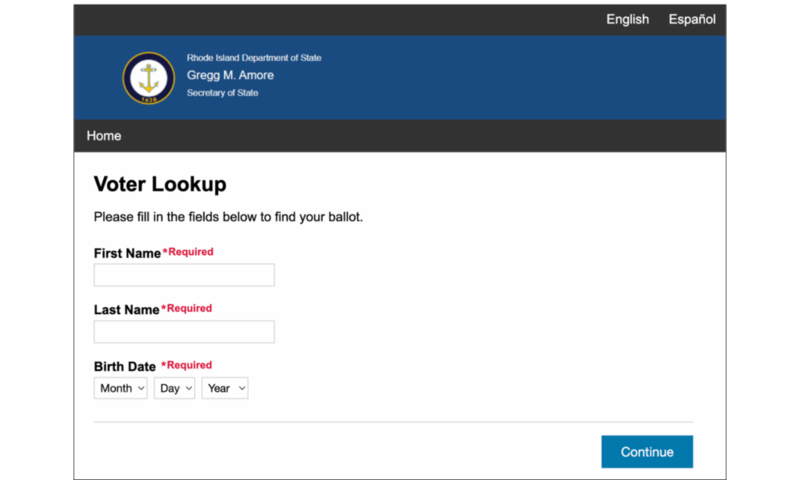
The Rhode Island Department of State website has a sample to demo online voting portal for voters with disabilities and military personnel. (Screenshot)
A measure to renew electronic voting provisions for disabled, military and overseas voters sailed through the Rhode Island House of Representatives Thursday.
The 61-8 vote, with eight of 10 Republicans voting no, came without debate or questions — a stark contrast to four years ago, when lawmakers first considered online voting for specific groups facing challenges to vote by mail or in-person. The 2022 legislation letting military, overseas and disabled voters submit ballots through an electronic portal was ultimately approved and signed into law, but not before passionate debate and opposition from conservatives and progressives worried about election security. Due to the concerns, the initial law was created as a pilot program that expired Dec. 31, 2025.
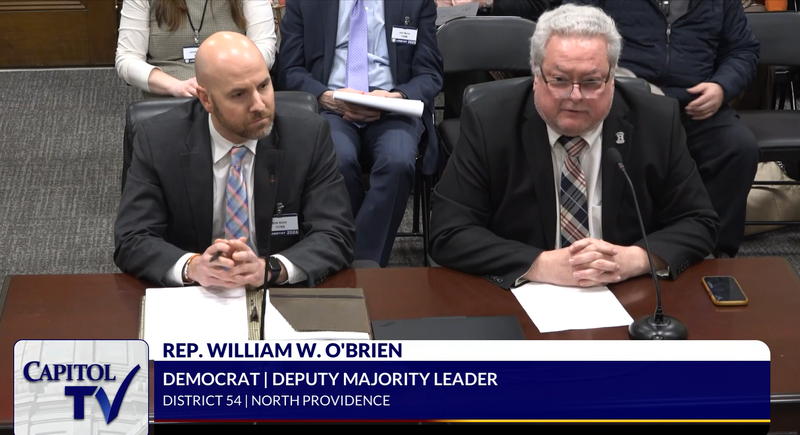
The 2026 bill, again sponsored in the House by Rep. William O’Brien, a North Providence Democrat, on behalf of Rhode Island Secretary of State Gregg Amore, reestablishes and makes permanent the electronic portal for the same groups.
Speaking to a panel of legislators in January, the usually stoic O’Brien teared up as he recalled how his father, a disabled veteran, was unable to vote independently for most of his life.
“I often think of how embarrassing it was for him to go through everything he went through and to have me or my sister vote for him,” O’Brien told the House Committee on State Elections and Government on Jan. 15. “This gives him back his constitutional right to vote without anyone else knowing how he voted.”
It’s never been easier for Rhode Islanders with disabilities to vote. But it’s still not perfect.
The reach of the proposal is limited — 1,871 voters used the electronic portal to submit ballots during the 2024 election, according to data from the Rhode Island Board of Elections. But for this select group of voters, its importance is critical.
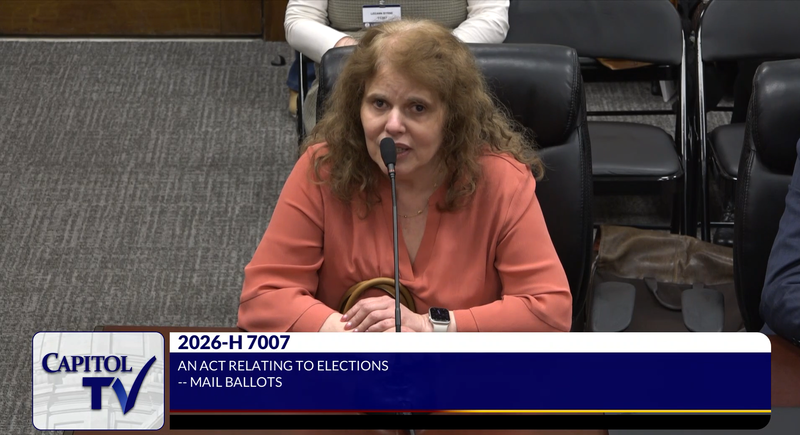
“If this legislation is not passed, voters who cannot see, hold, or mark a paper ballot will once again be forced to give up their right to vote independently and privately,” Graciela Pires, president of the National Federation of the Blind for Rhode Island, said in a letter to lawmakers. “This is unequal access to the ballot for voters who are blind and visually impaired. Let us not go back.”
Pires, who lives in East Providence, is blind.
This is unequal access to the ballot for voters who are blind and visually impaired. Let us not go back.
Military and overseas voters might not be able to submit ballots on time by standard postal service, and many lack the printer or fax machine still needed to do so, Rob Rock, deputy secretary of state, told the House elections panel.
“I don’t have a printer in my home,” Rock confessed.
Rock stressed the security of the portal, maintained by the Rhode Island Department of State with rigorous testing by third-party cybersecurity consultants. The encrypted portal used for the first time in 2024 was subject to 1,600 hours of testing by 1,800 independent cybersecurity researchers in 2025, Rock said.
While eligible voters mark and cast their ballots online, the submissions received by the Rhode Island Board of Elections are printed and fed through a voting machine, Rock said.
Other supporters include the Rhode Island Office of Veterans Services, the Governor’s Commission on Disabilities and the Rhode Island Department of Behavioral Healthcare, Developmental Disabilities and Hospitals.
High-risk?
Government watchdogs and some election technology experts remain concerned. The National Institute of Standards and Technology in 2020 determined that electronic ballot returns were a “high-risk” option, with potential for ballots to be “manipulated at scale,” along with privacy threats to voters who make use of them.
Despite technological advancements over the intervening five years, there is still no secure way for voters to submit ballots online, said John Marion, executive director of Common Cause Rhode Island. Rhode Island’s portal was used in 2024, seemingly without incident, but the inability to randomly sample paper ballots for accuracy — the standard election audit practice for mail and in-person voting — means the state might not know if there was a problem, Marion said.
“There are attacks on systems like this, that, if they’re not detected, they’re actually successful,” Marion told lawmakers during the Jan. 15 hearing.
The good government group urged lawmakers to reject the legislation due to concerns with the return of electronic ballots. Asked whether he had any other solutions for disenfranchised voting groups, Marion said no.
“There’s not an alternative we’re aware of that would allow Grace to vote as independent as this system would allow,” Marion said, referring to Pires. “It breaks my heart to say that.
C. Jay Coles, deputy director of legislative affairs Verified Voting, a nonprofit election security advocacy group founded by computer scientists, also wrote to Rhode Island legislators in opposition to the bill.
“The security risks associated with electronic ballot return are severe, well-documented and broadly acknowledged by the federal government’s top security agencies and the nation’s leading cybersecurity experts,” Coles wrote. “The risks — to ballot confidentiality, integrity and public confidence — simply outweigh any potential benefits at this time.”
Federal law has required states to send ballots to military and overseas voters electronically since 2009, but does not mandate electronic return. At least 32 states let military and overseas voters send back their ballots electronically, including by email or fax, but only 11 of those offer an electronic portal, according to the National Conference of State Legislatures. Meanwhile, 13 states let voters with disabilities send back ballots by email, fax or an online portal.
Massachusetts lets voters with disabilities submit ballots through an online portal, but requires email or fax for military and overseas voters. Connecticut does not provide for any electronic ballot submissions.
What a difference four years makes
Election fraud allegations remain a talking point among right-wing leaders, especially President Donald Trump, whose accusations of voter fraud and ballot tampering in the 2020 presidential election have been widely debunked. But four years ago, 16 state representatives — including seven of the most progressive Democrats — voted against the measure due to perceived security threats.
What changed in 2026?
Rep. David Morales, a Providence Democrat known for his progressive stances, said in a text Thursday night that his constituents who have disabilities have benefited from the electronic portal. Morales is challenging Providence Mayor Brett Smiley in the 2026 mayoral primary.
Rep. Edith Ajello, a Providence Democrat who also voted no” in 2022 but yes on Thursday, observed the increasing unreliability of the U.S. Postal Service during the committee’s Jan. 15 hearing. Ajello said she mailed a check from her East Side home to her granddaughter, who lives in North Carolina, in October, but the envelope didn’t arrive until December.
Rep. Leonela Felix, also a Providence Democrat, said via text Thursday that she did not remember why she initially opposed the bill.
House Minority Leader Mike Chippendale, a Foster Republican, switched from no to yes. Chippendale said in an email Thursday night that he was persuaded by a tweak to the original bill clarifying the definition of a voter with disabilities and setting imprisonment or financial penalties for those convicted of falsely attesting that they are disabled in order to vote online.
“I remain opposed in concept to voting electronically in general, but as a disabled Rhode Islander I took great exception to the definition of an eligible disabled voter as it was simply an assertion made by a voter which would qualify them to vote that way,” said Chippendale, who has muscular dystrophy. “I still feel there is opportunity for fraud here, but this was definitely a step above the original bill.”
Rep. Marie Hopkins, a Cranston Republican, also voted yes on Thursday; Hopkins was elected in 2024.
Two Democratic state representatives who voted against the bill in 2022 are no longer in office: Rep. Liana Cassar of Barrington and Rep. James McLaughlin of Cumberland.
A companion bill sponsored in the Senate by Matt LaMountain, a Warwick Democrat, has not been scheduled for a preliminary hearing as of Thursday.
If passed by both chambers and signed into law by Gov. Dan McKee, the reinstatement of the electronic voting portal would take effect immediately.
- 7:16 pmUpdated to include a response from House Minority Leader Mike Chippendale and to update the vote tally on the bill.

Providence, RI