DHS review clears chemical-hazard concerns at Surprise ICE detention center site
Nov 27, 2026 | 11:31 am ET
Description
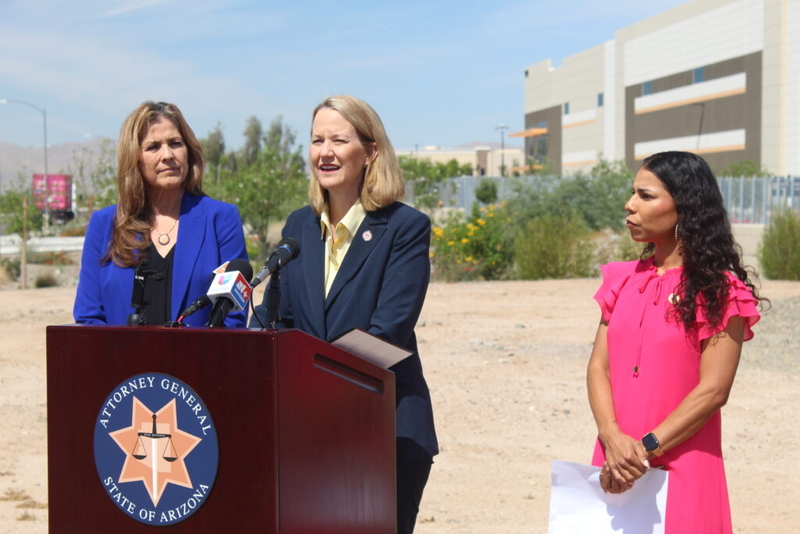
Attorney General Kris Mayes announces a lawsuit against the Trump administration on Apr 24, 2026 that seeks to stop the renovation of a commercial warehouse facility in Surprise, Arizona into an immigration detention center. Mayes alleges that doing so would violate federal laws that require public input and mandate the use of “appropriate” facilities to house immigrant detainees, because the warehouse is located across the street from a chemical storage facility. (Photo by Gloria Rebecca Gomez/Arizona Mirror)
A federal review of the plan to convert a warehouse in Surprise into an immigrant detention center concluded that a chemical storage facility located across the street isn’t a cause for concern — despite that fact spurring a lawsuit from Arizona’s attorney general, who warned that it could result in a “mass casualty event.”
Earlier this year, the U.S. Department of Homeland Security purchased 11 warehouses across the country in a bid to increase detention space, including a 418,400-square-foot building in Surprise in January that is slated to hold as many as 1,500 immigrants. Just three months later, Arizona Attorney General Kris Mayes filed a lawsuit, claiming that federal law bars the proposal from moving forward because of the risks posed by the chemical facility.
Standing in front of the warehouse during a news conference announcing her lawsuit, steps away from where two large tankers were parked just outside of the warehouse’s gates, the Democrat argued that the proposed detention center’s proximity to dangerous chemicals should put an end to the plan.
“Let this sink in: the federal government wants to open a jail inside a documented chemical hazard zone,” Mayes said on April 24.
In her lawsuit, Mayes also accused the federal government of failing to perform an environmental impact assessment, which is required under the National Environmental Protection Act. Similar lawsuits against proposed immigrant detention centers in other states using the NEPA as a legal basis have successfully blocked them from being built, creating an avenue for legal recourse where local jurisdictions otherwise have no say.
In July, DHS agreed to pause construction efforts and not hold anyone at the Surprise warehouse until 10 days after a final impact report has been completed. A draft of that report was published on Nov. 9, and the public comment period ends on Dec. 9.
The report acknowledges that the chemical storage facility houses “substances that pose the greatest risk of harm from accidental releases.” But the review goes on to note that the facility has had no accidental releases to date. And in a section outlining potential mitigation strategies for hazardous situations, DHS made no mention of the chemical storage facility or the potential for a chemical fire or spill at the neighboring building.
Instead, the assessment stated that the detention center would operate under a “Hazardous Materials Management Plan,” but didn’t outline what that would consist of.
“The Phase I ESA identified…no evidence of releases, contamination, or hazardous-material concerns was observed during site reconnaissance,” reads the report. “Facility operations would be conducted in accordance with the Hazardous Materials Management Plan and applicable federal, state, and local regulations.”
In an emailed statement, Richie Taylor, a spokesman for Mayes, said her office is still reviewing the environmental report and declined to comment on whether Mayes anticipates reinitiating litigation in light of the report’s lack of acknowledgement of the chemical storage facility.
The legal agreement to pause construction of the detention center doesn’t prevent Mayes from continuing the lawsuit after the environmental review is finalized, and in a statement accompanying an announcement of the delay in July, Mayes vowed to do just that if she disagrees with the review’s outcome.
“If necessary, the State reserves the right to challenge the adequacy of the review,” she wrote.
Local activists were incensed by the federal government’s decision to ignore the dangers posed by the chemical storage facility. Brent Peak, the co-chair of Northwest Valley Indivisible, which has mobilized public pushback against the plan, criticized the report as incomplete because it doesn’t include any strategies for how to handle a chemical disaster.
“DHS wants to lock 1,500 people in a warehouse across the street from a chemical stockpile, and its answer to the danger is ‘no mitigation measures are warranted,’” Peak said in a written statement. “Attorney General Kris Mayes was right: this site will never be suitable for mass detention.”
The detention center planned for Surprise is far from the only one in the state, but it would be among the largest. There are six existing immigrant detention centers located throughout southern Arizona, with the Eloy Detention Center currently the one with the highest capacity, at 1,500. The facility with the second highest capacity is one in San Luis, which can hold up to 704 people.
And another new detention center in Marana is expected to open in the coming months, with an estimated capacity of up to 1,300. The town council awarded the private company operating the detention center a business license earlier this week, one of the last procedural hurdles needed before the former state prison can start operating as an immigration detention center.
The construction of immigration detention centers may become easier in the near future, with Congress on track to limit the ability of states to challenge federal decisions under the National Environmental Protection Act. The Bipartisan American Affordability and Jobs Act, legislation that proponents say would speed up clean energy projects and lower costs for everyday citizens, would fasttrack federal permitting processes around large scale infrastructure projects like natural gas pipelines.
But critics warn it would also make it easier to build data centers and immigrant detention facilities, while at the same time stripping away the ability of state leaders and organizations to defend against federal actions. That’s because the proposal would sharply limit when challenges filed under NEPA can be made from six years to just 150 days after a federal decision is publicized.
And it would be much harder to stop a federal proposal under the new rules by barring judges from blocking a project that violates NEPA unless it also violates another federal law.
The legislation passed the U.S. Senate on Nov. 19, and the U.S. House of Representatives is expected to weigh in on it as soon as Nov. 30, when Congress returns to work.
Phoenix, AZ