Perceived reception to opposing political beliefs worse than reality, FSU survey says
Nov 27, 2026 | 8:58 am ET
Description
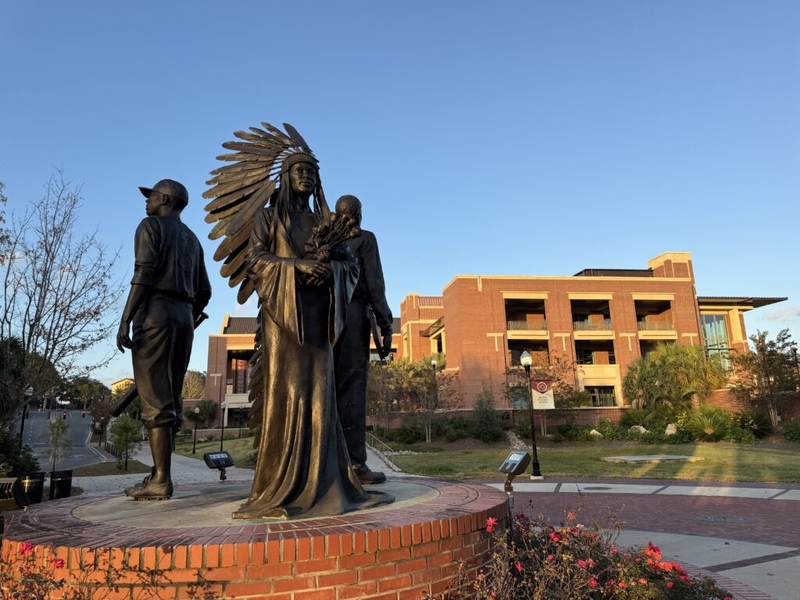
The Integration Statue stands in front of the Florida State University Student Union. (Photo by Jay Waagmeester/Florida Phoenix)
Students at Florida State University are more willing to engage in cordial political disagreements than they think their classmates would be, a survey conducted last month found.
According to FSU’s Institute for Governance and Civics, “There is more room for debate and discussion on campus than students assume.”
The survey asked students whether they would respond with a negative remark or in a hostile way to a student “openly expressing political views that you strongly disagree with.”
Just 2% of students responded they’d be “very likely” to be negative and 13% said they’d be “somewhat likely.”
The survey asked students to guess what percentage of FSU students would be “somewhat or very likely to respond negatively toward a student who openly expressed political views they strongly disagreed with” by making a negative remark or being hostile. Students’ average guess was that 51.9% of other students would be negative or hostile.
“In short, students overestimated negative reactions by 37 points,” the university said.
“When students expect negative reactions, they refrain from speaking, which diminishes the value of their education and the college experience,” Ryan Owens, director of the institute, said in a news release. “But our survey shows there is greater opportunity for open dialogue than students anticipate. Students should take notice. They can – and should – speak and debate more than they do now.”
The survey was sent to 7,000 students and 683 participated during September and October.
The survey asked several other questions, and the results break responses down by gender, race, political party identification, political ideology, and class year in school.
For example, it asked whether “[b]eing able to freely express and hear controversial social or political views is an important part of the college experience.” Nearly half, 48%, of students said strongly agreed, while another 45% agreed or somewhat agreed.
Republicans were more likely to strongly agree, while Democrats were more likely to agree or somewhat agree. The same pattern was true for liberal versus conservative students.
Freshmen were more likely to strongly agree than seniors, while seniors were more likely to somewhat agree.
When asked whether students should be able to “openly express unpopular opinions without fearing negative consequences from the university’s faculty, staff, and leadership,” overall, 93% of respondents net agreed while 4% net disagreed.
In asking that question again but replacing the university imposing consequences with “consequences from other students,” 88% net agreed and 8% net disagreed. Within that, 57% of Republican students strongly agreed, while 27% agreed and 10% somewhat agreed. Among Democratic students, 33% strongly agreed, 27% agreed, and 23% somewhat agreed.
A group of Florida International University students drew reprimands this year for protesting the university’s involvement with immigration enforcement. Those punishments were withheld last week, following a lengthy legal process.
When asked, “If a majority of FSU students on campus oppose an invited speaker, the speaker should be disinvited,” 53% net disagreed, 32% net agreed, and 15% were neutral. Students who identified as Democrats agreed at a higher rate than Republicans, with 46% net agreeing and 40% net disagreeing. For Republicans, 18% net agreed and 69% net disagreed.
Students seemed uncertain about how many students agreed with their politics. The table below shows the results to the question asking students whether they agreed or disagreed that “[t]he majority of students at FSU hold political views similar to my own.”
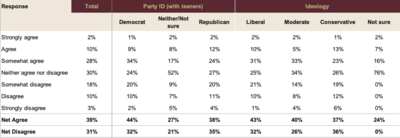
A similar spread happened on the next question, which asked about a majority of faculty holding similar political views.
Tallahassee, FL