Iowa State University researcher traces corn’s past through animal bones
Nov 25, 2026 | 4:17 pm ET
Description
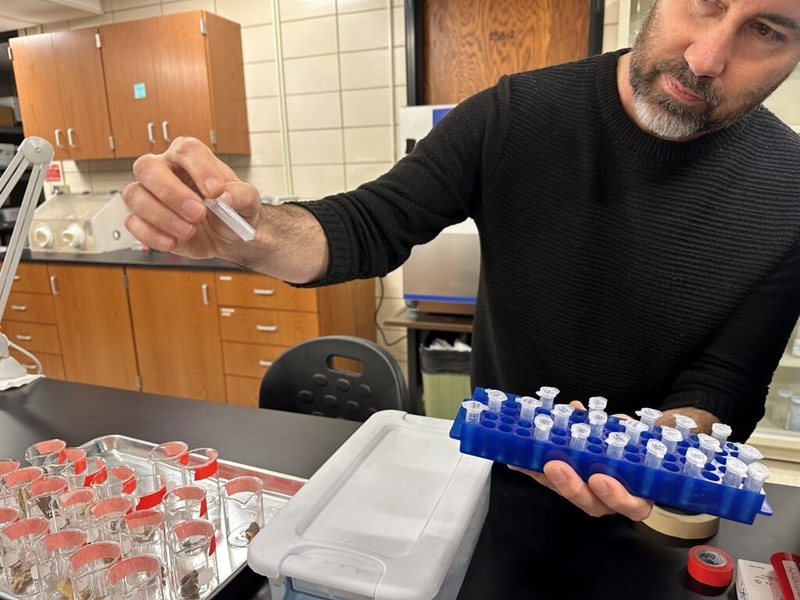
Iowa State University professor Andrew Somerville shows samples of bone mineral. (Photo by Brooklyn Draisey/Iowa Capital Dispatch)
In a lab at Iowa State University, faculty and students carefully shave material off of bones dating back thousands of years to understand how societies lived all through one thing — their diet.
People and animals are literally made of what they eat, ISU professor Andrew Somerville said, and analyzing the matter they leave behind gives important clues as to how they spent their lives, and how that would change over thousands of years for different groups.
His research has focused on the birthplace of corn as it is known today and sites with some of the oldest corn findings in the world. It can be easy to forget the immense role agriculture plays in society with the ease of modern-day conveniences like grocery stores, but Somerville said his and other researchers’ work underscores the importance of agriculture as a base of society.
“You can just see that there’s before farming and there’s after farming — religion comes and iconography and art and ceramics, and dogs. They didn’t have dogs until they started farming. Like in theory, they were somewhere around the Americas, but you don’t see them in the archeological record until people start farming,” Somerville said. “You don’t see domesticated turkeys until people start farming. You don’t see as much war and conflict until people start farming. So, like everything we think about civilization doesn’t even start until people start planting in this region. It’s corn.”
Before Somerville and his wife moved to Ames to work at the university in 2018, Somerville said he spent time as a postdoctoral research fellow studying different archeological sites in Mexico, with a focus on Tehuacán-Cuicatlán Valley in the State of Puebla.
This valley is home to some of the oldest recorded food and feats in the world, Somerville said, from corn to avocado pits and chili peppers to turkeys, as well as this hemisphere’s oldest dam. The rain shadow cast by nearby mountains leaves this cave-filled valley very dry, allowing “anything that any human ever dropped in these caves or left there” to be preserved for thousands of years.
Researchers discovered corn preserves in the valley in the 1960s, Somerville said, with layers showing how the crop changed not unlike the ground layers that show sediment and soil changes over time.
“You can see the whole history of corn evolution from this site. The cobs at the very bottom are like an inch long, they’re primitive, barely domesticated, and then through time, as you move up in the levels, you can just see the cobs getting bigger,” Somerville said. “Amazing archeological site.”
Since no one had touched the found animal bones “since literally 1963” and animal bone chemistry is a specialty of his, Somerville said he decided to focus his research in that area; however, he had to find them first. He spent a year before going to Tehuacán-Cuicatlán Valley emailing and calling people about the artifacts, but it wasn’t until he physically looked around a lab himself that they were spotted and given to him to study.
Studies show corn domestication and travel
The work he and others conducted in Mexico has led to multiple studies about the environment and climate of the valley over time, with the researchers looking at stable isotope ratios of carbon, nitrogen and oxygen to draw conclusions about how much grassland and moisture was around, as well as rainfall and temperatures.
The Tehuacán-Cuicatlán Valley sits in highlands around 1,700 meters above sea level, Somerville said, and domesticated corn arrived there between 6,300 and 4,550 years ago. Using deer and rabbit bones from the time, the team found that the window when corn was brought to the valley was “the wettest, most favorable, warmest climate conditions for thousands of years.”
“Humans are able to expand the range of corn cultivation for the first time during this exceptionally wet period, this exceptionally favorable climate,” Somerville said. “So that’s the kind of the part we thought was the coolest because it really helps us understand the history of corn and the expansion and how and why people started farming in the first place.”
Once the lowland variety of ancient corn, called parviglumis teosinte and the first ancient corn plant to be domesticated, was brought to highlands, it was crossbred with another breed of highland corn. Somerville pointed out that once domesticated, corn cannot reproduce on its own, meaning that humans had to have a hand in its spread.
Somerville said this hybrid is the basis for modern corn, with all modern corn having 20% of genes from the highland variety and the rest from parviglumis teosinte. He added that scientists are “pretty sure” that corn first came from the modern Mexican state of Guerrero around 9,000 years ago.
“As soon as that cross happened, that’s when corn exploded all over the Americas, basically,” Somerville said. “Once it had those extra genes to help it be more adaptive, then it just went all the way down to Peru all the way up to Canada.”
Future corn study could shift to Iowa
Somerville credited the Mexican researchers he worked with and continues to collaborate with today as a major reason why this research is being completed successfully. He said he has further projects with these colleagues to look at diets of different demographic groups and migration history.
Somerville’s time in Mexico grew his interest in corn, and it is still a central focus of his research today. His colleagues in Mexico sent him human bones, such as wisdom teeth, from around 1,400 years ago to analyze the ancient people’s diets and where they grew up.
The researcher is also looking into how corn cultivation and other early farming practices changed the relationships between humans and other animals, like dogs and turkeys. Another study from the Tehuacán-Cuicatlán Valley showed that the diets of dogs started departing from other animals as agriculture practices intensified and they had more access to corn.
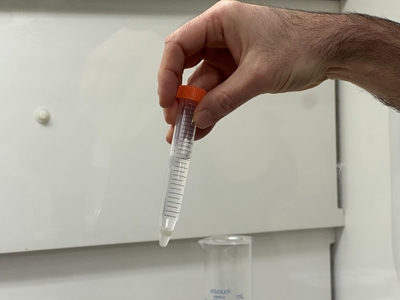
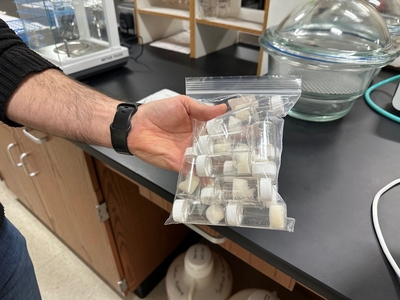
Eight students worked with Somerville in his lab this semester, where he taught them how to separate bone shavings into either just its mineral or biological components.
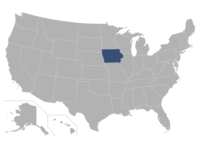
Somerville said that thousands of years from now, scientists could be doing the same kind of work he’s completing now but in Iowa rather than in Mexico. Iowa, despite its seasons bringing either quite warm or freezing temperatures, has amazing preservation abilities, Somerville said, seen from his work analyzing bison and other animal bones.
“Now we’re the most important corn-producing region in the world, yeah, future archeologists will probably be pretty interested in Iowa because our corn is in China, our corn is all over the country,” Somerville said.
Des Moines, IA