GOP state senator asks federal court to quash Clean Elections subpoena in campaign finance probe
Nov 25, 2026 | 4:17 pm ET
Description
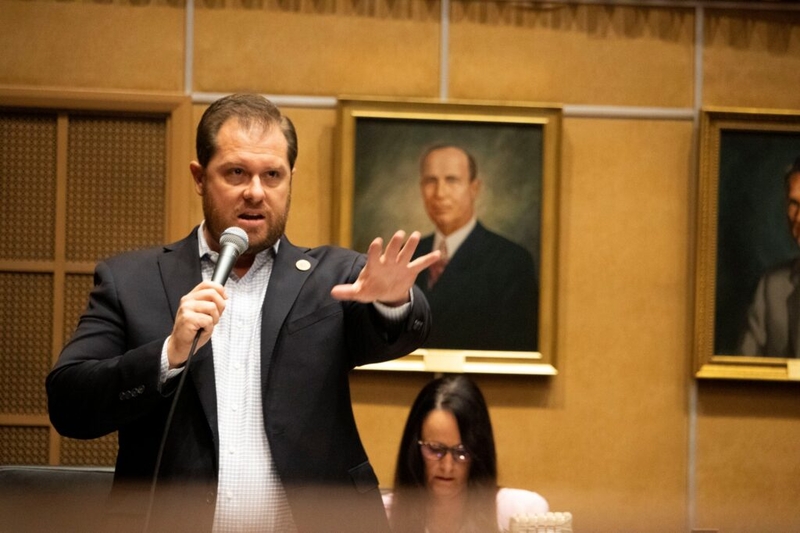
GOP Sen. Jake Hoffman speaks on the Senate floor on May 1, 2024, and denounces a pair of Republicans who voted with Democrats to repeal a near-total abortion ban first put into law in 1864. (Photo by Jerod MacDonald-Evoy/Arizona Mirror)
Republican state Sen. Jake Hoffman says the regulators who oversee Arizona’s public campaign finance system are unconstitutionally asking him to disclose information on his political clients, and he wants a federal judge to quash a subpoena issued to his political consulting company as part of an investigation into one of those clients.
The subpoena was issued to 1Ten, LLC, which Hoffman owns. That company worked with Ralph Heap, a Republican candidate for Arizona Corporation Commission who lost his campaign earlier this month. Heap voluntarily signed up for Clean Elections to receive public campaign funding.
Candidates that participate in Clean Elections agree to forgo large donations and money from PACs in exchange for a fixed amount of public funding, based on the office they seek.
Arizona voters passed the Clean Elections Act in 1998, establishing the Citizens Clean Elections Commission that oversees the use of those public funds. That commission has been investigating Heap since the summer, when a voter filed a complaint after the Republican candidate failed to report spending money for campaign signs before the July primary election, even though signs for his campaign were placed all over the Valley.
Heap’s attorney, Timothy La Sota, told the commission that the Mesa Sign Shop had extended a personal line of credit to Heap for the signs. The owner of the shop confirmed that to the commission. On Aug. 27, the commission found “reason to believe” that Heap had violated numerous campaign finance laws and Clean Elections rules requiring him to report loans like the one extended by the sign shop.
Heap attempted to withdraw as a clean election candidate after the investigation was launched, but the commission denied that request. The investigation has continued, and the subpoena to 1Ten that Hoffman wants quashed is part of the probe into Heap’s campaign spending.
Hoffman and his company are being represented by Scottsdale Republican state Rep. Alexander Kolodin, who ran unsuccessfully for Secretary of State this year. Kolodin, an election denier, has been sanctioned for making evidence-free claims in election litigation, including his role in the so-called “kraken” lawsuit after the 2020 election. That lawsuit was deemed “sorely wanting of relevant or reliable evidence” by the same federal judge assigned to 1Ten’s litigation over the subpoena election conspiracy theories in court.
Kolodin wrote in the subpoena lawsuit that the Clean Elections Commission’s request for information is overly broad and chills the First Amendment rights of 1Ten and its workers.
“(The subpoena) demands records showing who picked up signs, how many signs were placed and when, and payments to anyone who picked up, transported, placed, or removed them,” the suit says. “The demand exposes who helped distribute the campaign’s speech and how that work was organized, without distinguishing commercial deliveries from assistance revealing a person’s otherwise private connection to the campaign.”
The company also argued that the subpoena seeks information that requires 1Ten to “expose relationships beyond its own files simply because it knows where a relevant record is held” and that public statements made by the people associated with the complaint “tie enforcement to political objectives.”
Alongside the complaint, Kolodin included more than 200 pages of screenshots of social media posts by Hoffman’s critics, including those who filed the initial complaint.
“With no confidentiality protection in the Subpoena, the demanded communications and index could likewise expose private political relationships to people seeking withdrawal, prosecution, or adverse publicity,” Kolodin wrote.
Kolodin also argued that, if the subpoena is enforced, it could make campaign workers “hesitate” to work for 1Ten and “deter the candid exchanges and cooperation on which 1Ten’s political work depends. They pressure 1Ten and those who work with it to say less, put less in writing, and limit who they involve.”
The lawsuit includes a declaration from James Rogers, a Republican candidate who lost his election this year, that the subpoena made him “less willing to speak candidly, more reluctant to put matters in writing or identify supporters, and less willing to place an order alongside another candidate. His concern persists even if only the Commission receives the information.”
However, the commission, in its response to the lawsuit, said that federal court is the wrong venue for Hoffman and 1Ten to challenge the subpoena because Arizona law requires such actions to be filed in Maricopa County Superior Court.
And beyond that, the commission also argued that the lawsuit would make it impossible to enforce the Clean Elections Act if Hoffman’s arguments aren’t rejected.
“(I)f 1Ten prevails, no one can learn who paid for a publicly funded campaign whenever the payment runs through a political consultant,” Craig Morgan, the commission’s attorney, argued. “Stretching the First Amendment to protect such activity would (1) strip the Commission of its core function of monitoring participant spending and ensuring Fund monies are spent only as the Act allows, (2) hand every participating candidate a roadmap for evading the Act: route expenditures through a consultant, then run to federal court invoking the First Amendment, and (3) stymie the Commission from learning the truth about how Fund monies are spent.”
Morgan wrote that, when a candidate agrees to participate in Clean Elections, state law requires that they certify under oath that they are “subject to all enforcement actions by the Commission.”
“Dr. Ralph Heap volunteered to accept public funds and follow the (Clean Elections) Act. He reported a single $644.47 payment to Mesa Sign Shop, while a complaint documented 184 of his signs deployed across the State,” Morgan said. “The invoices for those signs are addressed not to Dr. Heap, but to ‘Jake Hoffman / 1ten.io,’ and one invoice reflects a $96,500.00 payment.”
Additionally, Morgan argues that the 14th Amendment claims of placing a burden on protected association “fails at the outset” because the Clean Elections Act allows Hoffman to modify or quash the subpoena, which he and his company did not do.
“The First Amendment does not give a paid consultant the power to hide how a publicly funded campaign was paid for, and nothing requires this Court to step in before the Act’s own procedures have even begun, let alone been exhausted,” Morgan said. “Worse, the injunction 1Ten seeks would prejudice the Commission and the people it serves by thwarting enforcement of the Act. The Court should deny the Motion.”
The commission argued that the independent investigation it voted for, which is being conducted by the commission’s executive director, defines the invoices sought in the subpoena as solely belonging to Heap. And it also notifies 1Ten of its right to “quash or modify” the subpoena.
“1Ten asks this Court to halt a subpoena that no one has tried to enforce, subject to a process 1Ten has never invoked,” Morgan said. “Its claimed injury depends on events that have not occurred and may never occur.”
The subpoena cannot be enforced without an action by the Maricopa County Superior Court, which has not happened.
“Until a state court orders production, not a single document will leave 1Ten’s files,” Morgan said. “There is simply no imminent harm approaching.”
And, the commission argued, the subpoena isn’t overly broad: It does not ask for a client list, donor list or any information about any candidate other than Heap, who is subject to the commission’s oversight as a publicly funded Clean Elections candidate.
Morgan also took issue with the evidence that 1Ten cited and said much of it is unrelated to the subpoena and the investigation into Heap.
For example, the declaration from Rogers claiming that the subpoena could chill his communications with 1Ten is irrelevant, Morgan wrote, because the subpoena “asks for none of that, and it seeks nothing from Mr. Rogers.”
“Mr. Rogers’s only connection to the Subpoena is a shared invoice that also lists signs for Dr. Heap, which Request 1 reaches only to the extent it concerns Dr. Heap, and which Mesa Sign Shop already produced,” Morgan said. “A declarant’s worry about requests that were never made or disclosure that could theoretically someday maybe happen cannot establish that the requests actually made burden association.”
Morgan also took issue with the hundreds of pages of social media posts, which largely predates the subpoena and fails to show that “anyone has suffered reprisal from anything obtained in the Director’s investigation, let alone a concrete associational harm likely to occur.”
Ultimately, Morgan and the Commission argued, a court endorsing Hoffman’s and 1Ten’s argument that the subpoena violates the First and Fourteenth amendments would kneecap their ability of the state to enforce the Clean Elections Act.
“Here, an injunction would invite publicly funded candidates to route expenditures
through consultants beyond the Commission’s oversight, and then escape scrutiny by rushing to federal court under the guise of protected association,” Morgan wrote. “(S)uch an injunction would render the Commission’s most basic function — monitoring participant spending and ensuring that Fund monies are spent only pursuant to the Act — impotent. That is precisely what 1Ten seeks, and it would irreparably injure the Commission and the people who enacted the Act.”
Hoffman also owns another company that has made headlines.
His company, Rally Forge, created “troll farms” alongside Turning Point USA ahead of the 2018 midterms, operating Facebook accounts that appeared to be Democrats but were in fact pushing conservative political messaging and disinformation.
The creation of the fake accounts, a majority of which were run by teenagers, according to reporting by The Washington Post, eventually led Facebook to permanently ban Hoffman and Rally Forge. The company, and later Hoffman himself, were also permanently banned from Twitter, but Hoffman was brought back after the website was acquired by billionaire Elon Musk.
Phoenix, AZ