Kansas City’s World Cup fell short of its $35 million tax revenue projection
Nov 25, 2026 | 6:50 am ET
Description
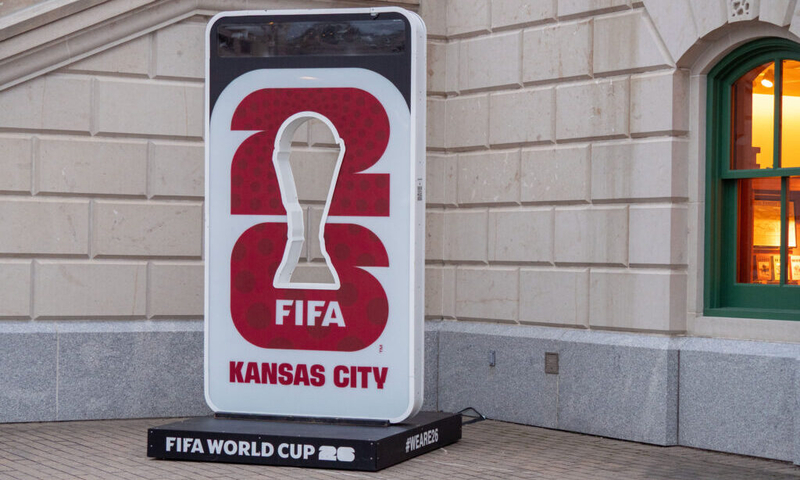
Kansas City is the smallest host city for the North American 2026 FIFA World Cup. A promotional sign appears on Jan. 13 outside the Kansas Statehouse in Topeka (Sherman Smith/Kansas Reflector).
In July 2023, Kansas City’s City Council voted to give KC2026, the local World Cup organizing committee, $15 million over three years based in part on an estimate that, “the tax revenue generated for Kansas City from the World Cup will be approximately $35 million.” The matches are over and available tax data show revenue fell far short of that projection.
This should be no surprise. As I’ve argued here, at the Show-Me Institute and in The Kansas City Star, mega-events rarely pay back the public money spent to host them. Records obtained from the city suggest an estimated $6.7 million in additional summer revenue across taxes affected by tourism, less than a fifth of what was promised.
The Council’s estimate of a $652.6 million economic impact came from the Kansas City Sports Commission, but the $35 million tax revenue claim has no identified author, methodology or report. It doesn’t appear in the city’s fiscal note, which instead promises, “an intangible positive fiscal impact that will allow the City to be stronger and more resilient”—a meaningless phrase if ever there were one. The omission raises questions about how much confidence city officials had in the $35 million estimate.
According to the Missouri Department of Revenue, sales tax collections associated with June and July 2026 sales were $8.1 million, or 13.5%, higher than during the same period in 2025. But sales from January through May, before any soccer match, were already running 6.8% ahead. Taking that into account, the World Cup produced only about $4 million in additional sales tax. In August, the first full month after the tournament, tax revenue was up just 2.6%.
Hotel taxes rose $1.7 million from June through August compared with the same period in 2025, about $1.5 million above trend. But the gain came largely from prices, not guests. Hotels raised rates so sharply that occupancy fell below expected levels. The consulting firm HVS estimates Kansas City’s occupancy during match weeks fell 4.6 percentage points below what it otherwise would have been.
Restaurant taxes rose $1.4 million over the same months, about $1.1 million above trend. Restaurant tax collections fell 6.7% in September and October, suggesting some of the summer spending may have been shifted from other months rather than representing entirely new spending.
Other revenue sources barely moved. Short-term rental taxes earmarked to fund the city’s $15 million contribution brought in only about $60,000 more than in 2025. Earnings tax withholding showed no bump at all.
Even those numbers overstate the benefit to the city’s general budget. Nearly all of Kansas City’s sales taxes are dedicated to specific purposes such as capital improvements, transit, fire protection and parks. Convention and tourism taxes go to their own fund. The city’s July financial report does not mention the World Cup, and it shows convention and tourism taxes up just 0.8% for the fiscal year.
Dave Helling’s Kansas City Stack reached a similar conclusion in October, noting that June sales tax collections were up $2.1 million in the city’s monthly report. But June’s payment covered April sales, two months before the first match. The jump was there before the tournament began.
The organizers had little trouble securing funding, however. KC2026’s impact report lists $136.55 million in funding, about $101 million of it from taxpayers at the federal, state and local levels. We don’t know how all that money was spent, but KC2026’s 2024 tax return shows it paid $361,000 in lobbying expenses.
In May, when those projections faced scrutiny, Visit KC president Kathy Nelson told reporters, “We didn’t work 10 years for this to be a flop.” Unfortunately, if one uses the standard of tax revenue set by the City Council, the financial results are difficult to call a success.
Nelson’s colleagues claim success but won’t show their math without a fee. Visit KC, which is funded largely by the city’s hotel taxes, was asked for the report, spreadsheets and methodology behind its 680,000-visitor and $570 million estimates. It quoted 23 hours of staff time and $1,130.91, later cut to $920, explaining that the records “are not just ‘sitting around’ in a single file.” It won’t release anything, even the methodology, until paid. A public estimate that can’t be supported without three days’ work and a $920 invoice deserves caution.
World Cup supporters claim the real payoff is visibility, reputation and future events. KC2026’s impact report cites $2.4 billion in media exposure—which it admits does not reflect actual revenue—and four new corporate prospects. But the report does not establish how much additional tax revenue the tournament generated for Kansas City. The Council didn’t approve $15 million for visibility and media exposure; it expected a return of $35 million.
The World Cup was a financial flop for Kansas City taxpayers. Local and state leaders accepted projections without checking them and funded the organizations producing them. Media outlets repeated the claims, apparently without verification. Many of them got to go to the parties, and taxpayers were left with the tab.
Jefferson City, MO