Biologists work to boost Louisiana’s striped bass numbers. They need help from anglers.
Nov 25, 2026 | 5:00 am ET
Description
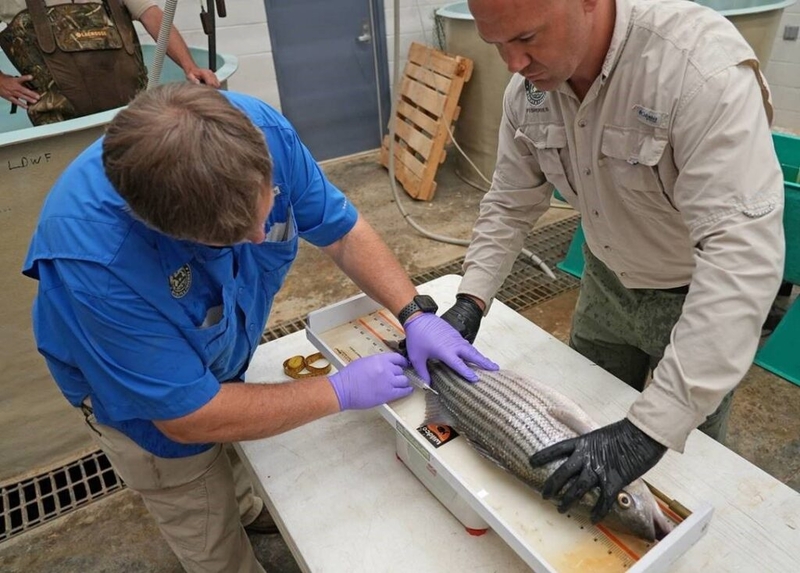
Louisiana Department of Wildlife and Fisheries biologist Matthew Duplessis, left inserts a tag into a striped bass as colleague Jonathan Winslow holds the fish. (Photo courtesy of LDWF)
State biologists are trying to revitalize Louisiana’s population of striped bass, which they say aren’t adequately reproducing in the wild because of warming waters and shrinking habitat.
A state Department of Wildlife and Fisheries program is tracking where striped bass find safe haven in Southeast Louisiana waters, but they can’t do it alone. Officials are asking anglers to help them collect samples of the fish and share where they’ve caught them to learn more about their domain and range.
“Ultimately, our goal is to use the best available science to help ensure the striped bass remains part of Louisiana’s fisheries for generations to come,” state fisheries biologist Jonathan Winslow said. “We have a great opportunity to learn more about striped bass in Louisiana, and we want the fishing public to be a big part of that effort.”
Striped bass can live in saltwater and freshwater, and they’re found in the rivers, streams and coastal waters of the Pontchartrain Basin that originates well into Mississippi. The fish eat just about anything they can find, from small crustaceans to other fish.
“They are fantastic fighting fish,” Winslow said.
Winslow said the Gulf strain of striped bass has been on the decline for quite some time, though there has not been a dedicated assessment to quantify their numbers. Scientists and anglers generally agree and share anecdotal accounts of a significant decline spanning over decades.
Researchers also point to temperature increases over time in the waters where the striped bass is found. The Gulf strain can withstand water temperatures up to 78 degrees, Winslow said, but warmer conditions can create significant stress, affecting its health and ability to survive.
Daily average air temperatures in Louisiana have increased 2.8 degrees Fahrenheit since 1970, according to data from the National Oceanic and Atmospheric Administration. These hotter conditions strongly correlate with warmer water and other changes in the water cycle, including rainfall, flooding and drought, all of which can affect aquatic environments and the creatures living within them.
“The biggest battle across the coast is finding where that cool water refuge is,” said Matthew Duplessis, a Wildlife and Fisheries biologist manager. “(Striped bass) need access to cool water and in Louisiana, there’s not much cool water.”
Striped bass also need access to uninterrupted stretches of fast-moving river water to reproduce. Human-engineered alterations, such as dredged channels, dams and other development, make it harder for the fish eggs to successfully hatch, according to scientists.
In order for eggs to survive once they have been fertilized, the flow of river water needs to be constant for uninterrupted lengths so eggs don’t fall to the bottom and get buried in sediment, Winslow said.
“With shortening the lengths of our rivers here, specifically the Pearl River and Bogue Chitto rivers … they can’t do that anymore,” he added.
To find solutions, Louisiana officials and the U.S. Fish and Wildlife Service created the Striped Bass Collaborative Anglers Project. With input from sportsfishers, they can better track the species’ movement, its genetic makeup and more effectively restock the species in the Pontchartrain Basin to improve their numbers.
The state has only three biologists assigned to the basin, making it hard for them to take enough striped bass samples, Winslow said.
“Anglers are out on the water every day of the week, covering more ground, going to areas that we don’t get to,” he said.
Biologists can insert trackers into live striped bass and release them where they were caught, with hopes of learning where there are cold water havens where the fish frequent, Duplessis said.
If anglers want to keep the striped bass they catch, they can still help scientists by clipping their fins for genetic research. Fin clip kits are available for free through Wildlife and Fisheries, and the department can pick up the samples.
The department will also accept cleaned striped bass carcasses for testing, with arrangements made through the same online portal. Frozen samples should be placed in sealable plastic bags and labeled with the catch date, along with water body and general location where they were caught.
“The anglers are crucial for this project,” Winslow said. “Every sample we receive helps us get a better understanding of these fish, where they come from, where they’re going and how they’re contributing to the population.”
Baton Rouge, LA