Democrats plan investigations of Trump. Here’s how his Justice Department is fighting back.
Nov 24, 2026 | 10:27 am ET
Description
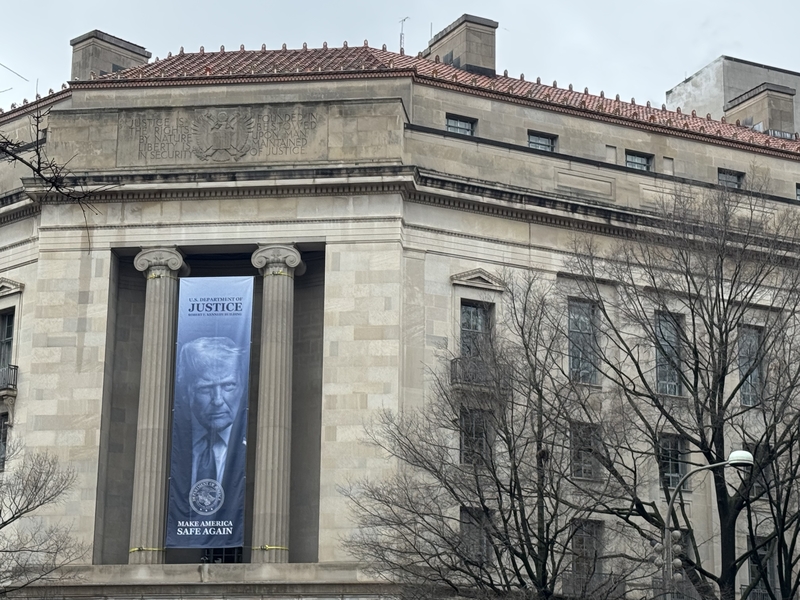
A banner showing President Donald Trump hangs on the Department of Justice in Washington, D.C., on Feb. 20, 2026. (Photo by Shauneen Miranda/States Newsroom)
As the Trump administration prepares for Democrats to launch an onslaught of investigations in the next Congress, the U.S. Department of Justice is turning to a three-word phrase to preemptively fight back: “Legitimate legislative purpose.”
The Justice Department has sent letters in recent days to leading Democratic lawmakers raising the possibility they’ll face criminal prosecution for conducting aggressive oversight of President Donald Trump and his aides. Legal experts have widely dismissed the threats as empty because the U.S. Constitution affords lawmakers wide protections from prosecution for official actions taken in Congress.
But the letters — and that short phrase within them — offer a blueprint for how the White House will try to undermine the investigations themselves, in addition to discrediting the investigators. Democrats will take control of Congress with majorities in both the House and Senate in early January.
Line of attack
The Justice Department is signaling it will attack congressional subpoenas seeking documents and testimony from federal officials as driven by retribution and outside the bounds of traditional oversight. The government appears ready to argue such requests cross a line into illegality.
The DOJ letters allege Democrats intend to violate federal laws that prohibit individuals acting in an official capacity from violating the constitutional rights of others. In this case, those supposedly having their rights violated would be Trump’s associates.
“As you should know, whatever investigations you and your fellow Democrats have planned must have a legitimate legislative purpose,” U.S. Attorney Aaron Reitz, the top Justice Department official in the Southern District of Texas, wrote on Nov. 19 to Rep. Jamie Raskin, a Maryland Democrat.
Reitz, a former Republican candidate for Texas attorney general, included similar language in letters to Rep. Robert Garcia and Sen. Adam Schiff of California, Sen. Elissa Slotkin of Michigan and Sen. Elizabeth Warren of Massachusetts. All are Democrats likely to play prominent roles in investigating the Trump administration after the party takes control of Congress in January.
Additionally, Will Scharf, the White House counsel, in a Nov. 9 letter to Garcia wrote that “abusive and capricious threats” were spreading among Democratic legislators. He warned that the Trump administration “will not be extorted” and expected lawmakers to investigate within settled constitutional limits.
Rocky 2 years ahead
The defiant posture comes as Trump braces for a final two years in office marked by aggressive oversight from House and Senate committees, as Democrats probe alleged corruption and mismanagement.
Many Democrats credit the blue tsunami that gave the party large majorities in both chambers to voters’ frustration with self-enrichment by Trump and other government officials.
In addition to the Justice Department letters, Trump on Nov. 20 signed an executive order that requires federal contractors to notify the White House of any congressional requests for information. Contractors are also required to abide by any White House instructions to withhold communications that the Trump administration says are covered by executive privilege.
Democrats are now on a collision course with the Trump administration that could end up in the courts.
Raskin pressed forward with his oversight efforts in the wake of despite Reitz’s letters. The ranking Democrat on the House Judiciary Committee, Raskin sent letters on Nov. 20 to the DOJ, FBI, Department of Homeland Security, U.S. Immigration and Customs Enforcement and the U.S. Bureau of Prisons — demanding that they preserve all records, including Signal chats, which can be set to auto-delete.
Slotkin responded to Reitz in a letter last week, calling congressional oversight an important constitutional responsibility. She called the DOJ official’s threats frivolous and a violation of his ethical duties as an attorney. The nonpartisan watchdog group Campaign for Accountability has filed a complaint against Reitz with the State Bar of Texas.
“I’m not going to participate in some sham investigation,” Slotkin said in a video response to Reitz. “Every American has freedom of speech. In particular, senators have special privileges and special responsibilities given by the Constitution for oversight.”
White House spokesperson Lauren Bis told States Newsroom that Trump is willing to work with anyone “to continue delivering victories for hardworking Americans.”
“If Democrats choose to pursue sham investigations and radical left policies, they are choosing to work against the American people,” Bis said in a statement.
The Justice Department didn’t respond to a request for comment.
The U.S. Supreme Court has previously ruled Congress has broad power to investigate the federal government.
Broad oversight authority
Constitutional law experts interviewed by States Newsroom said that while lawmakers don’t have unlimited investigative power, their oversight authority is sweeping, rooted in the need for lawmakers to have information before legislating.
“Although they are not stated in the Constitution, there is a clear line of cases that say as long as investigations are related to possible legislation, then they can proceed,” said John Vile, a professor of political science at Middle Tennessee State University who has written books on constitutional law.
In 1957, the Supreme Court found that the U.S. House Un-American Activities Committee had exceeded the bounds of congressional power after labor organizer John Watkins was prosecuted for refusing to answer lawmakers’ questions about whether certain individuals were members of the Communist Party.
The court threw out Watkins’ conviction, finding his due process rights were violated.
Retiz cites the case, known as Watkins vs. United States, in his letters to Democrats as he warns lawmakers that their planned investigations could be unlawful. In the court’s 6-1 decision, Chief Justice Earl Warren wrote that investigations solely to punish or for the “personal aggrandizement” of the investigators weren’t permissible.
Unmentioned by Reitz is that earlier in the same paragraph, Warren wrote that Congress’s power to investigate is “broad” and encompasses looking into both how current law is being applied and possible future law.
“It includes surveys of defects in our social, economic or political system for the purpose of enabling the Congress to remedy them,” Warren wrote. “It comprehends probes into departments of the Federal Government to expose corruption, inefficiency or waste.”
As recently as 2020, the Supreme Court reaffirmed the sweeping scope of Congress’ investigatory powers.
In a 7-2 decision in a case called Trump vs. Mazars USA, the justices didn’t immediately allow a congressional subpoena for Trump’s personal financial records to proceed, but they repeated Watkins’ description of lawmakers’ sweeping oversight authority.
“The congressional power to obtain information is ‘broad’ and ‘indispensable,’” Chief Justice John Roberts wrote in the majority opinion.
The speech or debate clause
Whatever the courts may decide about future subpoenas, constitutional scholars in recent weeks have been virtually unanimous in arguing that the Constitution’s speech or debate clause will protect Democratic lawmakers from criminal cases for launching congressional investigations into the Trump administration.
The clause says of lawmakers that “for any Speech or Debate in either House, they shall not be questioned in any other Place.” The provision has its roots in England, where members of Parliament used to fear prosecution for offending the crown.
Its protections have been on display as recently as October, when federal agents searched the D.C. residence of Minnesota Rep. Ilhan Omar, a Democrat. Recently unsealed court documents show a federal judge asked prosecutors for additional information on the “potential Speech or Debate Clause implications” of the search before signing off on a warrant.
Steve Vladeck, a professor of federal courts at Georgetown University Law Center and a leading expert on the Supreme Court, wrote on Nov. 23 that an indictment alleging lawmakers had conspired to deprive individuals of their rights through a “weaponized” oversight process would mean proving the illegitimacy of the investigation’s subpoenas, hearings or committee votes.
“Every one of those is a legislative act, for which the members’ motives are off the table,” Vladeck wrote in his newsletter, One First. “When the oversight itself is the alleged crime, the Speech or Debate Clause is arguably at its zenith.”
Lawmakers also can’t be sued for their speech in Congress, a protection that they sometimes use to make remarks that might otherwise open them up to allegations of defamation.
Last year, Rep. Nancy Mace, a South Carolina Republican, accused her ex-fiance and three other men of being sexual “predators” in an explosive speech on the House floor. A federal judge later dismissed a defamation lawsuit brought against Mace by one of the men.
Illegal orders video
The Trump administration has also so far failed in other efforts to target Democratic lawmakers over their communications.
Just over a year ago, several lawmakers with military or national security backgrounds, including Slotkin, posted a video telling members of the military and intelligence community that they should refuse illegal orders.
Trump called the video evidence of seditious behavior and as recently as this month asked whether the lawmakers would ever face prosecution.
The Department of Defense attempted to demote one of the lawmakers, Arizona Sen. Mark Kelly, a retired U.S. Navy captain. A federal judge has temporarily blocked the demotion, but the Trump administration has appealed the decision.
But even without prosecutions, Molly Nixon, a senior fellow in executive power at the libertarian Cato Institute, said the White House can still work to slow down investigations.
The letters and the recent executive order serve as “markers” that could deter cooperation with Congress, she indicated. Individuals pressed for information might weigh the pros and cons of quick and full compliance.
“The fact that if I were a member of Congress I would not be particularly worried about a successful criminal prosecution doesn’t mean the administration doesn’t have a lot of tools at its disposal,” Nixon said.
All States Newsroom content is free to republish. Read our republishing policy for more information.