Outcry over intended Medicaid cuts grabs lawmakers’ attention
Nov 23, 2026 | 7:35 pm ET
Description
A stir is created by the latest Medicaid-related changes announced by the Nebraska Department of Health and Human Services. (Courtesy of IronHeart/Getty Images)
LINCOLN — Uproar over changes coming to a broad spectrum of Nebraska Medicaid services swept through healthcare and low-income advocate circles Monday.
The concern followed announcements late Friday afternoon by Gov. Jim Pillen’s administration. The Nebraska Department of Health and Human Services notified health care providers of a variety of changes and Medicaid reimbursement rate cuts in programs ranging from dental to at-home personal care to hospital operations.
Those who received emails expressed outrage and disappointment. By Monday, groups and individuals had contacted state lawmakers and efforts were underway to try to stop changes that DHHS officials say are necessary to sustain the Medicaid insurance programs in light of escalating healthcare costs.
“These changes represent difficult, but responsible decisions intended to preserve access to essential services over the long term, not simply to obtain short term savings or abandon the individuals who depend on Medicaid,” said a letter from Jeremy Brunssen, interim director of Medicaid and long-term care for DHHS.
Center of controversy
At the center of the shifts, said a press release from the Nebraska Hospitals Association, is a proposed 3% reimbursement rate cut in 2027 to physicians, dentists and other providers who accept Medicaid. Another 3% cut is to follow the next fiscal year.
“These state cuts, combined with Medicaid cuts enacted by the federal government, will be a devastating blow to our already fragile rural healthcare infrastructure,” said Jeremy Nordquist, the association’s president and CEO. “Nebraska patients and Nebraska communities will feel the pain.”
Nebraska’s projected budget deficit set at $1.1 billion heading into 2027 legislative session
Kris Perkins is the co-owner of A Place At Home, a private agency that provides non-medical home care to hundreds of elderly and disabled Nebraskans, a portion of whom are Medicaid recipients.
She said she opened an email sent to her at 4:12 p.m. Friday from Tony Green, director of DHHS’ Division of Disability and Aging, announcing what she called significant reductions in reimbursement rates effective Jan. 1.
“That gives agencies just 41 days to prepare for a decision that could fundamentally change the availability of home care services throughout Nebraska,” Perkins said.
She, Nordquist and others believe that public health aid for low-income and vulnerable populations is the brunt of the state’s financial woes.
Said Perkins: “You can’t balance the budget on the backs of your most needy populations.”
State Sen. Victor Rountree of Bellevue said he and other lawmakers have been flooded with concerns from people including those representing Nebraskans with disabilities — ”many feeling they’re numbers on a spreadsheet.”
The state faces a newly revised projected shortfall of about $175 million for the current budget period ending June 30, 2027, and about $1.124 billion for the 2028-29 biennium that starts in July. Pillen has said the financial predicament means the state will need to find trims and make “tough decisions” over the next three years.
State tried to ‘minimize’ impact
A state DHHS spokesman said the agency researched rates in the region to come up with adjustments that would minimize the impact on both providers and beneficiaries while keeping Nebraska in line with neighboring states.
Over the years, said Jeff Powell, the spokesman, Nebraska’s Medicaid costs have increased significantly and the state had to respond. He said that nationally, Medicaid expenses have risen more than 40% since 2020.
DHHS ‘error’ in case of Nebraskan with disabilities hits home with state lawmaker
“DHHS will still need to request approximately $500 million in additional funding from the Legislature during the upcoming session to address rising Medicaid and waiver costs,” Powell said. “Without these adjustments, the additional funding request could exceed $1 billion.”
Rountree, who found out about the additional cuts Friday night, said it was unfortunate especially as the holiday season approached. He said he had a busy weekend and Monday fielding concerns and lawmakers are deliberating next steps.
The Nebraska hospital association is among groups calling for the Legislature to curb the “devastating cuts.” The association said that in addition to the 3% cut in provider reimbursement rates, concerns include:
- New copay requirements for people receiving certain Medicaid services
- Cuts to mental health and substance use treatment reimbursement, and changes to certain behavioral health services
- Changes to inpatient and outpatient hospital reimbursement
- Changes to specialty drug reimbursement
- New limits on adult dental coverage, capping Medicaid benefits at $2,000 annually
- A 4% cut in in provider rates in 2027 and again in 2028 for those who receive services through the Developmental Disabilities Waiver
Nordquist said Nebraska has already seen some rural clinics close, and “underpaying providers” drives up financial pressures elsewhere.
When a rural hospital closes its dialysis or labor and delivery unit or shuts down entirely, every resident in that community loses access to care, whether they are on Medicaid, Medicare or private insurance.
“When a rural hospital closes its dialysis or labor and delivery unit or shuts down entirely, every resident in that community loses access to care, whether they are on Medicaid, Medicare or private insurance,” he said.
Powell, in response, said Nebraska hospitals and healthcare providers are important parts of a healthcare system the Pillen administration values. He cited the governor’s signing of the Hospital Quality Assurance and Access Assessment Act in 2024 that “generates nearly $1 billion annually in additional funding for hospitals statewide.”
A grandma and a business owner
From Perkins’ vantage point, elderly and disabled Nebraskans are in jeopardy of losing access to essential care, as agencies like hers may not be able to employ caregivers.
According to intended changes, Perkins said, Medicaid reimbursement to agencies such as hers that deliver personal care will be reduced to a flat rate of $26.32 per hour, down from her current rate of $31.69. She said reimbursement rates currently vary according to the provider.
Independent providers are to receive $17 an hour.

Perkins recalled a study the state conducted five years ago, which identified about $43 as the hourly rate necessary to operate a home care agency while accounting for caregiver wages, payroll taxes, workers’ compensation, insurance, administrative costs and more.
“This isn’t just about business,” she said. Perkins said she wants to employ caregivers at a rate that lets them pay bills. She also is the grandmother of a profoundly autistic, nonverbal 7-year-old whose speech therapy, she said, is in jeopardy.
Green, in his email to A Place At Home, said the state recognizes the impact on providers, families and others.
“Our responsibility is not only to maintain services today but also to ensure Nebraska can continue providing meaningful, quality services well into the future,” wrote Green, who recently announced his February retirement from DHHS, the state’s largest agency.
Our responsibility is not only to maintain services today but also to ensure Nebraska can continue providing meaningful, quality services well into the future.
Sarah Maresh of Nebraska Appleseed called Friday’s Medicaid-related announcements “mind-boggling and sweeping.”
She pointed out as “extremely harmful” Nebraska’s accelerated implementation of copays for certain Medicaid services and recipients. Maresh said Nebraska is calling for the new copays 21 months earlier than what is required under the Big Beautiful Bill.
According to a state notice, copays are between $4 and $35 for services ranging from vision-related treatments to inpatient hospital stays. Certain populations are exempt, including pregnant women and people in nursing homes or other medical institutions.
Anticipated savings to the state from the copays, Maresh said, is roughly $6,000, which she describes as more “punitive” to poor people than a monetary boost to the state.
Angie Lauritsen, director of Nebraska For Us, noted that Nebraska for two months has not released new data related to the impact of previously implemented changes related to work requirements for certain recipients of Medicaid and the Supplemental Nutrition Assistance Program.
At last report, about 1,100 Nebraskans had been denied or lost Medicaid coverage since Nebraska launched the requirements in May — eight months ahead of the federal deadline.
“Now Nebraska wants to fast-track implementation of even more cuts,” Lauritsen said. “For a program based on financial need to force patients to come up with additional funds they do not have, this move makes it clear that the ‘Republican Tax Law’ hurts people in need to fund tax cuts for the wealthy.”
She noted a sign of how well the rollout is going: “The Trump administration is now giving the rest of the country an additional six months to execute changes that are well underway here. Nebraska has no plans to slow down.”
Not a ‘race worth winning’
State Sen. John Fredrickson of Lincoln, who is vice chair of the Legislature’s DHHS Committee, took to social media to challenge the state’s latest moves.
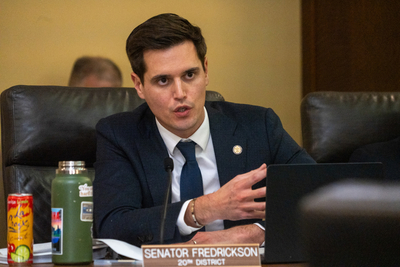
“Being first to make it harder to see a doctor isn’t a race worth winning,” he wrote.
He said his priority bill last session would have let Medicaid cover copays. “It passed 31-18 with support from both sides of the aisle. The Governor vetoed it. … Nebraska can do better.”
Maresh said advocacy agencies “won’t stop”; they plan to participate in public comment periods and hearings, and will urge action by state policymakers and lawmakers.
“I’m guessing there is going to be a busy legislative session coming up to protect healthcare access for all Nebraskans,” she said.
Lincoln, NE