Kansas lawmakers hear about efforts to secure utilities as national systems face outages
Nov 23, 2026 | 5:35 pm ET
Description
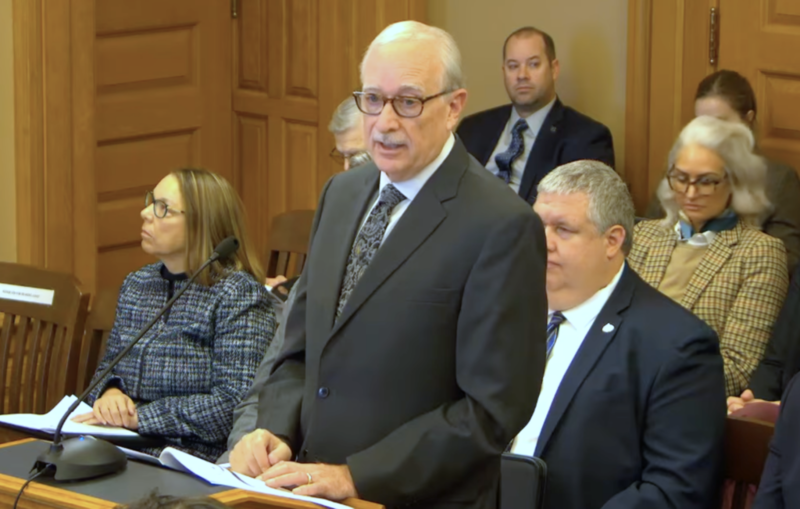
Brad Mears, executive director of the Kansas Municipal Utilities, tells the Kansas Security Committee on Nov. 23, 2026, that utilities are taking multiple steps to protect their operations from online security threats. (Kansas Reflector screen capture from Kansas Legislature video)
TOPEKA — In the midst of computer, aviation and banking outages across the country, a Kansas legislative committee learned Monday what utilities do to ensure their systems are secure.
Utility organizations and others briefed the Joint Committee on Kansas Security about what it takes to keep systems secure in a time of constantly changing challenges in cybersecurity and artificial intelligence.
Brad Mears, executive director of the Kansas Municipal Utilities in McPherson, said his organization considers “security resilience” to be about not just operational issues but about public safety.
Kansas Municipal Utilities is a state association for cities that own and operate electric, natural gas, water and wastewater operations. Mears pointed to recent Microsoft outages as an example of how organizations can be affected.
“Cybersecurity is not a hypothetical thing, and it’s not limited to large systems either that might be open to an attack,” he said. “Many Kansas cities run small utilities. They have limited staff, and a single incident could be dramatically detrimental to the entire community that they serve.”
Arkansas City’s water utility in September 2024 experienced a ransomware attack, which is when an outside entity takes control of internal computer operations and asks for ransom to return that control, said Randy Frazer, city manager.
Although water services weren’t affected, the city was affected financially and had no immediate access to control its system “in any way,” he said.
“A ransom note appeared on multiple of our monitors,” Frazer said. “Our SCADA, our supervisory control and data acquisition system, basically a dashboard that we use to control our plants and monitor everything, it initially turned black.”
Frazer said even dealing with an attack that didn’t cause any customer impact is expensive. The forensic and legal consults were $60,000 and infrastructure costs to replace services were $105,000, and then there were overtime costs and other staffing costs, he said.
Matt Metzinger, Arkansas City information technology director, said the city initially took the plant off the internet, closing all active connections. As he is the only person on the IT team, he said the city consulted legal counsel and cybersecurity experts, as well as vendors.
“We found out that they had been in our plant about three or four days prior, because anytime you have a cybersecurity incident, obviously they’re going to go in and scout your system,” he said. “They’re going to see where and what they can exploit.”
The cybersecurity attack was ultimately about accessing personal customer information, such as credit card and Social Security numbers, Metzinger said.
The city took all processes offline to manually operate the water system, which was never affected, he said.
It’s this type of situation, though, that has led Mears’ organization to work on cybersecurity issues with its member organizations over the last few years.
Each utility needs to understand how to operate its system if it has to go offline and run manually, among other issues, he said.
“We want to make sure that everybody can take their systems, remove them from the interconnections that the automation requires,” Mears said. “Just as an example for electric, what if we lose control of our generation, distribution, or substations, or there’s malicious activity that can actually damage the physical assets that we have out there, as well? In each case, the goal is to be able to provide a potential manual operation in order to keep things going.”
Through training and support from national organizations, Mears said, agencies have developed operational plans to prepare for a variety of circumstances.
Basic steps include strengthening sign-in capabilities to the system, determining a leader who can make quick decisions when an incident occurs, understanding critical systems, and making sure only vendors who need access are granted access, he said.
Jeremy Ash, general manager at the Kansas City Board of Public Utilities, which operates in Wyandotte County, is one of the larger utility organizations in the state and has 43 people in its IT department. The board serves 67,000 electric customers and 55,000 water customers, he said.
Over a seven-day period, its system experienced 2.4 million attempts to gain access or to infiltrate it in some way, Ash said.
“The threats, they’re everywhere, and Brad (Mears) talked a little bit about the different kinds of vulnerabilities that we have, the adoption of artificial intelligence, and really how that’s causing all of our security teams to have some new challenges to what we do,” he said.
The company has about 500 employees, and all are trained to watch for anything that “just doesn’t look right” and to notify the IT department immediately, he said.
Vendor relationships and security are critical, too, he said.
“With the adoption of everything being digitized and all of the commerce that we transact over the web, all of our third-party partners need to be playing on the same security field that we’re playing on,” Ash said. “The information has to be protected, the systems have to be protected, and so the third-party exposure … all of that has to be at the top of the security game, or there’s real exposure for us.”
Ash said the security employees who protect the company operate under regulations set by various authorities, such as the Federal Energy Regulation Commission and the Southwest Power Pool.
“The people that are interfacing with the energy markets, the people that are running our generators, the people that are pushing the protections onto the electric system to protect our employees and to protect the public, it’s a separate set of eight security professionals that run that run that, and they’re separated for a reason, so that we don’t have cross pollination,” Ash said.
Topeka, KS